
"Reign I forever! Here amid icebergs, Rule I the nations; This is my hammer....
Giants and sorcerers, Cannot withstand it!" ................Longfellow
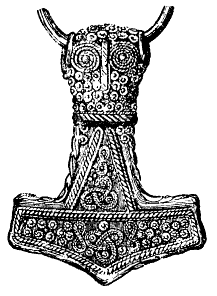
The Hammer of Thor, or Hermetic Cross, can often be
envisioned as a bolt of whirling flame, a symbol of dynamic strength,
representing the fire of the universal generating force, cleaving its
way through the blackness of matter. From out of this primal darkness
comes thunder and lightning---two fascinating and (in their elemental
power) menacing natural phenomena which can always bring to mind the
mighty Hammer of Thor at work! The Thor's Hammer as a symbol can be seen
as the power within both gods and mankind. As the great German
philosopher Wolfgang Von Goethe stated: "Everything which liberates our
spirit, without increasing our mastery of ourselves, is pernicious."
Thus, by freedom Goethe also understood the dignity of the freeborn, not
the nature and mode of life of the freed slave. With the loss of
freedom and dignity in political, spiritual and social life, how is the
preservation of one's personal and ethnic traditional values even
possible?
Thunder in olden days was generally believed
to be the threatening voice of the Supreme Deity, or the terrible blow
of a specific thunder god, such as Zeus or the brawny, red-bearded Thor
with his trademark hammer, Mjollnir, which means 'crusher' and
'grinder'. Long known as the god of thunderstorms and physical prowess,
Thor's hammer remains the quintessential symbol of dynamic power
attributed to Thor. Simply put, of all gods and men, Thor is the warrior
supreme, thoughtful and friendly in nature, but quick to dread fury and
ever at the ready to meet all challenges no matter how grave the
danger. In a world of dualistic opposing forces, the challenges to be
confronted can seem endless indeed.
Known as Asa-Thor
or Oku-Thor (the driving Thor), his realm is Thurdvanger (the Plains of
Strength), and his hall is called Bilsknir (the Hall of Lightning). It
was Thor's primary task to protect Gods and men from the evil forces of
chaos and destruction. Master of the thunderbolts, Thor was the lord of
war and justice. In his charge lay the order and harmony of the
universe, without his vigilance, all would be chaos. Thor was most
especially a friend to the farmer, warriors and the common man. Thursday
is still the day of the week named in his honor. Thor is the mighty son
of Wotan and half brother of Baldur. His wife is the goddess Sif and
his children are Modi (angry), Magni (strong), and Prudr (powerful). He
wears a strength giving belt and two iron gloves which he uses to hurl
his Mjollnir his trademark hammer. Each of Thor's gloves imply the
duality of positive and negative polarity.
"If the Gods own power did not lie within us, how could the divine enrapture us?"
............................Zahme Xenien III
The value of all tradition, particularly the energetic
core, lies in its symbolic language. The language may differ with
varying traditions, but all have specific modes of communication that
hold the wisdom and knowledge of our ancestors in some transferable
manner. When this language is developed at a deeper level of
consciousness through a willed re-application of its symbols, it can
flower into what is known in esoteric circles as meditation, which is a
tool used to assist in the reaching and attainment of spiritual
elevation. The common interpretation of meditation is a process in which
an individual acts as an interface for communication. In the deeper
aspects of an esoteric tradition the language (in whatever symbolic
forms, icons, mandalas, talismans, etc.) is transformed into a condensed
mode of consciousness which transcends intellect, emotions and verbal
communications.
It became quite common among Viking
warriors to traditionally wear the Thor's hammer talisman which served
as a sign of spiritual commitment, or an amulet of good fortune as well
as a reaffirmation of the thunder-god himself. The hammer is also known
as a symbol of masculine fertility, represented by its phallic-like
symmetry. All talismans are worn as a charm or preventive against evil,
mischief, disease, witchcraft and to generally bring good fortune to the
wearer and attract favorable influences. The Thor's Hammer worn about
the neck serves as even more than that, it represents ones commitment to
his ethnic gods, ancestry and heritage and by that commitment the
strength within oneself mirrored in the very might of Thor.
Thor is acknowledged as a god closely linked to the earth, making
him a suitable archetype to the farming community. It is said that
Thor's mother was Earth herself, so that the link between sky-god and
earth-goddess is still reflected in the traditions concerning him.
Throughout the ages the symbol for the Key of Life has transformed, the
determinative factor being the cultural perspective from which one is
viewing the Key. The hammer or double axe glyph was known as the
Earth-bound Tau cross 'T'. The double axe symbol was a dominate icon in
the Minoan Crete civilization, differing only in that there, in those
times, it was a matriarchal symbol of the goddess.
"Thor's
hammer, which split the earth and penetrated deep into it, may be
compared with Kaineus' foot. Inside the earth the hammer comports
itself like the treasure, for in the fullness of time it comes to the
surface again, i.e., is born again from the earth."
.......... C.G. Jung
The Tau cross was inscribed on the forehead of every person
admitted into the Mysteries of Mithras. When a king was initiated into
the ancient Aryan Egyptian Mysteries, the Tau was placed against his
lips. Later, the Egyptians added a circle glyph to its top, transforming
it to the Emblem of Life symbol, which became known to them as the
Ankh. This became recognizable in Egyptian hieroglyphs often held in the
hand by Egyptians Gods and Pharaohs. Egyptologists favored the view
that the ankh secretly represents the male and female genitalia
combined. This is why the circle became elongated, representing the
shape of the female vulva. Later, it would become used as the sign of
Venus with the circle raised. In the times of Atlantis which still
paralleled the days of early Egypt the sacred metal for the ankh was
orichalcum, a type of orange-gold no longer known to exist.
In Wotanist ceremony the Hammer of Thor can serve any number of
ritual needs, such as opening the Sacred Circle, consecrating weddings
or deaths, or raised over a newborn infant received into the community,
or artfully carved on memorial stones to the dead. The sign of the
hammer made with a clenched fist traced over the head, heart and
shoulders, was later adapted by the Catholic Church to cross oneself.
When a Wotanist makes the Sign of the Hammer, the forehead is first
touched with a clenched fist of the right hand, palm facing the face and
the name Wotan is pronounced. The clenched fist is then brought
straight down to the chest and the name Baldur is pronounced. Moving
your clenched fist now toward the left shoulder the name Frey is
pronounced and finally toward the right shoulder in which the name Thor
is pronounced. There is a symbolism apart from the hammer sign itself,
which is traced by the movement of the fist. Wotan is the "High one"
associated with intellect and wisdom, so the forehead is the natural
point of contact for him. Baldur is the good and reconciling god
connected with the heart. The strong right arm is the power and fire
side of the body and reminds us of Thor, while the left side is linked
to the intuitive, sexual pleasure-loving part of the body, clearly the
domain of the god Frey. Often in Wotanist ceremony the ritual Thor's
Hammer is used by an attending Gothi rather than a clenched fist, and
can be held with either one or both hands.
Sometimes
in Teutonic mythology, Thor hurled glowing fragments of red-hot metal at
his enemies, but his favorite technique was to smash their skulls with
his hammer. The association of fire with the god Thor has ancient ties
with the Roman god Vulcan and the Greek Prometheus. The Celtic
hammer-god Taranis was known for his ferocity and benevolence, quite
similar to Thor in every way. His counterpart Sucellus, who ruled the
underworld, was particularly popular among the Gauls. We find such
relative similarities with the Slavic god Perun and the Greek god
Hephaestus as well.
Through historical times, the
hammer has been used to represent military or industrial power. The
Bolsheviks were not the first to adopt the hammer and sickle. The
thunder-god of the Southern Gauls was sometimes represented with a
hammer and at other times with a sickle. The sickle was an important
symbol and ritual tool of the ancient Druids, whose high priest roots
reach back to far distant Atlantis. All life is a loss of balance and
becomes an ongoing process of a struggling back into balance to that
divine harmony which we constantly seek. Symbols have the ability to
awaken us more profoundly and quicker than any religion or any spoken or
written word.
Mjollnir had the miraculous quality of
shrinking in obedience to Thor's will. When thrown, this hammer, symbol
of creative power, would always return to his hand. Here we witness the
indomitable power of thought over matter in the material world. The two
iron gloves worn by Thor, which allowed him to catch the hammer safely,
implied the duality of positive and negative polarity. In Teutonic
mythology, when Thor was challenged to a duel with the giant Hrungnir,
Thor flung his hammer at the giant, who was armed with a stone shield
and who upon attack simultaneously threw his massive whetstone at Thor.
The hammer and whetstone met in mid-air, and the hammer not only
shattered the whetstone, but Hrungnir's head as well. One piece of the
stone, however, lodged into Thor's forehead. Here it is clearly
demonstrated that hammer breaks stone, that is, that a directed thought
can penetrate matter, yet it is not always so easy, and that matter is a
force to be reckoned with and not so easily overcome.
Thor was known as the giant-killer, and what made it possible to meet
such challenges was that he harbored no fear whatsoever from his
enemies. Even against seemingly impossible odds and force, Thor would
win through sheer primal perseverance. Thor, wise in the ways of combat,
understood that fear is a fabrication of the mind, and that opponents,
no matter how large, are often more bluff and bluster than a danger to
be feared. When facing overwhelming odds, one must resort to cunning,
such as when Thor's hammer was stolen by the giant Thrym. Imagination
has no limitation, and the well-directed thought can always prevail over
matter. It is essential that we never forget, relinquish or disregard
the sacred esoteric symbols which our knowing ancestors have preserved
and nurtured from the distant Golden Ages of civilizations past. The
sacred symbols do not lose power with time; they gain added intensity
with time. Capable of reaching deep within our soul, they become our
lifeline, our light through the isolation of the lower worlds and our
guide to higher awareness. The human body without spiritual animation is
a meaningless heap of chemical compounds. Without spiritual fire there
is no purposeful life in man, hence and likewise, we can observe the
importance of sacred symbol. Symbols, when interpreted correctly, can
serve as the Keys of Life which open doors to the great arcane
Mysteries. Legends reveal to us that they can be used to infuse lifeless
matter with life force and to conduct souls between worlds. The
T-shaped hammer symbol was, in fact, the very Key of Life symbol. Within
it was represented the sacred number 7, four representing the male
principle and three representing the female. In the ancient Mayan
hieroglyphs the symbol 'T' represented the Sacred World Tree, and in
addition, the air, the wind, the divine breath of God. Aside from the
Ankh, the Egyptians transformed the Tau symbol into the Rod of Power,
known as the Caduceus, the serpent entwined staff of Toth Hermes,
commonly used today throughout the medical profession. For the Romans,
the caduceus served as a symbol of moral equilibrium and of good
conduct. The wand represents power; the two snake’s wisdom; the wings
diligence.
In Wotanism the Thor's hammer amulet worn
about the neck carries a highly mystical and spiritual significance----a
profound and distinctive symbol of ethnic pride, steeped in the mystery
of legend, born from the realm of the Gods. This is Thor's gift of good
fortune, strength and prosperity to his people, for by the sacred
symbols are all powers awakened and re-affirmed.
"Force rules the world still, Has ruled it, Shall rule it; Meekness is weakness,
Strength is triumphant, Over the whole earth,
Still is it Thor's Day!" ...............Longfellow
Ron McVan
Posted in: Editorial,Eugenics,Indo-European


0 comMENTS:
Post a Comment