July 1. A court in Bavaria
ruled
that a law that prohibits Muslim legal trainees from wearing
headscarves is illegal. The district court in Augsburg ruled in favor of
Aqilah Sandhu, a 25-year-old law student who filed a lawsuit against
the state for barring her from wearing the headscarf at public
appearances in court while performing legal training. The ruling said
there was no legal basis for the restriction and "no formal law that
obligates legal interns to a neutral worldview or a religious
neutrality." Bavarian Justice Minister Winfried Bausback, arguing that
legal officials as well as trainees in the court needed to present the
appearance of impartiality, said he would appeal the ruling.
July 3. A 24-year-old woman, raped by three migrants in Mannheim in January,
admitted
to lying about the identity of her attackers. Selin Gören, a
Turkish-German woman, initially said that her attackers were German
nationals, when in fact they were Muslim migrants. In an interview with
Der Spiegel,
Gören, the spokeswoman of Germany's left-wing youth movement, Solid,
said she lied because she was afraid of fueling racism against migrants.
July 4. The newspaper,
Frankfurter Allgemeine Zeitung,
reported
that the 30 biggest German companies listed on the DAX blue-chip stock
market index have employed only 54 refugees, including 50 who were hired
as couriers by the logistics provider, Deutsche Post. The report casts
doubt on Chancellor Angela Merkel's promise to integrate the 1.1 million
migrants who arrived in Germany in 2015 into the German labor market as
quickly as possible. Company executives say the main problem is that
migrants lack professional qualifications and German language skills.
July 4. A court in Frankfurt
sentenced
a 35-year-old German-Turkish Salafist to two-and-a half-years in prison
for weapons possession, but absolved him of charges relating to
terrorism. Halil D. was originally accused of plotting to attack a
bicycle race in Frankfurt. At the time of his arrest, police found an
arsenal of weapons, including a pipe bomb, in his basement. Halil D.
claimed he built the bomb to spring open the contents of a cigarette
vending machine. Police also found Islamic State propaganda videos, as
well as copies of
Dabiq, the Islamic State's online magazine, on
his computer. At the time of his arrest, Halil D. said: "I believe in
the Sharia. German laws do not apply to me." The court said there was
insufficient proof that Halil D. was a terrorist.
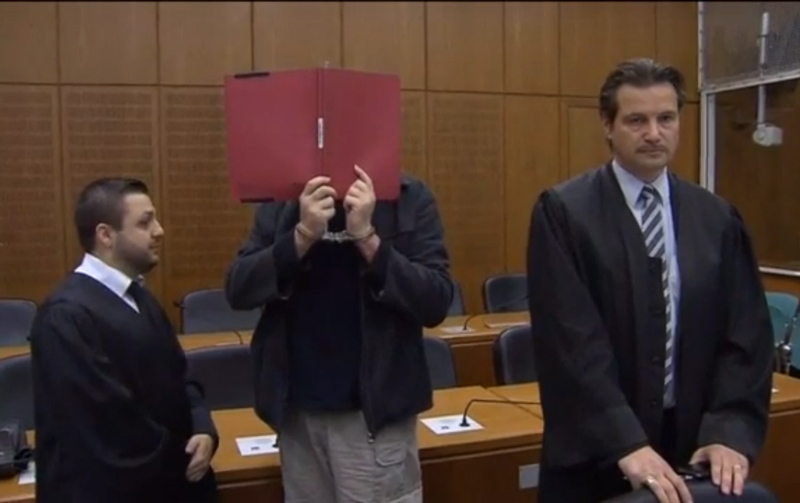
Halil
D. was accused of plotting to attack a bicycle race in Frankfurt. At
the time of his arrest, German police found an arsenal of weapons,
including a pipe bomb, in his basement, as well as Islamic State
propaganda materials on his computer. The court said there was
insufficient proof that Halil D. was a terrorist.
|
July 7. The Bundestag, the lower house of parliament, unanimously
approved
changes to the criminal code to expand the definition of rape and make
it easier to deport migrants who commit sex crimes. Under the bill, also
known as the "No Means No" ("
Nein heißt Nein") law, any form of
non-consensual sex will now be punishable as a crime. Previously, the
only cases punishable under German law were those in which the victims
could show that they physically resisted their attackers. As Germany's
politically correct justice system, is notoriously lenient when it comes
to prosecuting, sentencing and deporting foreign offenders, however,
the reforms are unlikely to end Germany's migrant rape epidemic.
July 7. More than six months after mobs of Muslim men sexually
assaulted more than 1,000 women in Cologne and other German cities on
New Year's Eve, a German court
issued
the first two convictions: The District Court of Cologne gave a
20-year-old Iraqi, identified only as Hussain A., and a 26-year-old
Algerian, Hassan T., a one-year suspended sentence and then released
both men. Hussain, who was 20 at the time, was sentenced under juvenile
law and was ordered to attend an integration course and do 80 hours of
community service. The newspaper,
Bild,
published
photographs of a jubilant Hassan smiling as he left the courtroom. An
observer said the light sentence was a mockery of justice and would
serve as an invitation for criminal migrants to do as they please with
German women.
July 8. Teachers at the Kurt Tucholsky secondary school in Hamburg
boycotted
this year's graduation ceremony to protest a Muslim student who refused
to shake hands with a female staff member. The school's director Andrea
Lüdtke, sided with the student: "I accept his decision," she said. A
German columnist, Heike Klovert,
defended Lüdtke by arguing that teachers should not be tasked with integrating students:
"She took her Muslim student seriously. She did not try
to bend him to adapt to a supposedly German way of doing things. She
understands that respect is not dependent upon a handshake, and that not
everyone who does not want to shake hands is a misogynist extremist."
July 10. A Federal Criminal Police Agency (BKA) inquiry into the sex
attacks in Cologne, Hamburg, Stuttgart, Düsseldorf and other German
cities on New Year's Eve
found
that more than 1,200 women were victims of attacks, which were
perpetrated by more than 2,000 men, many of whom are believed to be from
North Africa. BKA President Holger Münch
admitted: "There is a relationship between the attacks and the strong wave of migration in 2015."
July 10. More than a hundred Shia Muslims took to the streets of Bonn
to commemorate the death of Ali, the cousin and son-in-law of Mohammed.
Ali was assassinated in 661. Evoking scenes from seventh century Iraq,
130 shirtless men, hypnotically beating their chests and chanting to
beating drums, wound their way through downtown Bonn for more than five
hours (pictures
here). Local health officials reminded doctors they had a legal responsibility to treat anyone with self-inflicted injuries.
July 11. In a new survey, the Pew Research Center
found
that 61% of Germans believe the recent influx of refugees will
"increase the likelihood of terrorism in our country." The survey also
found that 61% of Germans believe Muslims in their country "want to be
distinct from the larger society."
July 13. The Platanus-Schule, a private bilingual school in Berlin,
apologized
to a Muslim imam after a teacher at the school called him
"misogynistic" and "ill-adapted to German life" because he refused to
shake her hand. The imam's lawyer said the apology was insufficient;
critics accused the school of "capitulating" and endangering the
principle of gender equality in Germany. CDU politician Philipp
Lengsfeld
wrote
on Twitter: "The essence of the handshake debate is not about religion
or an individual's opinion, it is about the authority of the state and
gender equality."
July 14. Figures released by Destatis, the government's statistics agency,
showed
that more than 2.1 million people migrated to Germany in 2015. More
than 633,000 arrived from Asia, including 309,000 from Syria, 84,000
from Afghanistan and 65,000 from Iraq. More than 113,000 migrants
arrived from Africa.
July 14. During a parliamentary investigation into the migrant sex attacks in Cologne on New Year's Eve, it was
revealed that one of the women who was raped became pregnant. She failed to report the attack to police because she felt ashamed.
July 14. Ruprecht Polenz, a former secretary general of the ruling Christian Democratic Union (CDU),
said that the German law which regulates name changes (
Namensrecht)
should be amended to make it easier for Muslim migrants in Germany who
feel discriminated against to change their legal names to
Christian-sounding ones. German law generally does not allow foreigners
to change their names to German ones, and German courts rarely approve
such petitions. By custom and practice, German names are only for
Germans.
July 15. At least 24 women were
sexually assaulted at a music festival in Bremen. The attacks were similar to the "
taharrush gamea"
[collective harassment] attacks in Cologne on New Year's Eve. Police
have been able to identify only five perpetrators, all of whom are
migrants from Afghanistan. Harald Lührs, the lead investigator for sex
crimes in Bremen said: "We have never experienced such massive attacks
in Bremen. That groups of men surround women in order to grope them,
this has never happened here in this magnitude. This is a new problem
that the police have to deal with."
July 16. A document leaked to the newsmagazine,
Der Spiegel,
revealed
that more than 33,000 migrants who are supposed to be deported are
still in Germany and are being cared for by German taxpayers. Many of
the migrants destroyed their passports and are believed to have lied
about their countries of origin to make it impossible for them to be
deported. Others have gone into hiding so that immigration police cannot
find them.
July 17. An investigative report by Bavarian Radio BR24
found
that deradicalization programs in Germany are failing because many
Salafists do not want to become deradicalized. The report also showed
that many jihadists who have returned to Germany from Iraq and Syria are
producing propaganda videos for the Islamic State.
July 18. An Afghan asylum seeker wielding an axe was shot dead by police after he
injured
five people on a train in Würzburg. The man shouted "Allahu Akbar"
["Allah is the Greatest"] during the attack. Green Party MP Renate
Künast
criticized
the police for using lethal force. In a tweet, she wrote: "Why could
the attacker not have been incapacitated without killing him????
Questions!" Künast's comments provoked a furious backlash, with many
accusing her of showing more sympathy for the perpetrator than for the
victims. The outpouring of anger against Künast indicates that Germans
have had enough of their politically correct politicians.
July 18. Lutz Bachmann, the leader of the anti-migration Pegida movement,
announced the formation of a political party, Popular Party for Freedom and Direct Democracy (
Freiheitlich Direktdemokratische Volkspartei, FDDV). The move is in response to government threats to ban the Pegida movement.
July 19. Three teenage jihadists who bombed a Sikh temple in Essen on April 16 were formally
charged
with attempted murder, aggravated assault and "bringing about an
explosion." The teenagers, who said they were upset about the way
Muslims are being treated by Sikhs in Northern India, were not charged
with terrorism offenses.
July 19. The managers of a German Red Cross refugee shelter in Potsdam were
accused of covering up the sexual abuse of women at the facility.
July 20. The Federal Labor Office (
Bundesagentur für Arbeit, BA)
reported
that the educational level of newly arrived migrants in Germany is far
lower than expected: only a quarter have a high school diploma, while
three quarters have no vocational training at all. Only 4% of new
arrivals to Germany are highly qualified.
July 22. Ali Sonboly, an 18-year-old Iranian-German who harbored hatred for Arabs and Turks,
killed ten people (including himself) and wounded 35 others at a McDonald's in Munich.
July 23. A mob of men shouting "Allahu Akbar"
barged
into a nudist beach in Xanten and "insulted and threatened" the
beachgoers. Police kept the incident hidden, apparently to avoid
negative media coverage of Muslims "in these sensitive times."
July 24. Mohammed Daleel, a 27-year-old migrant from Syria whose asylum application was rejected,
injured
15 people when he blew himself up at a concert in Ansbach. The suicide
bombing was the first in Germany attributed to the Islamic State. Daleel
had fought with the Islamic State and al-Qaeda in Iraq before coming to
Germany. In a cellphone video made before the attack, Daleel vowed that
Germans "will not be able to sleep peacefully anymore." Although German
authorities had tried to deport Daleel in early 2016, the effort was
blocked by German Left Party MP Harald Weinberg, who demanded that
Daleel get medical care for a knee injury. "After everything I knew at
that time, I would decide the same today," Weinberg
told the newspaper
Bild.
July 24. A 21-year-old Syrian asylum-seeker
murdered a 45-year-old Polish woman and her unborn baby in a machete attack in Reutlingen.
July 24. A 40-year-old migrant from Eritrea
raped
a 79-year-old woman in a cemetery in Ibbenbüren. The woman, who lives
in a local nursing home, was visiting the grave of her late sister at
6AM when the attack occurred. The migrant, who has been living as a
refugee in Germany since 2013, was arrested at the scene. He is unlikely
to be deported, however, because Eritrea is considered a conflict zone.
July 25. A 45-year-old Palestinian brandishing a "Rambo knife" and shouting "Allahu Akbar" tried to
behead
a doctor in Bonn. The attacker's 19-year-old son had complained about
the doctor's treatment for a fractured leg. While holding the doctor
down on the floor, the man said: "Apologize to my son. Go down on your
knees and kiss his hand." The attacker was arrested and then set free.
July 25. Sahra Wagenknecht, the leader of the Left Party (
Die Linke),
lashed out at Merkel's open-door migration policy:
"The events of the past few days show that the acceptance
and integration of a large number of refugees and migrants presents
significant problems. It is much more difficult than Merkel tried to
persuade us last fall with her reckless 'We can do it' ['Wir schaffen das']. The government must now do everything possible to ensure that people in our country can feel safe again."
July 25. Frank Henkel, a CDU Senator from Berlin,
said:
"No one should delude themselves: We obviously have
imported some brutal people who are capable of committing barbaric
crimes in our country. We have to say this clearly and without taboos.
This also means that we must deal aggressively with Islamism. If we do
not, we risk that German politics will be perceived as being detached
from reality."
July 25. Interior Minister Thomas de Maizière
revealed
that German authorities are currently investigating 59 refugees because
of the "suspicion that they are involved in terrorist structures."
July 25. Following a series of Islam-related attacks in a week, the President of Bavaria, Horst Seehofer,
said: "We must know who is in our country."
July 26. Seehofer,
said: "Islamist terrorism has arrived in Germany."
July 27. Police
raided
a mosque in Hildesheim. They also searched eight apartments belonging
to members of the mosque. Boris Pistorius, the interior minister of
Lower Saxony, said: "The mosque in Hildesheim is a national hot-spot for
the radical Salafist scene. After months of preparation, with these
raids today, we have taken an important step towards banning the group."
July 27. Police in Ludwigsburg
arrested
a 15-year-old who they said was planning a mass-shooting similar to the
July 22 attack in Munich. During a search of the teenager's home,
police found more than 300 rounds of ammunition, as well as knives,
chemicals and bullet-proof vests.
July 28. Speaking at an annual summer press conference in Berlin, Merkel
insisted
there would be no change to her open-door migration stance: "We decided
to fulfill our humanitarian tasks. Refusing humanitarian support would
be something I would not want to do and I would not recommend this to
Germany.... Anxiety and fear cannot guide our political decisions." She
also
said: "Let me be clear, we are at war with Islamic State; we are not at war with Islam."
July 29. Thomas Jahn, the vice chairman of the Christian Social Union (CSU),
lambasted
Merkel's open-door migration policy: "We need to control our borders.
That is the most important thing at the moment. And we need to send the
dangerous people with Islamist ideology back to the countries outside
Europe and the European Union."
July 30. CSU politician Jens Spahn said:
"My impression is that we all underestimated a year ago what was in
store for us with this big refugee and migration movement. Integration
is a Herculean task that does not end with a three-week language
course." He also called for a burqa ban: "A ban on the full body veil —
that is the niqab and the burka — is overdue... I do not want to have to
encounter any burqa in this country. In that sense, I am a burqaphobe."
Soeren Kern is a Senior Fellow at the New York-based Gatestone Institute