In the last
few months, with 10,000 asylum seekers arriving a week, the country has
reintroduced border controls and the anti-immigrant Sweden Democrats has
become the second largest party in Sweden, opinion polls show.
Instead
Tärnsjö, a relatively small village with a population of 1,200, is a
snapshot of those places where bubbling anger has spilled over into
violence and arson.
Racial tension has divided the village into two groups; those who support the immigrants and those who want them gone.
Far-right councillor Michael Ohman
Protesters
have set fire to 17 immigration centres in the past two months – and
the authorities have warned it is only a matter of time before someone
is killed in the race-hate arson attacks engulfing this once-peaceful
nation.
The
problem in Tärnsjö, far-right local councillor Michael Ohman told
MailOnline, comes down to the fact many of the villagers never wanted
the migrants to move in.
'Racial
tension has divided the village into two groups; those who support the
immigrants and those who want them gone,' he explained.
'There has been fighting between immigrants and the people living here.
'The
village integration works badly because people don't want immigrants in
the village. This is no longer a happy community, it's divided and is
not a pleasant place to live.'
The councillor continued: 'We have the highest tax rate in the county because we are paying for so many immigrants.
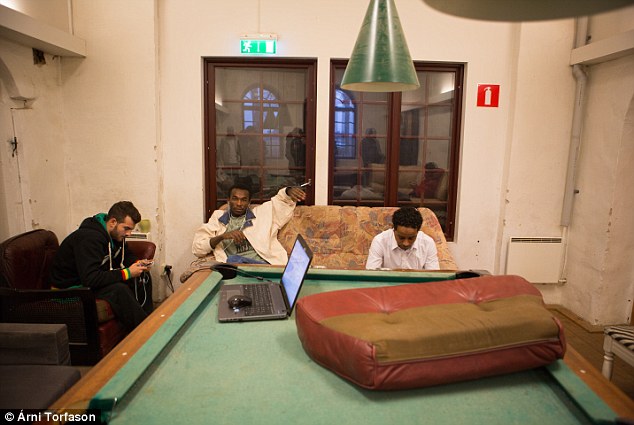
+24
Battle: The
problems in Tärnsjö started when migrants, many of them living in this
centre, began throwing stones at cars as they passed. Locals retaliated,
and threw stones back
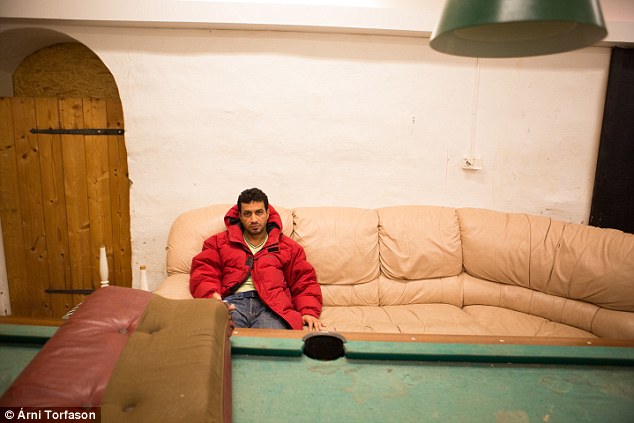
+24
Escalation: But then a window at the
centre, which is sparsely furnished, was smashed. The next day a refugee
family's car was burned. After that, the children were escorted to
school by the police
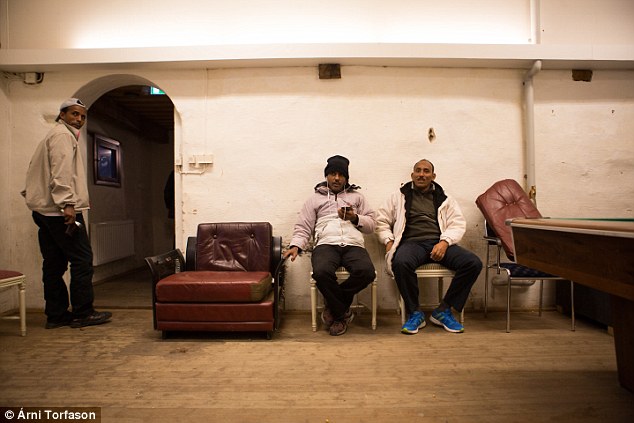
+24
Problem solving: Tärnsjö is not the
only village where migrants have been housed. It is becoming more common
as accommodation in the city becomes scarce, due to the sheer numbers
arriving
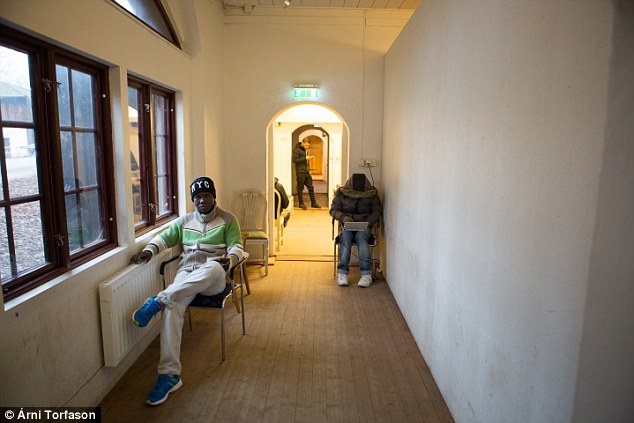
+24
Remote: Some don't like living so far
out; one asylum seeker described Tärnsjö as 'boring'. Another bus of
refugees refused to get off when taken to one isolated village,
demanding to be taken elsewhere
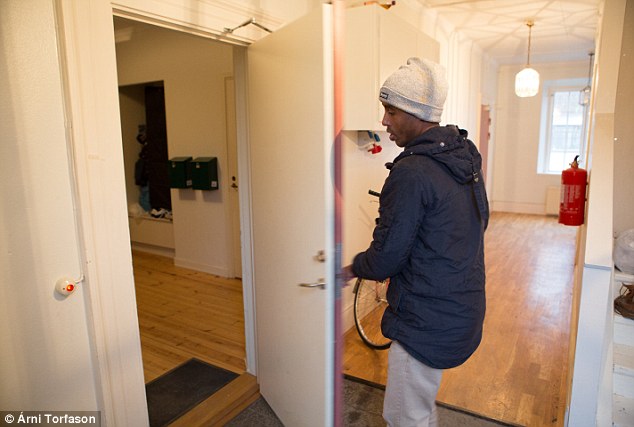
+24
Fury: The feeling
in some cases is mutual. We didn't want them here, Michael Ohman, one
of Tärnsjö far-right councillors, told MailOnline, it is ruining our
village. It is no longer a happy place to live
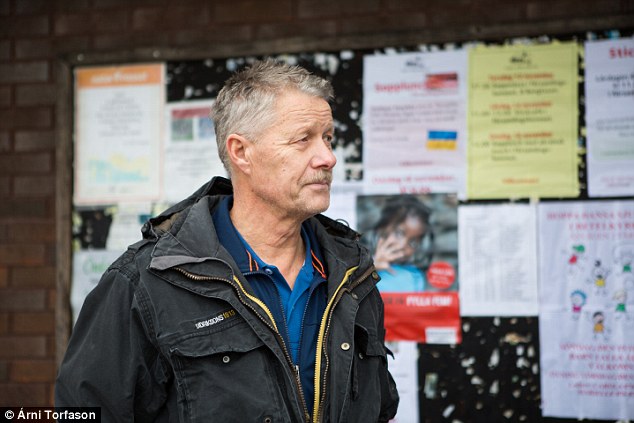
+24
Disappointed: Andreas Pettersson, the
local migration officer, had hoped the village would accept the new
arrivals, but is now faced with dealing with increasing hostilities
between the two sides
'Everyone who comes gets an allowance of 200 Kroner (£20) a week and free housing, and who pays for that? Us, taxpayers.'
Anders Petterson, a migrant liaison officer, admits many were 'outraged' when they began to arrive.
He
hoped people he knew in the area would help them to integrate and never
anticipated one day police would be called to escort migrants' children
to school as locals hurled abuse at them.
Things
have disintegrated to such an extent that children aged just five
sometimes run the gauntlet of hate and intimidation and sometimes arrive
at Tärnsjö Skola too terrified and upset to speak.
Even teachers there are too frightened to walk with them - worried they too will become targets of hate.
Tärnsjö
Skola Principal Nina Lundén told MailOnline: 'Children said they were
frightened, that they did not feel safe when they were going from their
home to the school.
The
situation became so fierce the teachers and police had to walk with the
children from the centre to the school. But there were teachers who
wouldn't walk with the children, because they were afraid of being
threatened.
'We then did everything we could to help them and arranged for them to be escorted in order to keep them safe.'
The
problems are said to have begun in September when migrants started
throwing stones at locals' cars, and residents retaliated by throwing
them back.
The
fires were further stoked on social media - and eventually locals,
thought to be teenagers, began organising 'events' where a gang would
gather to throw stones at the block of flats which has been turned into a
makeshift migrant centre.
Mr
Petterson said: 'This went on for about two weeks at a low scale,
almost every day. It escalated windows at the centre were smashed.
'This scared the migrants. They had come from Syria - from a war zone - to this.'
The following day a car belonging to a refugee family was set on fire.
Teachers aren't the only ones in the village worried of rising tension, and what it might mean for their own safety.
Rasmus Leng lives just metres from the migrant block, and has witnessed much of the problem first-hand.
'The
neighbours living in the apartment nearby have caused all kinds of
devilry,' he told MailOnline, pointing to marks on his car, where
someone had shot an air gun at it.
'I've heard a lot of noise and disturbance among them. I don't like them.
'They have been throwing stones and they scream a lot during the night.
'And then with the attacks from racists upon that? It does not feel safe here, especially with my wife being pregnant.'
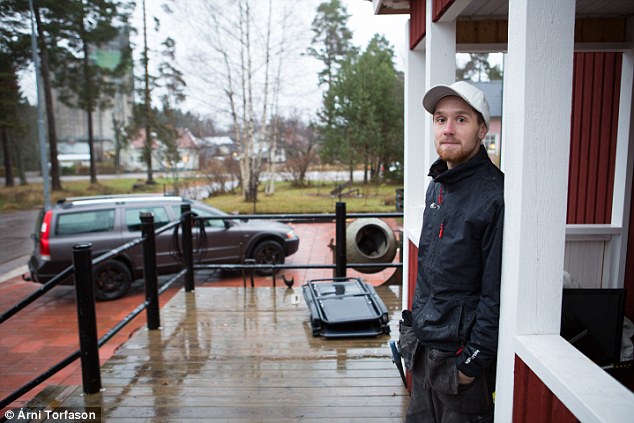
+24
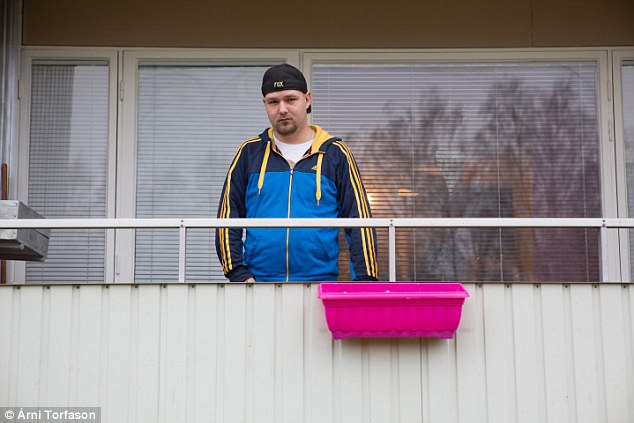
Scared: Rasmus Leng, who lives just a
few metres from the refugee centre, has witnessed some of the worst of
the behaviour for himself. He complains of noise, and says his car has
been damaged by an air gun
+24
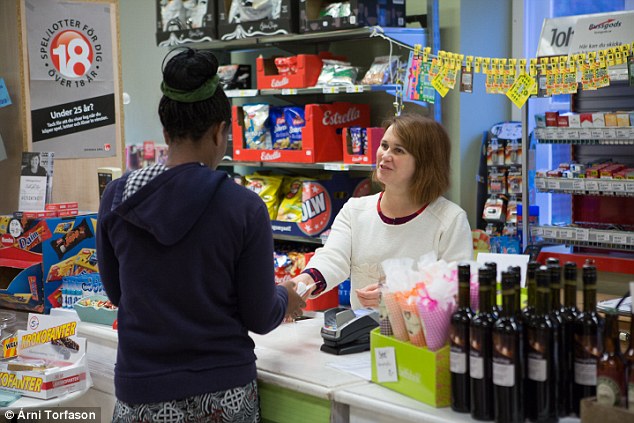
Crime: Tobias Willhäll accuses the new
arrivals of stealing bicycles and breaking into storage facilities. But
he says it is all down to just one family that has caused 'all these
troubles'
+24
Fearful: Other villagers (not
pictured) told MailOnline how they feared the rising tensions could end
with something similar to the attack on migrant pupils in the town
of Trollhättan, which left two students dead
Tobias
Willhall added: 'The immigrants have caused all kinds of trouble for
us. I have friends whose storage spaces have been burgled by immigrants
and bicycles have been stolen.
'It is particularly one family. It is the one which has caused all these troubles.
'There is a really bad tension in the village because of the refugees.'
Others were nervous about how much further the violence might go.
They
fear they are on the brink of a similar incident to the one where Anton
Lundin Pettersson, 21, walked into a school in Trollhättan in north of
Gothenburg, wearing a helmet, a Star Wars mask and used a sword to kill
two migrant students.
Back
in Tärnsjö, Lillemor, a hairdresser in her mid-fifties who didn't want
to give her surname, said: 'I'm concerned about the situation in the
village.
'Something like this might explode like happened in Trollhättan.'
The
refugees are just as scared. Tamam, who is living in the apartments
with his wife Rabaa, son Hamza, 13, and daughter Batoul, 12, is the
refugee whose car was torched.
Taman
said: 'We have no problems with the vast majority of the people who are
living here. We like living here. But there are some people who really
seem to hate us.
'We don't feel afraid when we're at home and all we want is peace and quiet.'
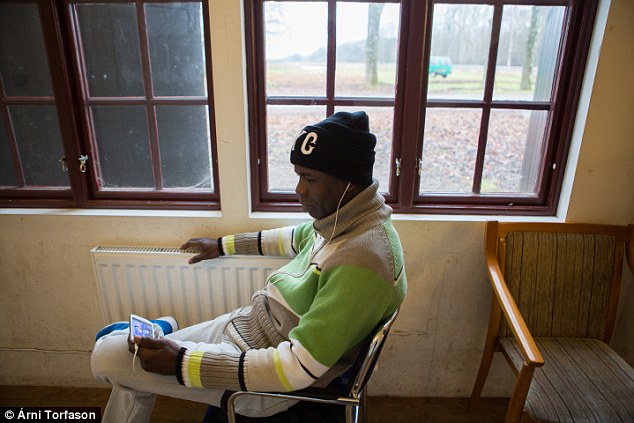
+24
The feeling is mutual. Father-of-two
Tamam, not pictured, said most of the residents were nice, there was
some who seemed to 'really hate' him and his family, as well as the
other refugees
+24
Taxes: Anger
comes from the benefits given to the migrants. Councillor Mochael Ohman
said: 'Everyone who comes gets an allowance of 200 Kroner (£20) a week
and free housing, and who pays for that? Us, taxpayers'
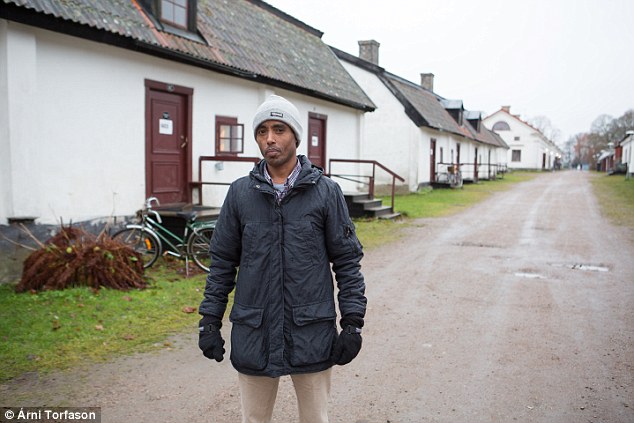
+24
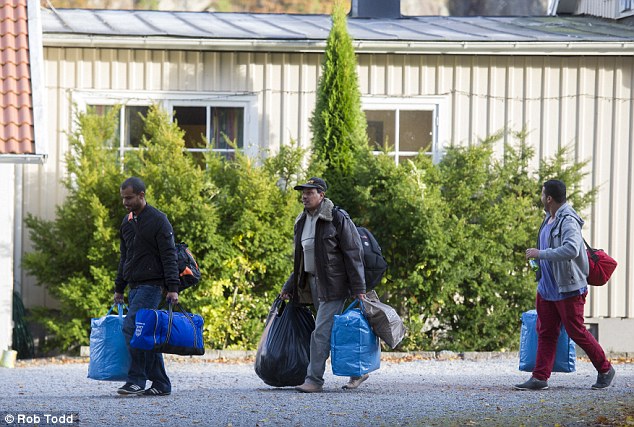
Frustration: Ngazi, an Eritrean
refugee, arrived in June 2014 after crossing the Mediterranean from
Libya. He is yet to be interview by the Migration Board, so that they
can assess his claim
Negazi,
25, who arrived in Sweden from Eritrea in July 2014. His main complaint
about Tärnsjö is not about racial tensions, but about there being
nothing to do in the isolated village, which has just one small shop,
and no pubs or bars.
All the same, the father-of-two said his life is better in Sweden than back home.
'I want to get a job and I want to get an education,' he told MailOnline
'I
left Eritrea because me and my family were in danger from the
government. I was critical of the government and I was being threatened.
I felt that I would come to harm if I stayed, so I got on a boat in
Libya for the coast of Sicily.
'It was a very dangerous journey and I thought we were going to die. I thought the boat would sink and I was going to drown.'
Negazi said he left behind two children in Eritrea.
'I want to claim asylum in Sweden so that I can bring my children and my wife over to have a better life.
'Apart
from it being boring and there being nothing to do, the only thing I
complain about is how long it takes to claim asylum in Sweden,' he
moaned.
'I
have been here since June 2014 and I haven't even been interviewed by
the migration board. I get 200 kroner a week from the government, so I
have no complaints. But it's an isolated place, so there is nothing to
do here, it's a bit boring.'
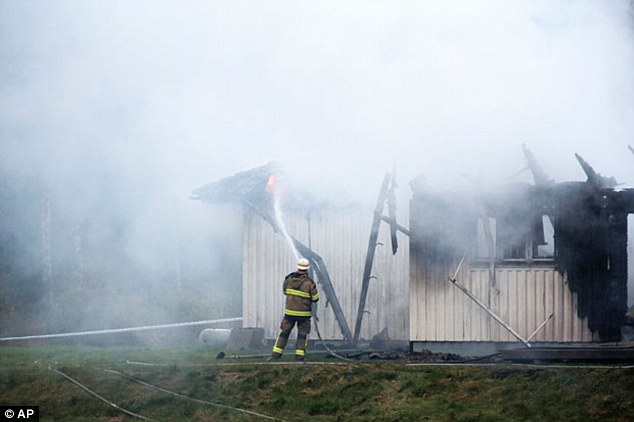
+24
Arson: The tensions in Tärnsjö are far
from a one off. Across the country, buildings which are earmarked to
house asylum seekers are being set fire to at an alarming rate
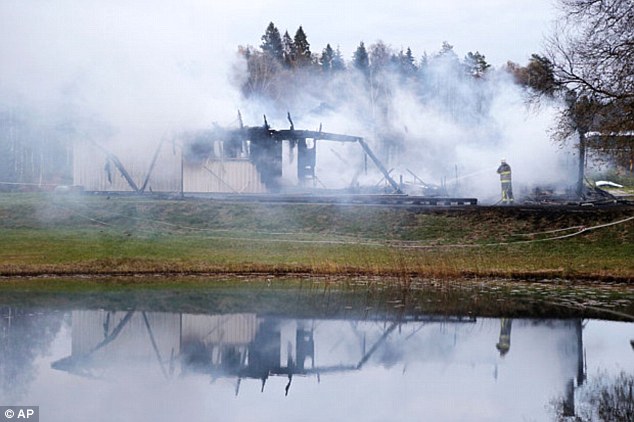
+24
Stark warning: These fires were set at
a rate of one every two days by the middle of the autumn. Firefighters
have warned that, should it continue, someone will end up dead
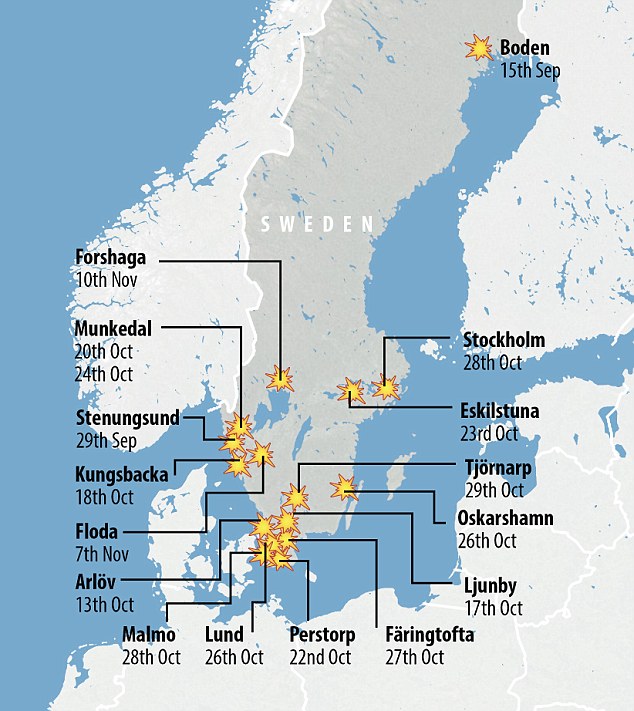
+24
Burning: The 17 fires have taken place all over the country, from the middle of September throughout October
Outside
of Tärnsjö, fire has become the weapon of choice for extremists angry
at how many people have arrived in Sweden since the start of the year.
Even the government has taken action, introducing border controls for the first time since the migrant crisis began.
Anna
Kinberg Batra, the leader of Sweden's centre-right Moderate Party,
which has always been pro-asylum seekers, has gone one step further, and
called for people to be turned away at the border.
'If we do not act now, we will have a collapse in the system,' she warned, according to Deutche Welle.
The
numbers speak for themselves. Since September, 80,000 refugees have
arrived - the same number of people as throughout the entirety of last
year. On one day alone, 2,000 arrived - another record in its own right.
At
the end of July, the official estimate for the total number of asylum
seekers was hovering around the 74,000 mark. It now believes the number
will be closer to 190,000.
For
Sweden, with a population of 9.8million, that is a population increase
of almost two per cent. The equivalent in the UK would be adding more
than a million people to the population, or six million extra people in
the U.S.
The
result is the country cannot house all those arriving, with the
government's Migration Board saying it needs another 45,000 homes to
meet demand.
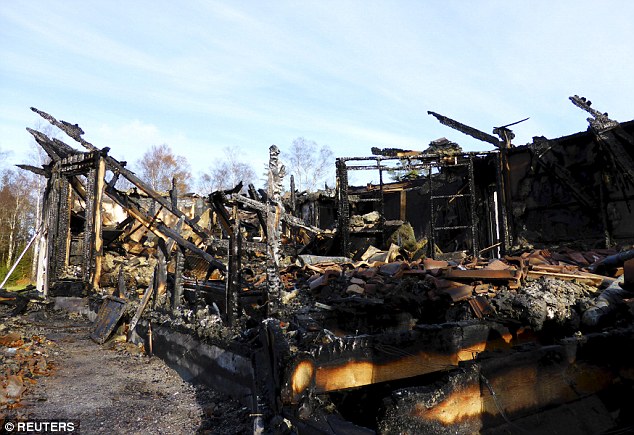
+24
Hidden: The Swedish government is now keeping the location of its refugee centres a secret
ARSON ATTACKS AGAINST ASYLUM SEEKERS' HOUSING IN SWEDEN
Since mid-September, a total of 17 planned or existing asylum seekers' housing in Sweden have been targeted by arsonists.
NOVEMBER
10 November:
A storage and office building in Forshaga, Värmland, is set on fire.
The town has some 6,200 inhabitants. The local municipality had started
investigating if the building could be used as asylum seeker's housing.
7 November:
A planned asylum seekers' housing is burned to the ground in Floda,
near Lerum, south-west Sweden, a town with some 8,000 inhabitants. The
reason for the fire is still unknown.
OCTOBER
29 October: Unknown
assailant/assailants pours flammable liquid through a window at a care
home which doubles as a home for unaccompanied minors in Tjörnarp, a
village with some 750 inhabitants, near Höör in southern Sweden. The
liquid was set alight but staff managed to put it out.
28 October: Three people taken to hospital after arson at a Swedish Migration Board arrival housing in Malmö.
28 October: Fire at planned asylum seeker's housing in the affluent Stockholm suburb of Danderyd.
27 October:
Fire caused by a burning item being thrown into planned asylum seeker's
housing at a former school in the small village of
Färingtofta(population: 70) in Skane, southern Sweden.
26 October: Fire at housing for unaccompanied minors in Lund (see incident on October 13). Staff put it out. Police believe it to be arson.
26 October:
A number of small fires at planned asylum seekers' housing in former
school in Oskarshamn(population around 17,300). Witnesses say they saw
two people throwing stones, pouring liquid and setting it alight.
24 October: Second fire at an asylum seekers' housing in Munkedal (population: 3,700), southwest Sweden - same as on October 20.
23 October:
A building used for children's summer camps near Eskilstuna, a city
west of Stockholm in south-central Sweden is burned to the ground. The
local municipality had started investigating whether the building could
be used to house asylum seekers.
22 October:
A planned asylum seekers' housing in Perstorp(population: 5,700) in
Skane, southern Sweden, set alight. Police are carrying out an arson
investigation
20 October: Fire at an asylum seekers' housing in Munkedal, southwest Sweden. 14 people evacuated.
18 October: Former
school in Onsala, a locality with a population of 12,000 in Kungsbacka,
Halland, which was set to be turned into housing is burned to the
ground
17 October: Former
school in Kånna(population: 352) near Ljungby in Småland, southern
Sweden, ready for asylum seekers to move in, burned to the ground.
13 October: Fire
in barracks in Arlöv, Skåne, the day before unaccompanied minors were
due to move in. Arlöv is located just eight miles from Lund, where the
local Sweden Democrats branch published a list of addresses of planned
asylum seekers' housing on their Facebook page.
SEPTEMBER
29 September:
Fire in a storage facility at a camping site near Stenungsund, western
Sweden, which has partly been used to house asylum seekers and refugees.
15 September: A flat in housing facility for unaccompanied minors in Boden, north Sweden, is set alight.
'We
have a situation where people are forced to sleep in tents outside the
Migration Boards offices, and sleeping in their receptions,' says Mikael
Hvinlund, the Swedish Migration Board's director of communications.
'And we have a situation where the Migration Board no longer is able to provide shelter to the applicants.
'At our ferry terminals and train stations unaccompanied children disappear every day, it's not fair to either us or them.'
There is no longer space in the cities, so officials are turning to the more remote villages like Tärnsjö.
The decision hasn't always been popular with residents or migrants.
A
coach load of asylum seekers, faced with having to stay in wooden huts
in Limedsforsen, north-west of Stockholm, refused to get off the bus.
It was, they said, too cold and too remote. They wanted to go to a big city.
The alternative is the new tent cities, where the latest arrivals will spend the bitterly cold winter.
But as the Migration Board struggles with this problem, support for the far-right Swedish Democrats continues to grow.
The
SDs want the border checks in place permanently, and have started a
nationwide campaign, calling for a referendum on migration.
Their
supporters have been greeting those arriving on Greece's beaches with
letters, written in English, warning that Swedish 'society is falling
apart' and 'the wealth has gone'.
It was signed by the Swedish Democrats, as well as 'the people of Sweden', according to SVT.se.
While
it may not refer to all the people of Sweden the SD does have large
support, said to have risen to one in five voters in recent months.
And among its number are those prepared to go a step further than leaflets and referendums to 'reclaim' their country.