Sweden is fast approaching a complete collapse. More and more
municipalities are raising the alarm that if the migrants keep coming at
this pace, the government can no longer guarantee normal service to its
citizens. In addition, ominous statements from government officials
have left Swedes in fear of what tomorrow may bring. If the migrant wave
keeps coming, in 10-15 years,
Swedes will be a minority in their own country.
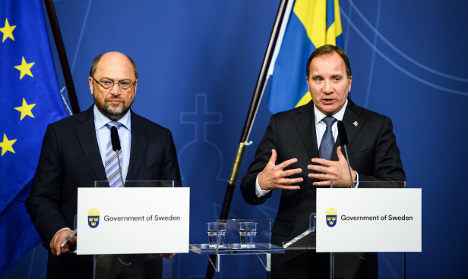
At a
press conference
October 9, Prime Minister Stefan Löfven said that Sweden is in a state
of crisis. However, when asked to clarify what he meant by this, Löfven
was unable to produce a single coherent sentence.
Three ministers appeared by the Prime Minister's side at the hastily
summoned press conference, which came on the heels of an extraordinary
government meeting. The purpose of the press conference seems to have
been to convey two messages:
- To explain to the world and the Swedish people that Sweden is
facing "one of the largest humanitarian efforts in Swedish history."
- That there is no more housing available, and migrants should be prepared to live in tents.
During the question period after the ministers' speeches, journalist Tomas Ramberg of
Ekot Public Radio asked: "You say that Sweden is preparing for a crisis situation, what do you mean by those dramatic words?"
Stefan Löfven's reply was incomprehensible:
"Yes, well first of all we, we are in the middle of what I
mean seriously when I'm saying, when I express a, a big thank you to
all the people doing such a great job, because it is a humanitarian
effort, it's just as the Minister for Justice and Migration just said.
What we are actually doing is that we are saving lives when people who
come from bombs, from, from killing, from oppression, their lives are
shattered. We, we help them and that is a, that is a great humanitarian
effort, and of course now that we can see the number of people who need
it, that are seeking protection, then it is one of the greatest
humanitarian efforts. And that we are facing a crisis situation, that is
in part why I, we are outlining today that we are also preparing for a
situation where we may need to house people in tents, because we stand
up with the humanitarian refugee policy, right of asylum, but we can now
also see that we cannot close our eyes to the fact that there are more
coming than ever in such a short time, and we need to provide a roof
over their heads. Then it is -- other things may be required."
However, the fact that the government is now talking about housing
migrants in tents, may be a signal that Sweden, despite everything, may
not want to be on the front lines of the "humanitarian" battle anymore,
after all. The prospect of spending an ice-cold Swedish winter in a tent
may make migrants choose countries other than Sweden. If not, a
complete collapse of the Swedish system is imminent.
In 2014, the Danish historian and social commentator Lars Hedegaard prophetically remarked in the book "
Farliga ord"(
Dangerous Words), that the economic breakdown of a nation always happens quickly and unexpectedly:
"If there is any lesson to be drawn from history, it is
that what you do not think will happen, does. Time and again. The final
consequence of the West and, above all, Sweden's immigration policy is
that the economy will collapse -- because who is going to pay for it
all? And economic breakdowns, once they happen, always happen very
fast."
Right now, the Swedish government is
borrowing
money abroad to pay for immigration. But that amount is not enough. On
October 8, the Swedish Association of Local Authorities and Regions
(SKL)
warned that municipalities need to increase the tax rate by 2%. The average municipal income tax is already
32%,
on top of which many Swedes also pay a federal income tax. A 2% rise in
the tax rate would mean 15,000 kronor ($1,825) more in taxes each year
for the average household.
High-ranking politicians and officials are also saying the situation
is extremely grim. On October 1, Minister for Home Affairs Anders Ygeman
said
that the current wave of immigrants will lead to "huge economic
strains;" and a few days later Immigration Service Director General
Anders Danielsson
explained
that "within the framework of the system we all know, we are now
approaching the end of the road." Statements such as these have never
been heard before in Sweden, especially in connection with the "sacred"
issue of migration. Until now, Swedes have perpetually been told that we
live in a rich country that has no problem handling all asylum seekers
who want to come here.
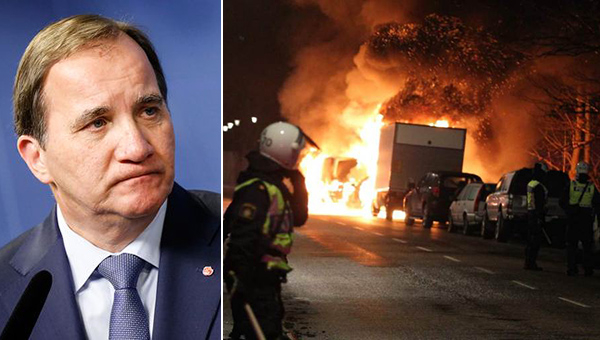
Swedish
Prime Minister Stefan Löfven (left) said last week that Sweden is in a
state of crisis. Pictured at right, the results of rioting in a
Stockholm suburb, December 2014.
|
In the shadow the
1.5 million migrants expected
to arrive this year in Germany, the EU's largest country (population 81
million), migrants are also pouring into a rather smaller Sweden.
Geographically Sweden is large, but consists mainly of forests and
wilderness, and fewer than 10 million people live in the country. Until
2010, Sweden took in about 25,000 migrants a year. However, in 2010,
then Prime Minister Fredrik Reinfeldt made a deal with pro-immigration
Green Party, (Miljöpartiet) -- by his own admission to
punish voters for allowing the anti-mass-immigration Sweden Democrats party (Sverigedemokraterna) into parliament.
Reinfeldt's deal opened the immigration floodgates. In 2014, 81,000 people sought
asylum
in Sweden; and 33,500 were granted asylum. However, as many of the
immigrants subsequently brought over their relatives, that figure
substantially increased. Last year, 110,000 people were granted
residency status in Sweden. One should add to this figure an unknown
number of illegal aliens.
There is now talk of
180,000 asylum seekers
coming to Sweden in 2015. That number is more than twice as many as the
year before. If half of them are granted asylum, and they each bring
over three relatives, we are talking about 270,000 new immigrants to
Sweden -- within one year. Over
8000 people arrived just last week, 1,716 of whom were so-called "
unaccompanied refugee children."
Swedes who only follow the mainstream media get the impression that
all the migrants arriving are war refugees from Syria, but the number of
Syrians is actually less than half of the total: 2,864 people last week
claimed to be from Syria. 1,861 claimed to be from Iraq, and 1,820 from
Afghanistan. Clearly, many people from countries that are not at war
are taking their chances and applying for asylum in Sweden; but this is
something about which the mainstream media does not see fit to inform
its followers.
That there is an exchange of populations going on, should be clear in
any sober assessment. The Swedish economist Tino Sanandaji (of
Iranian-Kurdish descent, and therefore tougher than most Swedes, who, if
they criticize the immigration policy, are immediately accused of
racism)
writes on his blog that Swedes could soon be in the minority in their own country:
"1,000-1,500 asylum seekers a day for 15 years equals 5.5
to 8.2 million asylum seekers. At the end of 2014, the Statistical
Central Bureau, SCB,
calculated that 21.5% of the Swedish population were of foreign
descent: 2.1 million, out of 9.7 million. The number of people of
Swedish descent -- born in Sweden with two parents born in Sweden -- has
been stable at about 7.7 million and is expected to remain stable or
increase slightly due to birth surplus. If those of foreign descent
increase their number by about 5.6 million, they will become the
majority."
One of the municipalities that has been flooded with migrants is
Trelleborg (population 43,000), located on Sweden's southernmost coast.
Over 100 "unaccompanied refugee children" arrive from Germany via ferry
on a typical day. During the last two weeks, more than 1000 such youths
have been registered; more than half of them have now vanished and are
listed as missing. No one knows why, or where they have gone. Add to
this 13,000 adult asylum seekers.
Impromptu temporary lodgings have been created in sports centers, ice rinks, and at the Sturup airport hotel, to name a few.
Trelleborg has written a desperate
letter of appeal for help to the government, just as, a few weeks ago, the Örkelljunga municipality
did in vain. The mayor and the Municipal Director of Trelleborg, who signed the letter on October 1, wrote:
"In the past, many asylum seekers have taken the route
through Denmark to Malmö, but this changed about two weeks ago. From
September 10 until the morning of October 1, 14,100 asylum seekers
arrived in Trelleborg by ferry. There is no indication that the pace is
slowing; if anything it is continuously increasing. On Tuesday,
September 22, Trelleborg received word from the Immigration Service that
the municipality where children and young people arrive is by law the
authority that is required to provide housing, care and living expenses,
until such time as the Immigration Service decides upon a designated
municipality. ... Trelleborg has quickly ended up in a situation where
the regular services to the community are at great risk of being
affected. ... By writing this letter, we would like to bring to your
attention the enormous strain we now find ourselves under."
Apparently, the Minister for Justice and Migration, Morgan Johansson,
has since been in contact with Trelleborg's mayor via telephone to
discuss possible solutions. On October 9, the Immigration Service
decided that Trelleborg should be
exempt
as a designated municipality for unaccompanied children. However, it is
unclear how this will alleviate Trelleborg's plight as far as the new
arrivals go. The only concrete help so far has come from some of the
neighboring municipalities, who have opened up facilities to house some of the Trelleborg migrants.
Malmö, about 18 miles from Trelleborg, is also in dire straits. For
the last few weeks, the central train station in Sweden's third largest
city has been overrun with migrants, and the volunteers that showed up
for the first few days with food, water and clothes now seem to have
lost interest. The daily
Sydsvenska Dagbladet summed up
the desperate situation in Malmö, where even the city's empty jail was
considered (and rejected) as possible housing for refugee children. It
now looks more like a possibility for adult refugees.
The Social Democratic mayor of Filipstad, Per Gruvberger, also
recently raised the alarm that his municipality of 6,000 people will not
be able to provide schooling and childcare for the 1,100 asylum seekers
now assigned to his municipality.
The reply of the Minister for Justice and Migration, Morgan
Johansson, to this cry for help was: "If need be, Filipstad will just
have to expand its operations."
This insensitive statement from Johansson caused the Mayor of neighboring Årjäng, Daniel Schützer, to
go ballistic. He wrote about his fellow party member on Facebook:
"Pardon my French, but Morgan Johansson is totally
f---ing stupid. 'Expand,' he says. It is not f---ing bricks and planks
that we are lacking, it is teachers!!!!"
The Immigration Service, which is tasked with reviewing the asylum
seekers' reasons for immigrating, is understandably swamped with work.
Even before the latest "refugee crisis" -- and despite
1,200 new employees
being hired last year -- its staff is struggling. The employees' union
is now raising the alarm, concerning more and more incidents of
violence, vandalism and suicide attempts -- this year (up to August),
1,021 such incidents were reported.
"The work situation for the entire authority is very strained. The
pressure is enormous. The work environment has deteriorated severely,"
said Sanna Norblad, local chairperson of the ST union, to daily
Norrköpings Tidningar.
While all this plays out, large portions of the Swedish people watch
in horror from the sidelines and wonder when the unavoidable collapse
will occur. At the same time, a surprisingly large portion of the
citizenry still overconfidently believe that "Daddy State" will make
everything all right. This a very Swedish view, like the wishes of
children, that Peter Santesson, head of polling institute Demoskop,
wrote about on the website
Dagens Opinion.
Santesson states that the Swedes have an unusually high level of trust
in the social order, and that they are convinced that "somewhere higher
up, there is always someone smarter and more informed, taking
responsibility and making sure everything works." If the government
officials turn out to be incapable of handling the refugee chaos they
themselves have created, it could be disastrous. Santesson continues,
"Responsible decision makers need to ponder the trust the
people have now bestowed on them, and they need to handle this trust
with care in this difficult crisis. If the people's confidence is
betrayed by them turning out not to be able to handle the situation – if
'Sweden' turns out to be insufficient as a miracle cure and the crisis
becomes too much to handle -- the outcome could be political and social
consequences reaching far beyond the issue of immigration."
The blogger Johan Westerholm, a Social Democrat who is critical of the government, points out in an October 7 titled "
System infarction in the Immigration System,"
that in addition to those who are already in Sweden, we need to add
those who are not granted asylum in Norway and Finland, and will
therefore be sent back to the last country they were in -- Sweden.
Considering that Finland
rejects 60% of asylum applications, it is fair to assume that during the coming weeks, the chaos will only escalate.
Westerholm writes that the situation in Malmö is "out of control,"
and states that we do not have any idea who those arriving in Sweden
are:
"A very large group of administrators [at the Immigration
Service] do not even know the designated terror organizations, and then
there are the sympathizers -- people who, on principal, would never
file a report to the Immigration Service security department, for
ideological reasons. A large group consists of those who are scared into
silence. In an organization characterized by fear and stress, to do
nothing is a surefire way to keep your job. If a report of suspicion is
filed anyway, typically nothing happens. If the life and health of the
terrorist is threatened, as is often the situation, the person gets to
stay. Initially he is given a temporary residence permit, but in
practice, this turns out to be permanent."
The 152 asylum seekers
reported to the Security Service so far this year as possible threats to national security, are thus most likely just the tip of the iceberg.
The Swedes who have already lost faith in the authorities and the
politicians are now preparing for the unthinkable -- that their once so
secure society is about to collapse. On the website
72timmar.se,
the Civil Contingencies Agency informs the public on "our five most
basic needs: Water, food, heat, sleep and security." The readers are
told to keep water and canned goods at home, and make sure they can stay
warm.
"Prepping" is becoming more common in Sweden. Last summer, the daily
Svenska Dagbladet ran a
story on the first Swedish online store for preppers, and that interest was huge. According to the polling institute
Sifo,
until recently, seven out of ten Swedes have been completely unprepared
for a crisis that knocks out the power supply and thereby the
infrastructure. The owner of the online store, Fredrik Qvarnström, told
the paper that, in his estimation, the Swedes are the worlds most poorly
prepared for a crisis:
"There is lot of talk about the greenhouse effect and
economic crisis. People seem to be aware that there are problems, but I
do not think they know how vulnerable we really are. We rely on the
state to take care of us, as it has in the past."
It will not be long until the Swedes realize that the state will not
look after them. The country that just 20 years ago was considered one
of the safest and most affluent in the world, is now in danger of
becoming a failed state.
Ingrid Carlqvist is a journalist based in Sweden, and a Distinguished Senior Fellow of Gatestone Institute.








 The payment of family benefits (housing benefit, family allowance, early childhood benefit)