Games to be held in Berlin for first time since Holocaust, a chance to show world Jewish life in bloom
Seventy years after the fall of the Third Reich,
its memory still resonates on the bleachers of Berlin's Olympic stadium.
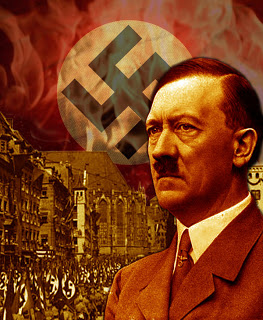
The stadium, built on Hitler's orders for the 1936 Olympics, is still
best remembered for its swastika flags surrounding a Nazi-saluting
crowd. But at the end of this month, the same hallways and benches will
be filled with thousands of Jewish athletes from all over the world,
gathering in Germany's capital for the 14th European Maccabiah Games.
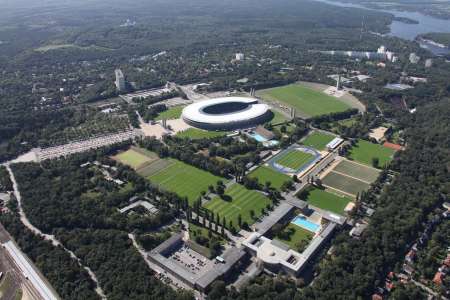 Lutz Imhof"Berlin stadium"
Over 2,300 sportsmen and women from 36 countries will compete in 19
disciplines at the Olympic park from which Jewish athletes were excluded
in 1936. The week-long event, taking place on German soil for the first
time since WW2, coincides with the 50th anniversary of the start of
German-Israeli diplomatic relations, the 50th anniversary of the
refounding of Maccabi Germany, and of course, the 70th anniversary of
the end of the war. Yet the decision to use this controversial location
was not taken lightly.
“When I entered the stadium for the first time a year and a half ago,
even I wondered if it's right to host the games here,” admitted the
president of Maccabi Germany, Alon Meyer, speaking to
i24news.
“I still get goosebumps when I imagine what happened here, who stood
here and what they were shouting. It's unbelievable. But now we are
returning to the very same place and saying, 'you have failed, we are
the ones who won.'”
For him, the games are finally returning to the place where it all
began. “The first Maccabiah games, in Europe and in Israel, were
organized from Berlin. Even when the Maccabi headquarters moved to
London, its president was still German,” he says. The Jewish sports
clubs in Germany were reopened in 1965, and four years later Germany
participated again at the Maccabiah in Israel. But hosting the games
sooner was out of the question for the local Jewish community.
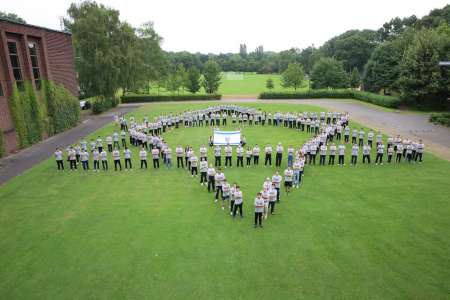 Rafael Herlich"Maccabiah delegation"
“The old generation wasn't ready for this,” stated Meyer. “They
didn't feel at home here, and many were living with their suitcases
packed, ready to flee. But we don’t feel that way anymore. Now Jewish
life in Germany is flourishing and this is our chance to show this to
the world.”
This reasoning was enough to quiet those who initially were troubled
by the idea of having the Maccabiah in “Hitler's stadium”. In the end,
only one thing remained taboo: the torch relay – a tradition introduced
by the Nazis at the 1936 Olympics for propaganda purposes. Instead, the
Maccabiah's organizers decided on a different historic homage. The torch
will be carried into the stadium by motorcycle riders, making their way
from Israel through Europe, just like the bikers who spread the news of
the first Maccabiah in Israel (then Palestine) in 1932.
For the riders - some of them noted Israeli personalities - this will
be the pinnacle of a 22-day journey through Greece, Bulgaria, Serbia,
Hungary, Slovakia, and the Czech Republic. During the ride, which will
be captured in the documentary film “Back to Berlin”, the bikers will
explore their own personal family roots in Europe, as well as the
current situation of the Jewish communities there.
“The Maccabiah represents Jews who are proud to be Jewish, who show
strength and refuse to be victims, and for many of the communities in
Europe, to meet Jews like that is a completely different experience,”
says the film's director, Catherine Lurie-Alt.
But these aren't the sides of the story she wishes to highlight when
speaking of this with Germans. “It's a sensitive subject. We are
describing the film simply as a recreation of the original bikers'
journey, a straightforward and joyous story,” she added. “'Back to
Berlin' means we are coming back as victors. It's a moment of
conciliation and redemption.”
Meyer also knew that showcasing the right narrative was key to
getting the authorities' support. “The politicians also want this to be a
successful ceremony, they have an interest in presenting Jewish lives
in Germany, but still I needed to sell this in order to convince them to
allocate funds. I reminded them that having journalists write how great
the Maccabiah games were is good PR for all of Germany, as well as for
its Jewish community.”
The German interest in self-promotion was also used to address one of
the biggest challenges of the Maccabiah: funds for security purposes.
“We aren't worried the games would trigger an anti-Semitic spike, but we
are concerned about them becoming a target for terror attacks,” Meyer
stressed. Initially, he says, Berlin's authorities didn't offer adequate
financial support, but the suggestion that the security will be lacking
because of insufficient funds, was enough to turn the situation around.
 Maccabi"2015 Maccabiah Games"
Subsequently, the Israeli Foreign Ministry and the Ministry of the
Interior also chipped in, with the Shin Bet security service providing
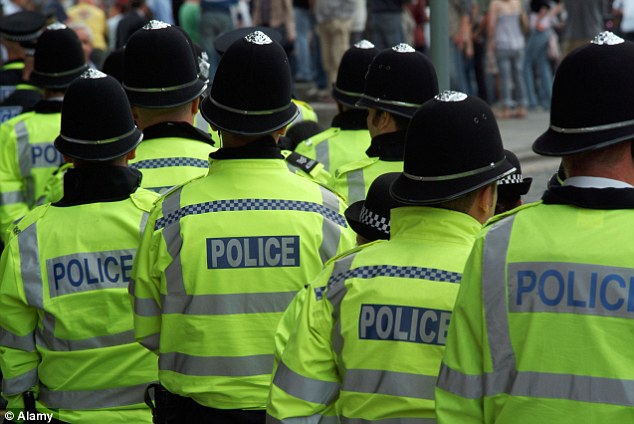
advice. In total, almost 800,000 euros were spent on private security -
on top of the hundreds of policemen assigned by the city of Berlin - out
of a budget of about 5.5 million euros.
“We might not enjoy the same budgets four years from now, since
getting people to acknowledge the importance of this is becoming harder
with time,” said Meyer, expressing his concern. “We are trying to make
sure people won't forget what happened here, but every new generation
prefers to deal less and less with Germany's history.”
“If the Maccabiah Games take place here again in 30 years, it will be
completely different,” he continued. “The Holocaust would be
historically too far already and nobody will be left to tell his story.
But now, the people coming here – some of them descendents of those who
were forced to flee Germany – have a chance to get closure. Now is the
perfect time to have the Maccabiah in Berlin.”





 MIGRANT
rights organisation Doras Luimní says it is “appalled” by the rise in
racist and homophobic posters being put up around the city.