The
people who lived in the “Byzantine Empire” never knew nor used the word
“Byzantine.” They knew themselves to be Romans, nothing more and
absolutely nothing less. By transferring the Imperial capital
from Rome on the Tiber to the New Rome on Bosphorus, dubbed
Constantinople, the Emperor Constantine I had transferred the actual
identity of Rome to the new location. Long before Constantine I, the
idea of “Rome” had become dissociated from the Eternal City on the
Tiber. For a Roman meant a Roman citizen, wherever he lived. Before the
Imperial period, in 89 BC, a Roman law had granted Roman citizenship to
people throughout Italy. Afterwards, citizenship became extended to an
increasing number of people in different parts of the Empire. In
212, Emperor Caracalla declared all free persons in the Empire to be
Roman citizens, entitled to call themselves Roman, not merely subject to
the Romans. Within a few decades, people begin to refer to the entire
Empire less often [in Latin] as “Imperium Romanorum” [Domain of the
Romans] and more often as “Romania” [Romanland]. The Empire at
Constantinople should not be called the “Byzantine Empire” at all, the
very name “Byzantine Empire” is, in fact, an insult.
Greek-speaking Byzantines adopted the Slavic name Vlach
(originally Germanic) for the Pastoral Care of Romance-speakers of the
Balkan Peninsula and beyond. We have reason to believe that in their own language the Vlachs called themselves Romans or Ruman. In his De Administrando Imperio, written in the 10th century, Byzantine emperor Constantine Porphyrogenitos describes the Latin-speaking Romanoi as distinct from the Greek-speaking Romaioi.
By the 8th century Greek had replaced Latin as the language of the
administration of the empire. Even so, the Byzantines considered
themselves the continuators of the original Roman Empire, and they
called their empire Romania. The term Byzantine Empire did not even
exist until some time after the fall of the Empire to the Ottomans in
the 15th century. So why did the Byzantine Greeks adopt the term Vlach?
One explanation is that they had lost contact during the Slavic
migrations and especially during the existence of the First Bulgarian
Empire, from the 9th to the 11th century.
The Pope placed the Imperial crown on Charlemagne’s
head at Christmas, 800. After his coronation, Charlemagne called himself
“Carolus Augustus Imperator Romanorum gubernans Imperium” [Charles
Augustus, Emperor governing the Domains of the Romans]. The authorities
at Constantinople did not wish to recognize the claims of the Frankish
upstart in the West, although political reality forced a compromise on
the part of Emperor Michael I [811-813]. Michael began to call
himself [Michael, Roman Emperor]. Before this change, no Roman Emperor
had ever used the word “Roman” in his official titles: the Emperor was
simply the “Imperator Caesar Augustus.” Diplomatists at
Constantinople would soon argue that “Basileus Romaion” and “Basileus”
were two different things. In that view, “Basileus Romaion” stood as a
superior and unique title reserved for the ruler at Constantinople.
According to this clever theory, Michael had really conceded Charlemagne
nothing except a royal title, “Basileus” in the sense of “King.”
equivalent to the Latin “Rex.” No wonder “Byzantine” means duplicitous.
Not until the time of Emperor Otto III [983-1002] did Western Emperors
consistently start calling themselves “Imperator Romanorum” [Roman
Emperor] in direct challenge to the “Basileus Romaion” of
Constantinople.
Medieval Westerners referred to the territory of the Romaion Empire with the name “Romania” [Romanland]. Case
in point: from the sixth to the eighth century, the city of Ravenna was
the capital of the Romaion province of Italy, the headquarters of the
Exarch. The region close to Ravenna was directly governed by the
Imperial authority. In the minds of the Lombards, the Germanic people
who wrested much of Italy from Imperial control, the area around Ravenna
was “Romania.” To this day, the same region of Italy is called “Romagna,” derived from “Romania.”
Centuries later, the “Franks” of the Fourth Crusade
stormed Constantinople in 1204. In the subsequent Imperial hiatus, these
adventurers, largely French, elected their own Emperor and established
their own Frankish or Latin Empire. The Frankish or Latin
Imperial title was “Imperator Romaniae” [Emperor of Romania]. The
“Imperator Romaniae” was something different from the “Imperator
Romanorum.” In Western Europe, the title the “Imperator
Romanorum” belonged to the German successors of Charlemagne and Otto III
when they were crowned by the Pope in Rome. Until 1800, most
Europeans, particularly Catholics, spoke of the “Sacrum Romanorum
Imperium” [Holy Roman Empire] as a serious and important enterprise.
Nonetheless, Western Europeans did not call themselves Romans or refer
to their homeland as Romania. These words were conceded, albeit
grudgingly, to Constantinople.
In the eleventh century, a branch of the Seljuk Turks
established a Sultanate in Asia Minor, after the Battle of Manzikert
[1071] in which Emperor Romanus IV
fell into the hands of the Turks as a prisoner. This Turkish state in
Asia Minor was called “Rum” from Rome (and Romanus IV). The later
Ottoman Turks adopted the term “Rumelia” to designate the portions of
the Balkan Peninsula that they acquired from the Romaioi in the
fourteenth century. “Rumelia” was a dimunitive word. If Anatolia was Rome [Rum], than the European territories were Lesser Rome [Rumelia].
After Wallachia and Moldavia coalesced into a single
entity in 1859, the name “Romania” was selected in 1862 to describe the
combined state. At the time, Romanian unity and independence required
the support of France under Emperor Napoleon III [1852-1870]. The “Latin
connection” with France aided the Romanian cause by inspiring French
interest in their “sister nation” of Romania. For more than a millennium, the state that we call, inaccurately, the Byzantine Empire was “Romania.”
Modern Greeks call themselves “Hellenes,” like the ancient Greeks did.
The switch from “Romaioi” back to “Hellene,” like the switch from
“Vlach” to “Romanian,” came from the politics of nationalism in modern
times.
Greeks needed Western European help to become
independent in the early nineteenth century. The Greeks were not likely
to attract assistance if the Western peoples thought of Greeks as
Byzantines. However, if the Greeks were imagined as the children of
Plato and Pericles, then the sympathies of educated Westerners, steeped
in the Classical tradition, would be with Greece. In the Greek
Revolution of 1832, the “Philhellenic” [Greek loving] sympathies of
Britain and other European governments were deeply engaged. Intervention
on behalf of Greek independence proved decisive. The name of “Hellene”
was revived in order to create a national image which rejected the
“Byzantine” past.
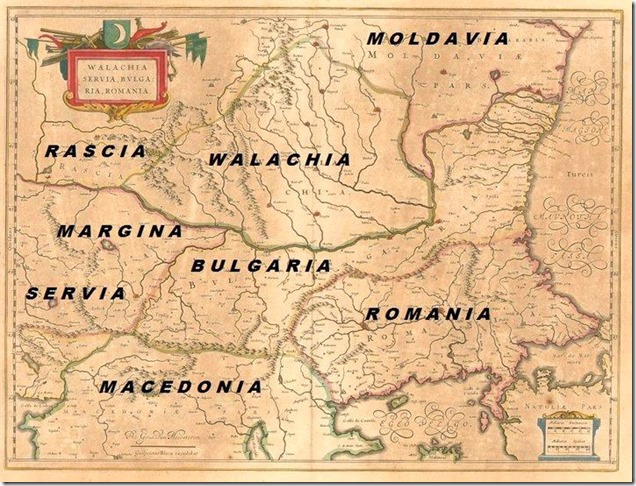
wiki > Imperiul Roman de Răsărit Denumirea oficială era
Ρωμανία,
Romanía sau
Βασιλεία Pωμαίων (
Basileía Romaíon),
Imperiul Roman.
Heraclius I a elenizat imperiul aproximativ pe la 640, prin adoptarea
limbii grecești ca limbă oficială, dar majoritatea populației din zona
europeană a imperiului, cu excepția grecilor, au continuat să vorbească
latina populară până la apariția limbilor populațiilor migratoare (slavi
și bulgari). Termenul
Imperiul Bizantin a fost inventat în 1557, la aproximativ un secol după căderea Constantinopolului, de către istoricul german
Hieronymus Wolf. Bizantinii se numeau pe ei înșiși
Ρωμαίοι – Romaioi, prin care se deosebeau de vechii
Έλληνες – Elini,
care, în Evul mediu, însemna „greci antici păgâni”. Sub stăpânirea
otomană, grecii au continuat să se definească ca Ρωμαίοι (Romaioi, în
turcește, Rum), apoi treptat, odată cu dezvoltarea naționalismelor
moderne și cu regăsirea istoriei antice, din ce în ce mai frecvent,
Έλληνες Elines.
Revista AS >>
Imparatii daci ai Romei -
Dacia – abandonata sau eliberata? Regalian, stranepotul lui Decebal este cel dintai dac care a urcat in aceasta ierarhie. Poate
fi doar o genealogie imaginara, ceea ce insa nu se poate pune la
indoiala este originea dacica a lui Regalian. In anul 260, in vreme ce
pe tronul Romei se afla Gallienus, dacul Regalian, general cu talent de
strateg, se afla in fruntea trupelor din zona Dunarii, din Pannonia si
Moesia. Nu mult dupa anul 260, el pune la cale o rebeliune, in urma
careia este proclamat imparat de catre trupele sale. Figura lui
Regalian este deosebit de importanta in istoria provinciei Dacia,
deoarece coincide cu un moment-cheie: abandonarea provinciei de catre
Gallienus. Desi Aurelian este considerat autorul retragerii
trupelor si administratiei romane din Dacia, totusi, izvoarele istorice
si arheologice ne confirma faptul ca provincia Dacia a fost abandonata
mai devreme, in vremea lui Gallienus, iar Aurelian nu a facut decat sa
consemneze in acte un fapt deja consumat si pe care oficialitatile multa
vreme nu au avut curajul sa-l recunoasca.Scrierile vechi ne informeaza
ca “Dacia a fost pierduta” in vremea adversarului lui Regalian, iar
arheologia ne arata ca tot in vremea acestui imparat au incetat
inscriptiile romane din Dacia, precum si baterea de monede.
Tot in vremea lui Gallienus a trait si Marcus Acilius Aureolus, dac dintr-o familie de ciobani, el insusi pastor in tinerete.
A fost proclamat suveran la Mediolanum de catre armatele sale, in anul
268. Totul se petrecea in plina criza politica a imperiului, celebra
criza a secolului al II-lea, cand s-au succedat la tronul Romei o
multime de imparati, mai toti provinciali, mai adesea sprijiniti de
armata. Gallienus a pornit impotriva celui de-al doilea dac autoproclamat imparat, Aureolus,
care i-a cerut ajutor lui Postumus. Acesta insa l-a refuzat, tradand
prietenia care ii lega. Totusi, cel care a murit in asediul de la
Mediolanum a fost Gallienus, iar Aureolus a reusit sa-si pastreze
titlul, pana in vremea lui Aurelian, dar a fost tradat si ucis, ca si
Regalian, de propriii lui soldati.
Galerius Maximianus (292-311) i-a urmat la domnie lui Diocletian, al carui protejat a fost.
S-a nascut intr-un sat din apropiere de Serdica (Sofia), dintr-o mama
daca, venita din nordul Dunarii, din Dacia Traiana. Se crede ca, dupa
numele sau romanizat, Romula, mama sa ar fi venit de undeva din Oltenia,
din Dacia Malvensis, poate chiar din orasul Romula (astazi Resca, jud.
Olt). Lactantiu, scriitorul crestin care ne confirma originea dacica a
imparatului Galeriu, ne mai da cateva informatii uluitoare despre acest
dac ajuns imparat. In primul rand, a vrut sa supuna la obligatia
platii impozitelor Roma si intreaga Italie, drept razbunare pentru
umilirea dacilor de catre Traian, care le-a impus tribut dacilor. In al doilea rand, a vrut sa schimbe numele Imperiului roman in Imperiul dacic.
Inainte de a muri, imparatul s-a retras in satul sau natal, care a fost
numit Romulianum, dupa numele mamei sale. Dacismul lui Galerius este
incontestabil, la fel si adversitatea sa fata de romani si de numele de
“roman”, declarata deschis de imparat. Nu ar fi exclus ca seria lunga de
documente ce relatau cucerirea Daciei, toate disparute astazi, sa fi
fost cenzurate sau distruse in vremea lui Galeriu sau a altor imparati
de mai tarziu, care au incercat sa apere astfel memoria dacilor.
Daia si Licinius. Maximinus Daia (sau Daza)
era nepotul imparatului Galeriu. S-a nascut in Dacia Aureliana, la sud
de Dunare, avand-o ca mama pe sora imparatului. A ajuns sa fie adoptat
de unchiul sau, dar chiar si dupa adoptie, a tinut sa-si pastreze numele
dacic. In schimb, despre Licinius, izvoarele spun ca se tragea dintr-o
familie de tarani daci din Moesia Superior. S-a nascut in anul 265 si a
ajuns prieten foarte bun cu Galeriu. Imparatul Galeriu i-a conferit lui
Licinius titlul de “Augustus” in vestul imperiului, in anul 308, in timp
ce Daia, nepotul imparatului, si Constantin (si acesta de origine
moeso-dacica) au fost numiti “fiii augustilor”. In felul acesta,
toti cei patru suverani care formau tetrarhia (forma de conducere cu
patru imparati, doi de rang superior si doi de rang mai mic), erau de
origine dacica. Cu acesti patru imparati de origine dacica, ce
au condus imperiul simultan, a inceput o noua epoca in istoria
Imperiului roman.
Dar cel mai mare imparat roman de origine dacica este Constantin, primul imparat crestin din istorie. S-a
nascut la sud de Dunare, la Naissus, in Serbia de astazi, pe atunci
provincia Moesia Superior. Tatal sau, imparatul Constantius Chlorus, era
tot din Naissus. In anul 325, in vremea conciliului de la Niceea, la
Naissus este atestat un episcop care isi spune “Dacus”. Prezenta dacilor
la sudul Dunarii, atat inainte de cucerirea Daciei cat si dupa aceea,
este incontestabila. Deci, Constantin era, mai exact, un moeso-dac. Desi
nu stim in ce fel dacismul sau i-a influentat actiunile, stim sigur un
lucru: el este cel care, la doar doua secole dupa cucerirea Daciei,
spoliaza monumentele din splendidul for al lui Traian. Marea
friza de piatra a lui Traian, masurand peste 30 de metri (dupa altii
mult mai mult) si fiind a treia ca marime din intreaga antichitate, este
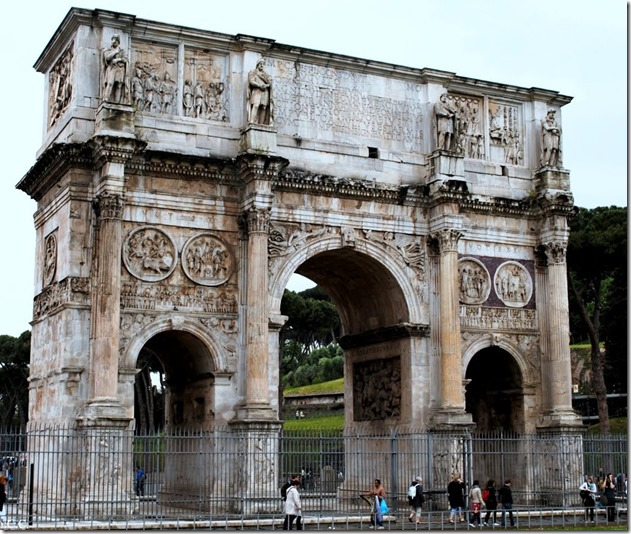
sparta in bucati de Constantin. Patru bucati sunt incastrate
in arcul sau de triumf de la Roma, dupa ce figura lui Traian este
stearsa din reprezentarile reliefurilor. Mai mult, opt din grandioasele
statui de daci, inalte de trei metri, care impodobeau forul lui Traian,
sunt scoase de la locul lor si urcate pe Arcul imparatului Constantin.
Ce logica sa aiba dislocarea unor statui colosale de daci si plasarea
lor pe un monument al unui imparat roman, daca nu faptul ca acesta era
nascut tot in tara dacilor? Cu siguranta, Constantin avea o mare
pretuire pentru stramosii sai. Iulian Apostatul ne povesteste ca, dupa
ce a vazut pentru prima data forul lui Traian, Constantin a fost abatut
timp de mai multe zile, spunand ca el nu va avea niciodata un for atat
de grandios. Dar nu este suficienta aceasta explicatie. Oricat de mare
ar fi fost lipsa de materiale si de artisti talentati, nici un imparat
nu ar fi indraznit sa distruga monumentele unui predecesor, daca acesta
era pretuit, memoria sa era onorata si facea parte din galeria sacra a
parintilor Romei. Gestul atat de neobisnuit si de socant al
plasarii celor opt statui de daci pe Arcul de triumf al lui Constantin
isi gaseste in acest fel o explicatie. Statuile de pe arc simbolizeaza
obarsia dacica, mandra si iubitoare de libertate, a imparatului.
Din aceasta perspectiva, nu ar fi deloc absurd sa ne gandim ca scrierea
de capatai a lui Traian despre cucerirea Daciei a disparut, ca si
celelalte scrieri ce relateaza acest eveniment dramatic din istoria
dacilor, din ordinul lui Constantin. Daca Galerius nu a contribuit la
disparitia acestor scrieri, se poate sa o fi facut Constantin.
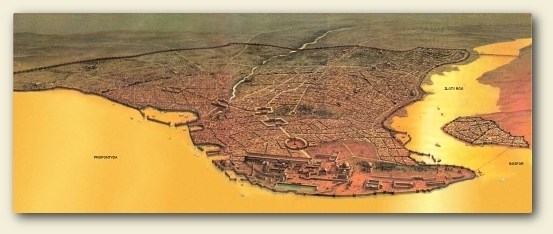
Constantin cel Mare este cel care a mutat capitala imperiului la
Byzantion, numit dupa moartea sa Constantinopol.
Elena, mama lui Constantin, era nascuta, se pare, in
Asia Mica, intr-o familie foarte modesta. A avut o legatura neoficiala
cu Constantius Chlorus, viitorul imparat, si l-a nascut pe Constantin in
teritoriul dacic de la sudul Dunarii. Scrierile vechi spun ca Elena a
contribuit foarte mult la intarirea crestinismului ca religie a
imperiului. Ea a primit titlul de Augusta. Calatorind la Ierusalim, se spune ca a descoperit resturile crucii lui Isus, pe care le-a adus la Roma. Descoperirea
s-a facut in urma unor sapaturi pe care ea insasi le-a comandat si
coordonat. De aceea, astazi, Sfanta Elena este patroana arheologilor.
Sarcofagul sau din porfir rosu egiptean se afla la Muzeul Vatican, in
sala numita “Crucea greceasca”. Este ornamentat, in mod destul de bizar,
cu scene de lupta. Intre soldatii reprezentati se disting cu claritate
figuri de daci, cu inconfundabilele lor caciuli. Sfintii imparati Constantin si Elena, praznuiti de Biserica Ortodoxa la 21 mai, au schimbat definitiv cursul istoriei.
Romania – Imperiul Roman cu capitala la Bizanţ Constantin
cel Mare s-a născut la Niş şi a crescut în complexul mediu al
traco-romanilor şi protoromânilor aflaţi la putere în Imperiu.
Drumul său către Hristos a fost, ca la aproape toţi oamenii, un drum
lung şi greu în care ispitele au fost multe. El a fost multă vreme
influenţat de religia tatălui său – pe care sigur, dincolo de
nedreptatea făcută mamei sale, l-a iubit şi admirat. Dar în final nu
doar a acceptat creştinismul, ci s-a făcut şi propovăduitor al acestuia
în tot Imperiul, fara sa fie persecutor al altor religii. Să nu uităm că
mult admirata biserică Sf. Petru din Roma i se datorează, ca şi cea din
Lateran, ca şi Biserica Sfântului Mormânt (a Învierii) din Ierusalim,
cea a Naşterii Domnului din Bethleem şi cea a Înălţării de pe Muntele
Măslinilor. Tot el a ridicat şi alte locaşuri sfinte la Cirta (Numidia),
Nicomedia şi Antiohia şi le-a înzestrat cu mari averi. Alte biserici
deosebit de frumoase a ridicat în Bizanţ, cea mai vestită fiind biserica
Sfinţilor Apostoli
3.
Dar ceea ce conferă domniei sale o semnificaţie care
este superioară pentru noi, Românii, celei general creştine, este acel
act uimitor al mutării capitalei de la Roma la Bizanţul tracic. Mutarea
capitalei are o semnificaţie aparte. Dar motivaţiile lui Constantin cel
Mare au fost mai profunde decât un simplu calcul militar sau
administrativ. Roma era păgână. Constantin cel Mare era creştin. Avea nevoie de o Capitală creştină, nu de una păgână. Centrul de greutate al creştinismului de limba latină se afla în acea vreme în ceea ce mai târziu s-a numit Dioceza Traciei. Din
acest moment apare Romania, Terra Romanorum. Din acest moment Vechea
Romă, ostilă şi străină, este înlocuită de Noua Romă, simbol al tuturor
aspiraţiilor religioase, sociale şi economice ale Românilor. Trebuie subliniat că a fost iniţial un oraş mai mult românesc decât latin – păgânesc – sau grecesc, iar efectul său asupra spiritualităţii româneşti a fost profund.
Deşi se consideră de obicei că epoca Romaniei /
Imperiului Roman de Răsărit începe cu anul 395 considerăm că este
nepotrivit ca o excepţie – unitatea Apusului şi Răsăritului sub Teodosie
I cel Mare – să fie tratată ca regulă. Bazele divizării
Imperiului fuseseră puse încă în perioada împăraţilor păgâni
traco-iliri, iar Sfântul Constantin cel Mare a consfinţit această
situaţie încă în timpul domniei sale, atât prin mutarea capitalei cât şi
prin felul în care şi-a asociat fiii la domnie. Mai este cazul să
spunem că divizarea etnică dintre latinii apuseni şi Românii din zona
Dunării şi Asiei Mici a favorizat această separaţie. Şi
pentru că momentul în care Străromânii ajung la putere este momentul
victoriei Bisericii, 313, credem că acesta, ori cel mai târziu 325, sunt
anii de la care putem vorbi cu adevărat de apariţia Imperiului Roman de
Răsărit (Romaniei).
De-a lungul Dunării, din Noricum în Sciţia, se găseau numeroase centre episcopale. O
listă a episcopilor din Panonia Inferior, Moesia Superior, cele două
Dacii – Ripensis şi Mediterranea – Dardania, Moesia Inferior şi Sciţia
Mică a fost realizată în 1975 de părintele Mircea Păcurariu9.
Completată de listele pentru Iliria, Panonia Superior, Noricum, Epir,
Macedonia, Thracia, Chersonez etc., ar putea ajuta la formarea unei
imagini nu doar asupra unităţii Românilor sud şi nord dunăreni, ci şi
asupra vechii istorii bisericeşti a Neamului Românesc.
Întrebarea care se pune este: în ce măsură exista o unitate a Românilor
din zonele aflate sub administraţie romană şi cei din zonele aflate sub
influenţa Imperiului? Într-adevăr, până când, popoarele alogene
balcanice, de la neogreci la croaţi, au început a-şi dezvolta cultura
naţională şi a o impune şi Românilor de pe teritoriul lor, limba română
avea un aspect deosebit de unitar10. Or, explicarea unităţii lingvistice a unui neam atât de întins a creat multe dileme şi polemici.
Poporul român s-a format atât în Romania
balcanică, din Noricum în Bitinia, cât şi în Romania nordică, de la
izvoarele Oderului la ţărmurile Azovului; singura diferenţă
este că Românii din nord, inferiori atunci celor sudici atât pe plan
economic şi social cât şi organizatoric, militar etc, au fost mai mult
influenţaţi decât au influenţat în raporturile lor cu Românii sudici.
Este bine să ne reorganizăm viziunea asupra începuturilor Neamului
nostru, pentru a putea duce mai departe moştenirea şi misiunea.
Autor: Preot Mihai-Andrei Aldea
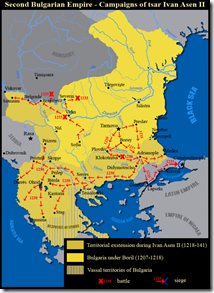
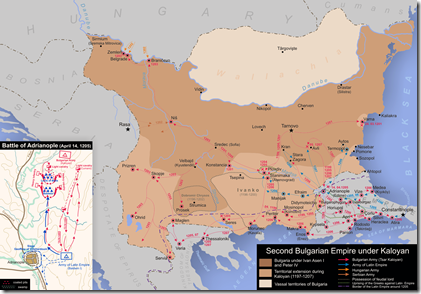
Țaratul (regatul) vlaho-bulgar a
fost în egală măsură valah (aromânesc la sud de Dunăre și românesc la
nord) și bulgar. Asta nu înseamnă că valahii (aromânii și românii) i-au
cucerit pe bulgari sau că bulgarii au cucerit principatele dunărene, ci
înseamnă că în cadrul acestui stat au conlocuit două populații, una
romanofonă, celalată slavofonă, pe ansamblul teritoriului său, toponimia
veche aratând o predominanță a slavilor la șes, și a romanicilor în
zonele peri-montane, deluroase și mai păduroase; țărmurile aveau o
populație preponderent grecească. Ulterior, despărțirea
proto-românilor de către populațiile slave așezate printre ei, a creat
cele patru grupuri lingvistice : daco-român, aromân, megleno-român și
istro-român; daco-românii absorbind treptat slavii din
nordul Dunării, în timp ce slavii au absorbit treptat majoritatea
aromânilor, megleno-românilor și istro-românilor din sudul Dunării[8].
The original version of this article appeared in the Celator [Volume
10, Number 3: March 1996]. Portions are also quoted in the book
Ancient Coin Collecting by Wayne G. Sayles, published [June 1996] by Krause Publications.
Introduction – By modern convention, the phrase “Byzantine Empire” refers to a political entity that once dominated the Mediterranean world.
The city called Constantinople or [on today’s maps] Istanbul functioned
as capital of the Empire. The “Byzantine Empire” originated with the
founding of Constantinople in the fourth century AD on the site of the
much older Greek colony of Byzantium. The Roman Emperor Constantine I
[died 337] called the site New Rome or Constantinople. Constantine
situated his capital in the new city named after himself. The successors
of Constantine I lived in Constantinople without interruption until
1204. In 1204, Crusaders from Western Europe, diverted from the path to
Jerusalem, captured and looted Constantinople. They held the city until
1261. The “Byzantines” restored the “Byzantine Empire” at Constantinople
in 1261 after the “Franks” were expelled. In 1453, the Ottoman Turks
stormed Constantinople. The “Byzantine Empire” ceased to exist.

The role of the “Byzantine Empire” in European history is not
sufficiently understood by the educated public of today. Constantinople
stood at the economic, political and cultural heart of Europe from its
founding until the wanton sacking of Constantinople by the Crusaders.
The New Rome withstood the assault of many attackers, protecting all
Europe against the flood of invasion. The “Byzantine Empire” flourished
in the same era that found Western Europe ensnared by poverty and
violence. One cannot omit the added fact that Constantinople yet remains
the religious lodestar of Orthodox Christians: the predominant faith of
Russia and other lands is rooted in the Byzantine experience. In our
time, with recent changes in Russia, her Byzantine roots seem more
relevant than ever to the present. In spite of its rich heritage and
significant role, the achievements of Byzantine civilization have often
been given short shrift and denigrated:
the very name “Byzantine Empire” is, in fact, an insult.
The phrase “Byzantine Empire” was coined and popularized by French scholars such as Montesquieu, an influential figure of eighteenth century intellectual life.. He was the same author whose seminal volume
The Spirit Of The Laws
did much to inspire the Founding Fathers of the United States in their
writing of the American Constitution. Like other thinkers of his time,
Montesquieu revered the ancient Greeks and Romans with immoderate
enthusiasm as masters of politics and culture to be emulated.
Following
a Western European tradition that extended back to the early Middle
Ages, Montesquieu regarded the Empire at Constantinople as corrupt and
decadent. Although he wrote a long history of the Empire at Constantinople,
Montesquieu
could not bring himself to refer to the Empire at Constantinople with
the noble names of “Greek” or “Roman.” From the obsolete name
“Byzantium,” Montesquieu used the word “Byzantine.” The word “Byzantine”
denoted the Empire and connoted its supposed characteristics:
dishonesty, dissimulation and decadence. The English scholar Edward Gibbon in his Decline and Fall of the Roman Empire treated the Empire after the sixth century as an epic of unrelieved degradation and corruption.
The
people who lived in the “Byzantine Empire” never knew nor used the word
“Byzantine.” They know themselves to be Romans, nothing more and
absolutely nothing less. By transferring the Imperial
capital from Rome on the Tiber to the New Rome on Bosphorus, dubbed
Constantinople, the Emperor Constantine I had transferred the actual
identity of Rome to the new location. Long before Constantine I, the
idea of “Rome” had become dissociated from the Eternal City on the
Tiber. For a Roman meant a Roman citizen, wherever he lived.
Before
the Imperial period, in 89 BC, a Roman law had granted Roman
citizenship to people throughout Italy. Afterwards, citizenship became
extended to an increasing number of people in different parts of the
Empire. In 212, Emperor Caracalla declared all free persons in the
Empire to be Roman citizens, entitled to call themselves Roman, not
merely subject to the Romans. Within a few decades, people begin to
refer to the entire Empire less often [in Latin] as “Imperium Romanorum”
[Domain of the Romans] and more often as “Romania” [Romanland]
In the provinces close to Constantinople, where the Greek language
predominated over the Latin of Old Rome, the idea of Roman citizenship
and identity appealed to a broad segment of the population.
Greek
speaking citizens were proud to be Romans: in Latin, “Romani,” or, in
Greek, “Romaioi.” The word “Romaioi” became descriptive of the Greek
speaking population of the Empire. The old ethnic name applied
to Greeks, “Hellene”, fell into disuse. In ancient times, of course,
“Hellene” had meant Greek. Hellene meant Greek from the seventh century
BC onward, if not earlier. Although Homer called Greeks by other names,
Herodotus, Pericles, Plato and Alexander were all “Hellenes,” as were
Greek speaking inhabitants of the Roman Empire in the first and second
centuries AD. In the fourth century AD, as the Empire became
Christianized, the term “Hellene” became redefined by common convention
to include people who still worshipped the old gods and studied
philosophy in hopes of resisting the new faith of Christianity. Emperor
Julian II [361-363], an Emperor who tried to stop the Christian tide,
described himself as a “Hellene.” By “Hellene,” Julian signified his
combination of Neo-Platonic philosophy and worship of the Olympians.
In the final years of the fourth century AD, Emperor Theodosius I
[379-395] made Christianity the sole state religion after subduing the
rebellion of an “Hellene” usurper, a westerner named Eugenius. After
Theodosius’ critical decision, fewer and fewer people were willing to
call themselves “Hellenes.”
For centuries more, the word
“Hellene” remained in bad repute, associated with outlawed religious
ideas and disloyalty to the state. Greek speakers found the
identity of “Romaioi” in place of “Hellene” to be a safe refuge in
changing times. Greek speaking “Romaioi” inhabited the Empire until the
its demise in the fifteenth century.
The Empire at Constantinople should not be called the “Byzantine Empire” at all.
If it requires a special name, we might better name the Empire at
Constantinople with the title of the “Romaion Empire” from the Greek
“Basileia Romaion” [Empire of the Romaioi].
Coins and Continuity – The
Romaion Emperors went to great pains to express the continuity between
their authority at Constantinople and the tradition of Old Rome before
Constantine I. For example, coins continued to carry inscriptions in
Latin centuries after the people of Constantinople could no longer speak
or read the language. Consider the observe legends found on coins in
the various Imperial reigns. As a benchmark, look at the coinage of the
last Emperor to reign many years in Italy, Valentinian III [425-455]. A
typical observe legend on one of Valentinian III’s coins reads like
this:

Expanded by spelling out abbreviations in full, we
get: “Dominus Noster Placidius Valentinianus Pius Felix Augustus” [Our
Lord Placidius Valentinianus the Pious and Blessed Augustus]. Compare
Valentinian’s obverse legend to observe legends from later Romaion
issues. Start with an inscription of Emperor Justinian I [527-565], who
spent his life trying to reconquer the lost western provinces, with
limited success:

There are two small changes between Valentinian and
Justinian. First, “Pius Felix” had been replaced by
“Perpetuus”[Forever]. Emperor Leo I [457-474] had mandated this change.
He thought that the phrase “Pius Felix” possessed too many associations
with the pagan past to be acceptable in the new Christian Empire.
Another difference was that “Augustus” had become abbreviated with “AVC”
instead of “AUG.” This small change evinces the influence of the Greek
language. In Greek, the sound “g” is expressed by the letter “gamma” [G]
which is the third letter of the Greek alphabet, equivalent to the
Latin “C.” In spite of these minor changes, Justinian’s observe legend preserved continuity with the Roman past. The Latin remained in use.
The Emperor remained “Dominus Noster” and “Augustus.” One century after
Justinian I, these titles still remained in use. The standard obverse
legend of Constans II [641-668] was

Note that Greek letters “delta” and “tau” have
entered the picture. The ambiguous “gamma” had been dropped from the
abbreviation of “Augustus.” Nonetheless, the Latin titles remained.
Roman forms were preserved, and still venerated.
The transition to a more Greek style of titulature after 700 might be associated with a change in dynasty.
The family of Heraclius [reigned 610-641] hailed from Latin speaking
North Africa. Heraclius’ descendants, including Constans II, were
probably slow to abandon Latin titles partly in tribute to their own
family heritage. The Latinity of the Heraclian family did not confine
itself to forms and titles. Constans II actually considered moving the
Imperial capital from Constantinople to Syracuse in Sicily. Although
Syracuse itself was as Greek a city as Constantinople, famous since
antiquity, the movement of the capital westward out of Constantinople to
Syracuse would have pulled the focus of the Empire in a new direction, a
direction less fundamentally Greek. Constans II suffered an untimely
death, which prevented the fruition of his plans. He was murdered at
Syracuse, likely by enemies of his planned transfer of the capital.
Notwithstanding the fate of Constans II, the Heraclian family remained
in power at Constantinople two generations longer. The end of the
Heraclian era in 711 signaled a further shift in the orientation of the
Empire towards the Greek world.
The next ruling family, the
Isaurian Dynasty [717-802] was Greek speaking from the start. In the
course of the eighth century, “Dominus Noster” disappeared from Imperial
coins. The words “Perpetvus Augustus” also began to fade in the same era, replaced by the Greek “Basileus.”
The word “Basileus” deserves a history of its own.
In
classical Greece, “Basileus” meant “King,” equivalent to the Latin
“Rex.” From the time of Emperor Augustus [died 14 AD], Greeks called the
Roman Emperor by the name “Basileus.” In the Latin language, of course,
the Emperor was never called “Rex,” which was offensive to Roman
Republican sensibilities: the Emperors were, in theory, chiefs of a
Republican government. Roman Republicanism notwithstanding, the
use of “Basileus” became standard among Greek speaking Romaioi to
describe the Emperor. No way existed to translate the titles of
“Imperator” or “Augustus” into Greek that did not sound contrived or
ridiculous. The word “Autocrator” was coined to translate
“Imperator.”;”Sebastos” stood as the parallel to “Augustus,” but neither
“Autocrator” nor “Sebastos” acquired popular currency. Instead, the
pretense developed that “Basileus” meant “Emperor” instead of “King.”.
Romaioi
commenced to use the Latin “Rex” to mean “King” in reference to
non-Roman rulers of lesser rank than their own Emperor. The new usage of
“Basileus” gained formal status much later. In the seventh century,
Emperor Heraclius first employed “Basileus” in Greek language legal
documents as his official title, but the word only replaced “Augustus”
on the coinage in the Isaurian era [717-802].
One impetus to the adoption of the new title came from the Empress
Irene [797-802]. She had been the wife of Emperor Leo IV [775-780].
After Leo’s death, Irene assumed power as the regent of their infant son
Constantine VI . In 797, Irene deposed and blinded her son to prevent
his achievement of power after achieving adulthood. Irene declared
herself ruler in her own right, a claim that no woman had ever made
before in Imperial history. In advancing her novel claim, Irene faced a
difficulty of nomenclature. The Imperial title “Augustus” was, of
course, male. Irene could not call herself “Augustus” without appearing
ridiculous. The female form of “Augustus,” “Augusta” might have served
the required purpose, except that “Augusta”had signified in the past the
wife of the Emperor or other important female relation, not a
legitimate ruler. The usage of “Augusta” to designate female members of
the Imperial family dated back to the early years of the Empire. Emperor
Augustus’ widow Livia accepted the name “Julia Augusta” from the Senate
in 14 AD. Throughout a span of close to eight hundred years, “Augusta”
had not ever been suggestive of a ruler in her own right; the existence
of an “Augusta” implied the existence of an “Augustus.” Irene had no
desire to remind the Romaioi of her son Constantine. Therefore, Irene’s
inscriptions uniformly eschewed the word “Augusta.” Instead, Irene
elected to call herself by the female form of “Basileus,” that had in
the past been employed by reigning Queens as well as consorts and
mothers of Kings. The unabbreviated form of the inscription was:

Note the mixture of Latin and Greek letters. On coins, the abbreviated version
appeared in most cases.
The stunning event of Irene’s reign was the coronation at Old Rome of
Frankish King Charlemagne [Carolus Rex Francorum] as Emperor in 800.
Many authorities in the Latin speaking world had continued to recognize
the Emperors at Constantinople as the legitimate Roman Emperors until
Irene deposed her son in 797. In the eyes of the Latin West, the throne
became vacant upon the removal of Constantine VI. Irene appeared
objectionable on three counts: she was a woman, she had committed the
heinous act of blinding her own son, and she adhered to Eastern
religious practices , which the West rejected. Although Charlemagne, a
Germanic tribesman [better to think of him as Karl instead of the
Frenchified Charlemagne], was no Roman, he had brought unity to much of
Europe. Why should not he, instead of some Greek women [Graeca], be
Emperor? The Pope thought on these lines, and placed the Imperial crown
on Charlemagne’s head at Christmas, 800. After his coronation,
Charlemagne
called himself “Carolus Augustus Imperator Romanorum gubernans
Imperium” [Charles Augustus, Emperor governing the Domains of the
Romans].
The
authorities at Constantinople did not wish to recognize the claims of
the Frankish upstart in the West, although political reality forced a
compromise on the part of Emperor Michael I [811-813].
Michael’s envoy from Constantinople saluted Charlemagne at his court in
Aachen as “Basileus,” that the Westerners translated with satisfaction
as Emperor. Of course, the Greek speakers had room to live in the
ambiguity of the word “Basileus.”
Back in Constantinople, Michael began to call himself [in unabbreviated form]:
[Michael, Roman Emperor]. Note the Greek “upsilon”[U], “chi” [C] and “eta” [H]. On coins, the usual form was
Before this change, no Roman Emperor had ever
used the word “Roman” in his official titles: the Emperor was simply
the “Imperator Caesar Augustus.” Diplomatists at Constantinople would
soon argue that “Basileus Romaion” and “Basileus” were two different
things. In that view, “Basileus Romaion” stood as a superior and unique
title reserved for the ruler at Constantinople. According to this clever
theory, Michael had really conceded Charlemagne nothing except a royal
title, “Basileus” in the sense of “King.” equivalent to the Latin “Rex.”
No wonder “Byzantine” means duplicitous.
Not
until the time of Emperor Otto III [983-1002] did Western Emperors
consistently start calling themselves “Imperator Romanorum” [Roman
Emperor] in direct challenge to the “Basileus Romaion” of
Constantinople. Otto III took this step on the
prompting of his mother Theopano, a princess from Constantinople who
understood the subtleties of the problem. The “Basileus Romaion” of the
time, Basil II [reigned 976-1025] was not a kinsman of Theopano, and she
desired to elevate her son above the competition at Constantinople by
calling Otto “Imperator Romanorum.” Of course, well-informed people in
the West knew already that the best way to insult the authorities in
Constantinople, if that was the goal, was to deny their identity as
Romans. Call them “Graecus:” that translated to “Hellene,” that implied
pagan as well as not Roman.
The Land Called Romania – Clever diplomatic insults aside,
medieval Westerners referred to the territory of the Romaion Empire with the name “Romania” [Romanland]. Case in point:
from
the sixth to the eighth century, the city of Ravenna was the capital of
the Romaion province of Italy, the headquarters of the Exarch. The
region close to Ravenna was directly governed by the Imperial authority.
In the minds of the Lombards, the Germanic people who wrested much of
Italy from Imperial control, the area around Ravenna was “Romania.” To
this day, the same region of Italy is called “Romagna,” derived from
“Romania.”
Centuries
later, the “Franks” of the Fourth Crusade stormed Constantinople in
1204. In the subsequent Imperial hiatus, these adventurers, largely
French, elected their own Emperor and established their own Frankish or
Latin Empire. The Frankish or Latin Imperial title was “Imperator
Romaniae” [Emperor of Romania]. The “Imperator Romaniae” was something
different from the “Imperator Romanorum.” In Western Europe, the title
the “Imperator Romanorum” belonged to the German successors of
Charlemagne and Otto III when they were crowned by the Pope in Rome. After
Otto III, German Kings called themselves “Rex Romanorum” [Roman King]
in the interval between their election in Germany and coronation at
Rome, which might be many years. After the middle of the thirteenth
century, many of the German Kings never took the Imperial crown at all.
They remained “Rex Romanorum” throughout their tenure. At the moment
that the Fourth Crusaders elected their founding Emperor Baldwin I
[reigned 1204-1205], the Western Imperial throne was vacant. German King
Philip had not been crowned Emperor by the Pope and never would be
crowned Emperor. Still,
Baldwin I respected Western tradition:
he did not dare offend the Pope by presuming to claim the title
“Imperator Romanorum,” but only the title of “Imperator Romaniae,”
Emperor of Romania. In Western eyes, only the Pope could make an
individual “Imperator Romanorum.”
In the West, the idea of “Imperator Romanorum” survived to describe the
ranking Roman Catholic ruler until the nineteenth century. In 1508, the
Pope authorized the “Rex Romanorum” to call himself “Imperator
Romanorum Electus” [Elected Roman Emperor] without coronation at Rome.
The last “Imperator Romanorum Electus” abdicated in 1806. Voltaire
scoffed at the Holy Roman Empire in its senescence. The Holy Roman
Empire was, Voltaire gibed, “…neither Holy, nor Roman, nor an Empire.”
As in other matters, Voltaire ridiculed the things in which other people
believed.
Until the end, most Europeans, particularly
Catholics, spoke of the “Sacrum Romanorum Imperium” [Holy Roman Empire]
as a serious and important enterprise. Nonetheless, Western Europeans
did not call themselves Romans or refer to their homeland as Romania.
These words were conceded, albeit grudgingly, to Constantinople.
Western Europeans were not the only despoilers of the Romaion Empire to
refer to it by the name of Rome. In the eleventh century, a branch of
the Seljuk Turks established a Sultanate in Asia Minor carved out of
land in Asia Minor. The Sultanate’s territory had been cut from the
Empire after the Battle of Manzikert [1071] in which Emperor Romanus IV
[reigned 1067-1071] fell into the hands of the Turks as a prisoner.
This Turkish state in Asia Minor was called “Rum” from Rome. The Sultanate of Rum continued until after 1300 with its capital at Konya [Iconium].
The
later Ottoman Turks adopted the term “Rumelia” to designate the
portions of the Balkan Peninsula that they acquired from the Romaioi in
the fourteenth century. “Rumelia” was a dimunitive word. If Anatolia was
Rome [Rum], than the European territories were Lesser Rome [Rumelia].
The name “Rumelia” survived into the nineteenth century. After a
Turkish defeat at the hands of Russia, the two combatant governments
signed the Treaty of San Stefano [1877]. The Treaty included a provision
to create a “Principality of Eastern Rumelia” under Russian
“protection” on land now in Bulgaria. The attempt to create Eastern
Rumelia never came to fruition. After diplomatic pressure from other
powers, the Treaty of San Stefano underwent significant modification at
the Congress of Berlin in 1878. Eastern Rumelia vanished before it came
into proper existence.
One might wonder why the name “Romania” became applied to the present
nation called Romania. The association of the name “Romania” with the
present nation “Romania” stems from the nineteenth century. In their
first appearances in the historical record of the Middle Ages, the
Romanians were called “Vlachs” by chroniclers from Hungary and
Constantinople. A principality called “Wallachia” emerged among the
Vlachs before 1300. Separate Vlach principalities of Moldavia and
Transylvania followed. Later, scholars realized that the Vlach language
derived from Latin; Vlach was a sister language to Italian, French and
Spanish. How did Latin speakers find their way to this remote part of
Europe north of the Danube River? Scholars developed the theory that the
Vlachs were descended from Roman colonists and Latinized natives who
lived in the area north of the Danube River during the second and third
centuries AD. In the period, the region constituted the Roman province
of Dacia. Whether the theory is right or not, it became the basis of
Romanian nationalist feeling in the nineteenth century.
The idea
of a Roman descent gave Vlachs new pride in themselves. After Wallachia
and Moldavia coalesced into a single entity in 1859, the name “Romania”
was selected in 1862 to describe the combined state. At the time,
Romanian unity and independence required the support of France under
Emperor Napoleon III [1852-1870]. The “Latin connection” with France
aided the Romanian cause by inspiring French interest in their “sister
nation” of Romania.
In light of the late date at which modern Romania acquired its name, it
appears clear that earlier, the term “Romania” referred to the
territory where the Greek speaking “Romaioi” lived.
For more than a millennium, the state that we call, inaccurately, the Byzantine Empire was “Romania.” After the end of the Empire, Greek speaking inhabitants of the Ottoman Empire continued to call themselves “Romaioi.”
Modern Greeks call themselves “Hellenes,” like the ancient Greeks did.
The switch from “Romaioi” back to “Hellene,” like the switch from
“Vlach” to “Romanian,” came from the politics of nationalism in modern
times. Greeks needed Western European help to become independent in the
early nineteenth century. The Greeks were not likely to attract
assistance if the Western peoples thought of Greeks as Byzantines.
However, if the Greeks were imagined as the children of Plato and
Pericles, then the sympathies of educated Westerners, steeped in the
Classical tradition, would be with Greece. In the Greek Revolution of
1832, the “Philhellenic” [Greek loving] sympathies of Britain and other
European governments were deeply engaged. Intervention on behalf of
Greek independence proved decisive. The name of “Hellene” was revived in
order to create a national image which rejected the “Byzantine” past.
Conclusion – The
names by which things are called are important in shaping our
interpretation of reality. People are often surprised to discover that
historical labels which define the past are inventions of later
scholarship and ideology, not parts of the past itself. Men and women of
the Middle Ages did not know that they lived in the Middle Ages: people
who lived in Classical Athens or Renaissance Italy suffered the same
disability.
The people of the “Byzantine
Empire” had no idea that they were Byzantine. They regarded themselves
as the authentic continuators of the Roman world: the Romans living in
Romania.
















 Angela Merkel has described Pegida as a movement followed by those with ‘hatred in their hearts’ (Getty)
 Supporters of the Pegida movement wave German flags during their protest in Dresden, Germany, on Monday (Getty)