14 Words by Email

“Please, men of Germany. Do something!”

Hello, you can read the newspapers but this video is about the real situation in Germany. I would like to tell everyone about this on Youtube and Facebook. I am almost 16. I would like everyone to know what is going on, what I am authentically feeling at this moment. .

Seasoned Feminist Not So Tolerant After Being Raped By ‘Syrian’ Refugees

Amanda Crosby was like many other Western girls, emotional and completely naive to human behavior as she was taught from a young age that everybody is equal. “I thought, you know…If they just came here they might stop gang-raping women and torturing homosexuals,” she explained to our reporters

Was there really a holocaust

The Holocaust has become the greatest instrument of sympathy which any nation has ever been able to use to gain support for wars, expansion and foreign-aid: This has made Israel the world's sixth strongest military power. .

Wotan

“In Germany shall divers sects arise, Coming very near to happy paganism. The heart captivated and small receivings Shall open the gate to pay the true tithe.”

Ingratitude

The chief of firemen stands in front of a blazing house. A sobbing woman says her child is still in there. She implores him to send a fireman into the inferno to save her child.

Tuesday, 30 September 2014

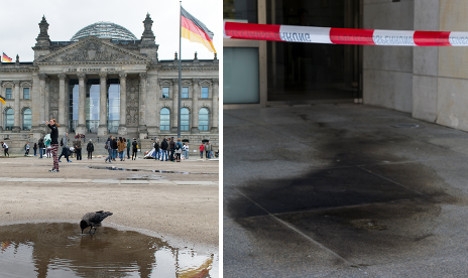
Police suspect neo-Nazis of Reichstag attack

Investigators believe a Molotov cocktail thrown at the Reichstag building in Berlin early on Monday morning was the work of a far-right group, a police spokeswoman said on Tuesday.
The link to political extremism means that the case will now be handed over to the Office for the Protection of the Constitution (BfV), Germany's domestic security agency.
A flyer from a neo-Nazi group was found at the Paul-Löbe-Allee entrance to the parliament building where a Molotov cocktail was thrown at around 2am.

Investigators are examining similarities with an attack on the Christian Democratic Union (CDU) headquarters near Berlin's Tiergarten on August 25th, the Berliner Morgenpost reported.
As in the Reichstag attack, a bottle filled with flammable liquid was thrown at the entrance but burned itself out without the fire spreading or injuring anyone.

Saturday, 27 September 2014

AN OPEN LETTER TO WHITE AMERICA

Dear White America,
As you well know, the concept of race and the issue of racism have been staples of Western Civilization from the moment that Christopher Columbus “discovered” the Caribbean. From this “discovery” we eventually saw the settling of the North American continent and the rise of a nation that was supposed to rest upon the principles of freedom, justice, equality, and liberty. Many consider these four concepts the cornerstones of this nation.
Please understand that this communication is not constructed from a position of animosity toward you and yours. However, it is an appeal to your humanity; that inner place that intuitively reveals to you what is correct and incorrect, Christians call it the Holy Spirit, Ferguson 2atheists call it a moral compass, I call it the ability to speak truth to power even when you will be punished for your position. Edmund Burke articulated it a different way when he stated, “The only thing necessary for the triumph of evil is for good men to do nothing.”
Hence, this call from an African-American male with a son, nephews, cousins, and friends who resemble many of the men who have been murdered by officers in American streets asks for you to weigh in, in a significant manner regarding the repeated killing of my brothers in American streets.
Now I am certain that you have already tired of and been completely turned off by the droves of blanket criticism that my people extend in your direction, criticism that the vast majority of you do not deserve, however, you must excuse our tendency to group all whites together as a monolithic group; from our perspective on issues of Charliracial conflict you rarely, if ever, differentiate yourselves. There are few things that can remove the in-fighting and bi-partisanship of the white community like racial matters; you appear very white bread and monolithic at those moments.
I hope that you can understand that the African-American community has been down this road of white officers murdering African-American males repeatedly, and nary a time have we heard many, if any, members of your community speak truth to power and denounce the murder of American citizens in America’s streets, regardless of the victim or victimizers race.
So in an effort to help you avoid being mistakenly identified as a supporter of the vicious killing of Black men in the streets of America by law enforcement officers, consider this a welcoming invitation for you to weigh in regarding this matter in a significant way; behave as if this string of deceased American citizens were not lync1only white, but also a close family friend. Behave now on the side of freedom, justice, equality, and liberty, as if it were your son, nephew, brother, husband, father, grandfather, that you felt compelled to pray for each time they left your presence; a prayer that asked a higher power to put a hedge of protection around them from the evils to be found in the outside world.
Make no mistake about it, your failure to speak up at this moment of crisis will cause African-Americans to group you with those who publicly support, if not encourage white officers murder of Black men, as if they are cheering for their favorite sports team. Your lynch2individual and collective silence ensures that evil will triumph; as none of the good whites did anything to either prevent evils ascension or denounced it once it ruled this nation.
Dr. James Thomas Jones III

Gay parade is scheduled in Belgrade (Serbia) for Sunday 28.09.2014

Numerous ultra groups are announcing that they will not allow this walk like parades that were supposed to happen last 2 years. All of Serbia's ultra scene is uniting against this event.It will be very hot in Belgrade because there will be clashes with police definitely. Here are some photos and videos from last years Gay parade that was aborted by ultras and hooligans!


Thursday, 25 September 2014

Muslims, Christians and Jews rally against gay marriage in Paris(video)

Hundreds of thousands of people have been demonstrating in Paris against the French government's plans to legalise marriage and adoption for same-sex couples.
Protesters travelled from all over the country for Sunday's demonstration, supported by leaders of the centre-right opposition, the Catholic church and France's Muslim community.
Police estimated the crowd at 340,000, making it one of the largest demonstrations in Paris since an education protest in 1984. Organisers said a million people were attending.
The "Demo for All", a reference to the government's billing of its legislation as "marriage for all", started at three points across Paris, filling boulevards throughout the city as demonstrators walked to the Eiffel Tower.
President Francois Hollande, who promised to legalise gay marriage and adoption during his election campaign last year, has a comfortable parliamentary majority to pass the law by June as planned.
But his poor handling of other promises, such as a 75 percent tax on the rich that was ruled unconstitutional or his faltering struggle against rising unemployment, has soured the public mood.
'Defence of children'
The demonstration, in near-freezing temperatures, included young and old protesters, many of them couples with children.
"The French are tolerant, but they are deeply attached to the family and the defence of children," said Daniel Liechti,
vice-president of the National Council of French Evangelicals, which urged its members to join the march.
Slogans on the posters and banners approved by the organisers included "marriagophile, not homophobe," "all born of
a father and mother" and "paternity, maternity, equality".
Harlem Desir, the Socialist Party's First Secretary, said the size of the demonstration would have no impact on the government's plans.
"The right to protest is guaranteed in our country but I'd remind everyone that we are fully committed to enshrine in law the principle that all those who love each other should have the right to marry and adopt," Desir said.
Gay marriage opponents such as Cardinal Andre Vingt-Trois, head of the Catholic Church in France, have asked why Hollande is pushing through a divisive social reform called "marriage for all" when voters seem more concerned about "jobs for all".
Vingt-Trois spearheaded the opposition with a critical sermon in August. Other faith leaders - Muslim, Jewish, Protestant and Orthodox Christian - soon spoke out, too.
Support for gay marriage in France has slipped by about 10 percentage points to under 55 percent since opponents began speaking out, according to surveys, and fewer than half of those polled recently wanted gays to win adoption rights.
Same-sex nuptials are already legal in 11 countries including Belgium, Portugal, Netherlands, Spain, Sweden, Norway and South Africa, as well as nine US states.

KKK paper delivered in Zeeland shocks city officials

Zeeland officials expressed shock after dozens of newspapers produced by a Ku Klux Klan group were dropped off early Monday morning, Sept. 15. Councilman Schyuler Wilson told The Sentinel he heard a loud pick-up truck rumbling down Church Street before dawn.
When he stepped onto his porch he found a copy of the newspaper.
"I looked down the street and they were on everyone's lawn, in blue bags," he said, adding he saw more on his walk to work, including bundles left on the lawns of some downtown churches.
Wilson brought the paper to Monday's council meeting. No other city officials present received the paper; all expressed shock.
City Attorney Jim Donkersloot said the paper is protected by the Constitution's First Amendment, which protects free speech. Delivering the paper is not against the law, he said. the city has an ordinance against littering, but that could create a "sticky" situation, city officials said.
"Certainly we're not endorsing it," said City Manger Tim Klunder, who noted the street names where the paper had been spotted and is keeping Wilson's copy on file. "Why they chose this area, I have no idea."
One person filed a complaint with Zeeland's police department on Tuesday according to Zeeland police.
The paper was produced by the Knights of the Ku Klux Klan, which produced the paper, said Billy Roper in a phone interview from the group's Arkansas headquarters. Roper said he is a member, but not an official spokesman, referring Sentinel inquiries to former Detroiter Thomas Robb, Knights of the Ku Klux Klan's national director. Robb was unavailable Tuesday afternoon, Sept. 16. Roper confirmed that the paper had been produced by his group. Roper, who declined to cite figures, said the The Knights Party has a "strong membership" in Michigan and surrounding states and scattered members worldwide.
"We're not always responsible for everything done under the KKK headline, but we do own kkk.com and kkk.bz," he said, adding that he assumed some fellow members of his group made the Zeeland delivery. "We're not at all upset someone is helping us deliver our message, which is in opposition of white genocide."
Klunder, who has worked for the city since 2002, said he had not heard of an KKK-related activity in Zeeland.
KKK history in Ottawa County dates back many years. A Sept. 17, 1923, story in the Grand Haven Tribune mentions a cross-burning rally on Dewey Hill, where the city's musical foundation now stands.

Jewish posters spark outrage in London

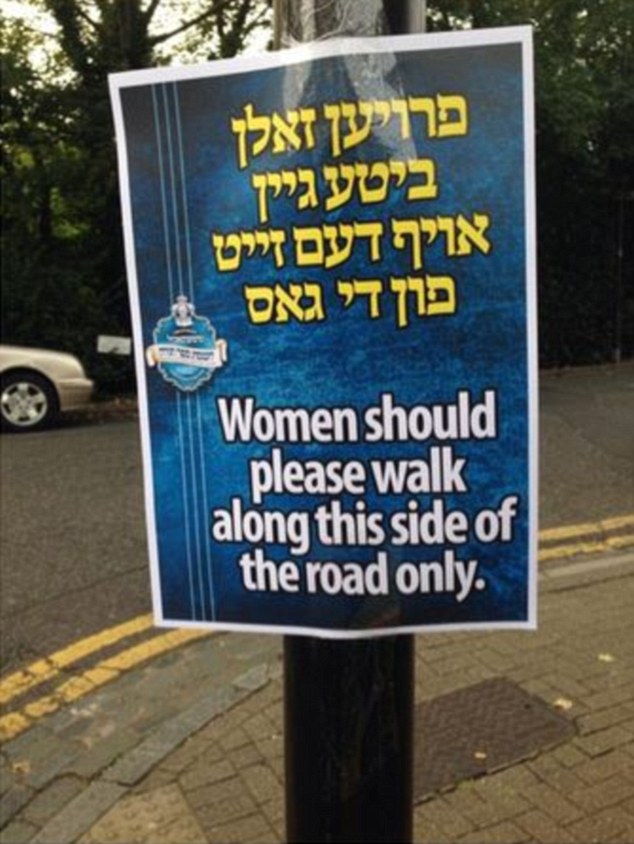
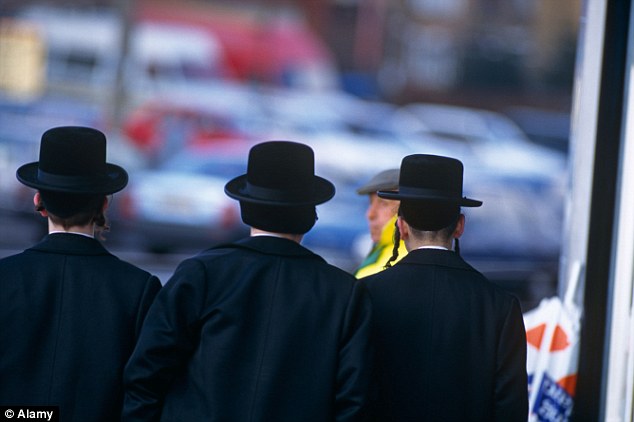
Posters instructing women to only walk on one side of the road have been taken down after a wave of public criticism. 
The notices, which were put up along streets in Stamford Hill, north London, were written in both English and Yiddish using Hebrew letters.
They read: 'Women should please walk along this side of the road only.' 
Posters instructing women to only walk on one side of the road have been taken down after residents complained to the council
The Shomrim Group, a Jewish neighbourhood patrol group which assists the police, said the posters were put up in the street by an orthodox Jewish group for the Torah Procession, which was held last week.
The group said it had since contacted the event organisers to explain that the posters could have offended those who do not understand the Yiddish wording and logo, due to a lack of explanation in English.
Men and women from the religious group who are not married or related are prohibited from touching.
Members of the Jewish neighbourhood watch group and social media users raised concerns that the posters 'lacked explanation' to the wider public.
The posters were removed after outraged residents complained to Hackney Council. 
Superintendent Andy Walker, from Hackney Borough, said: 'These signs were erected for the recent Torah parade. 
'The intention of the signs was to separate the women from the men for that section of the parade, as is customary. 
Members of the Jewish neighbourhood watch group and social media users raised concerns that the posters 'lacked explanation' to the wider public (file picture)
'We have spoken with the organisers about the potential misinterpretation of the signs. 
'They have agreed that next year they will only be written in Yiddish and will be removed more swiftly after the event.'  
A Hackney Council spokesman said: 'As soon as the signs were brought to the Council's attention they were removed.' 
Stamford Hill West councillor Rosermary Sales told the Evening Standard: 'It is of course quite unacceptable to try to restrict women's movements in a public place and council officers removed these posters as soon as it was reported to them.'
source jewishmail

Sunday, 21 September 2014

Austrian town officials resign after Nazi basement film

VIENNA (Reuters) - Two conservative town council members in eastern Austria have resigned from their posts and left the People's Party after a documentary film showed them singing and toasting one another in a basement room filled with Nazi memorabilia.
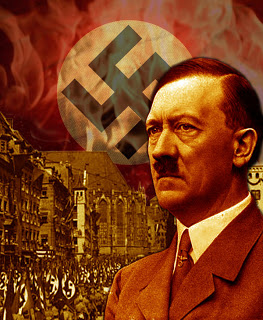
The case has prompted extensive media coverage in Austria, which is still coming to terms with its past as part of Nazi Germany after Adolf Hitler, who was born in Austria, annexed the country in 1938.
The scene from cult filmmaker Ulrich Seidl's "Im Keller" (In the Basement) shows five men in traditional dress singing a drinking song in a room featuring a portrait of Hitler, a swastika flag and mannequins wearing Nazi uniforms and helmets.
Two of the men from the People's Party - elected to the town council in Marz in the province of Burgenland after the film was made in 2009 - have now resigned from their posts.
"We distance ourselves with deepest conviction from any Nazi ideology and atrocities. To prevent further damage to the community and the party, we decided voluntarily, with immediate effect, to withdraw from our council mandate," the two said in a statement on Friday.
"It was a mistake to take part in the filming."
The men have also left the Austrian People's Party (OVP), junior coalition partner to Social Democrats in the national government, OVP's Burgenland group said in a statement.
Austria's far-right Freedom Party this week expelled the 78-year-old mayor of Gurk in Carinthia province for expressing sympathy for Nazism. "Re-engagement with National Socialism" has been a crime in Austria since 1947.
"I distance myself only from what they did, not from Nazism," Siegfried Kampl had been quoted as saying in a newspaper interview.
Austria has for decades maintained that it was Hitler's first victim and glossed over the enthusiastic welcome he got from many Austrians

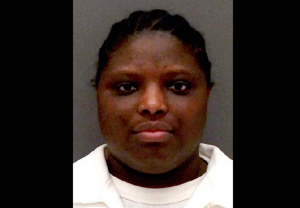
Texas executes monkey for starvation of boy, 9

A Texas woman convicted of the starvation and torture death of her girlfriend's 9-year-old son a decade ago was executed Wednesday evening.
Lisa Coleman, 38, received a lethal injection about an hour after the U.S. Supreme Court rejected a last-day appeal to spare her. She was pronounced dead at 6:24 p.m. CDT, 12 minutes after Texas Department of Criminal officials began administering a lethal dose of pentobarbital.
Coleman became the ninth convicted killer and second woman to receive lethal injection in Texas this year. Nationally, she's the 15th woman executed since the Supreme Court in 1976 allowed the death penalty to resume. During that same time, nearly 1,400 men have been put to death.
Coleman smiled and nodded to several friends and an aunt who watched through a window, thanking them and expressing her love. She also said she loved the other women on Texas' death row and urged them to "keep their heads up."
"I'm all right," she said. "Tell them I finished strong. ... God is good."
She mouthed an audible kiss, laughed and nodded to her witnesses in the seconds before the lethal drug took effect.
"Love you all," she said just before closing her eyes and taking a couple of short breaths. Then there was no further movement.
Coleman was condemned for the death of Davontae Williams, whose emaciated body was found in July 2004 at the North Texas apartment Coleman shared with his mother, Marcella Williams.
Paramedics who found him dead said they were shocked to learn his age. He weighed 36 pounds, about half that of a normal 9-year-old. A pediatrician later would testify that he had more than 250 distinct injuries, including burns from cigarettes or cigars and scars from ligatures, and that a lack of food made him stop growing.
"There was not an inch on his body that not been bruised or scarred or injured," said Dixie Bersano, one of Coleman's trial prosecutors.
Coleman's trial attorneys said the boy's death at the apartment in Arlington was an accident. They said he may have had mental health issues that made him difficult to handle and Coleman and Williams didn't know how to deal with him in a positive manner.
After a Tarrant County jury in 2006 convicted and sent Coleman to death row, Williams took a plea bargain and accepted a life prison sentence. Now 33, she's not eligible for parole until 2044.
Coleman's lawyer, John Stickels, argued unsuccessfully to the high court that while the child's hands were tied with clothesline at various times, it was "mostly a misguided means of discipline" used by both women. An aggravated factor of kidnapping, which made the charge against Coleman a capital murder case, was incorrect, making the jury's conviction on that charge also incorrect, Stickels contended.
Jefferson Clendenin, an assistant Texas attorney general, told the justices in his argument against the appeal that Coleman's arguments "had no merit."
As of Jan. 1, 60 women were on death row in the U.S., representing about 2 percent of the total death row population, according to the Death Penalty Information Center, a Washington-based anti-capital punishment organization. Coleman's execution leaves seven women on death row in Texas.

Saturday, 20 September 2014

Your guide to Munich Oktoberfest's beer ! White people only!!

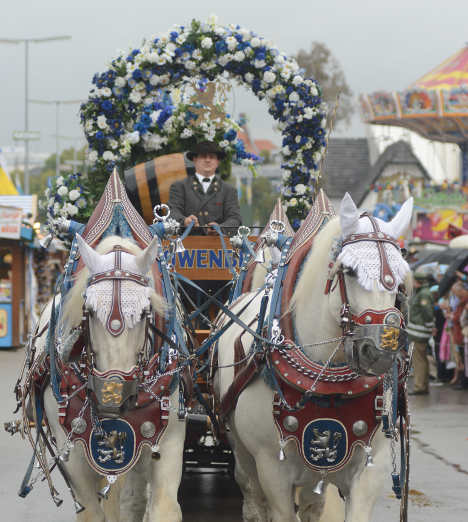
There are six Oktoberfest breweries. Six and only six. And they are all Bavarian.
If some Beck's representatives showed up one day and asked to set up a little stall at the entrance, they'd be condemned according to ancient law without trial and taken to a Munich prison, where they'd have to share a cell with a frisky wild Bavarian boar that had been captured in the forest “within the last month.”
Okay, that was all made up, but Bavaria's attitude to beer has always been ruthlessly litigious.
The famous Reinheitsgebot (purity law) was introduced in 1516, and is still heralded as the world's first consumer protection law.
It was followed by the Brauordnung of 1539, which ruled that you could only brew beer between September and April. But that clearly didn’t last as long as the purity law.
These six breweries have mischief on their minds when September comes around, for they infuse their Oktoberfest brews with more alcohol than their regular output.
On top of this, connoisseurs say that Oktoberfest beer is brewed lighter, sweeter, and less carbonated, to make it slide down all those throats with greater ease.
To ensure that after Oktoberfest the transition back to your regular beer runs smoothly, the special festive brews are made available in supermarkets and in many of Munich's regular bars and restaurants.
Four of the six breweries have their own major tent at the Oktoberfest, while the others are heavily represented everywhere else. According the aforementioned connoisseurs, there are apparently differences between them, so here they are:
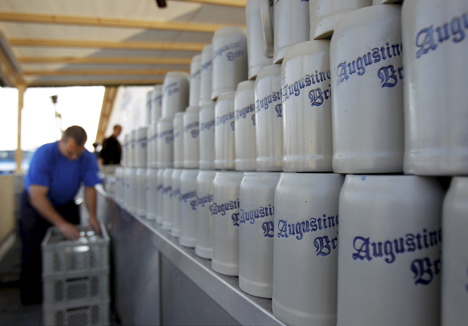
Augustiner-Bräu-Oktoberfestbier: 6 percent alcohol. Available in - Augustiner-Festhalle and Fischer-Vroni. The only Oktoberfest beer that still comes from wooden kegs. Everyone loves this one – except the people that prefer the others, of course.

Löwenbräu-Oktoberfestbier: 6.1 percent alcohol. Available in - Löwenbräu Festzelt, Schützenfestzelt. This one is bottom-fermented, light, sweet, and with a spicy aroma.

Hofbräu-Oktoberfestbier: 6.3 percent alcohol. Available in – Hofbräuzelt. According to the Hofbräu people, this one has a “slightly bitter taste” best enjoyed in combination with a big pile of grilled meat and dumplings.
Paulaner-Oktoberfestbier: 6 percent alcohol. Available in - Winzerer Fähndl, Käfers Wiesnschänke, Armbrustschützenzelt, Nymphenburg Wein- und Sektzelt. One reviewer said this brew was “malty, with good quilting, and a spicy finish.”

Spaten-Oktoberfestbier: 5.9 percent alcohol. Available in - Schottenhamel, Spatenbräu Festhalle and Ochsenbraterei. This one is meant to be “malty, light, sweet, full-bodied, and with a light hops-bitterness.”
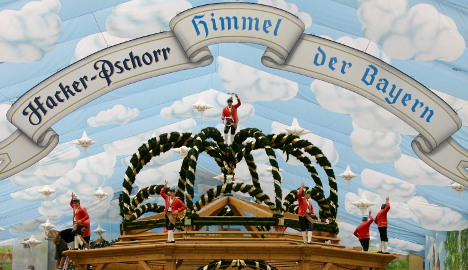
Hacker-Pschorr-Oktoberfest-Märzen: 5.8 percent alcohol. Available in - Festhalle Bräurosl, Hacker-Festzelt. Described as “golden, bottom-fermented, with a malt-aroma and a very mild bitterness.”

SEE ALSO: Your guide to Oktoberfest traditions

Muslims beat white woman in Holland (Video)

Swiss village angry over tax increase to support just 1 negro family

A village in the Swiss canton of Zurich has expressed anger over the situation of just one refugee family. To carry on supporting a mother from Eritrea and her seven children, authorities aim to increase taxes, media report.
Just over 1,000 people live in the village of Hagenbuch, which is forced to spend over 60,000 Swiss francs (around US$64,000 euro) a month on the family – 30 percent of the monthly expenses for the entire village.
The authorities are pondering a tax increase of at least 5 percent, Blick newspaper reported.
“I don’t know where to turn. I think we have no other choice but to raise taxes,” Mayor Therese Schlaepfer told the daily.
She also expressed her anger at the fact that immigrants have only rights and no obligations. According to the mayor’s words, the situation is causing the obvious outrage of the villagers as well.
A woman from Eritrea and her seven children moved to the quiet village three years ago, with a visa allowing her to stay in Switzerland for five years, and the possibility to extend it later.
The municipal government immediately took responsibility for paying her rent and also gave the family 2,600 francs a month to cover living expenses.
Other villagers are not happy with the situation. "Our citizens have to pay a lot in taxes, and the third of the local money goes just to one family. There are plenty of families in Switzerland who do not have much to live on, but they get by. This seems wrong to us. The government has to do something," a local woman said.
Another Hagenbuch resident thinks that with the amount of money paid to the family per month, "much more could be done, either in Africa or in Switzerland. They could help far more than seven people. It simply makes no sense."
It also turned out that the mother was quite overwhelmed with family commitments, so four kids were sent to an orphanage, where they’re kept at the authorities’ expense as well. The government spends 9,000 francs on each per month.
Additionally, social workers have been assisting the woman with groceries shopping, cooking and cleaning. Plus, they helped to take the children to various guided tours and to the zoo.
"We are cleaners and we don't think it's right to clean their apartment. The lady could do it herself, she has a whole day free," an elderly woman commented.
On average, the workers spend six hours a day, 25 days a month. These carers cost the budget 135 francs per hour, with weekends and evenings pushing the rate to 145 francs per hour.
“An impossible situation. I’m a resident, but still forced to cut my costs,” the mayor remarked.
It comes after a scandal a few days earlier, when the Bern police chief used the politically-incorrect term ‘Negerbubli’, referring to black immigrants. Blick reported that the officials of such rank should make no such slip of the tongue.

source rt.com

German Muslims rally against extremism

Imams at more than 2,000 mosques took part in the event organised by Germany's four main Muslim groups, with government ministers, lawmakers and city mayors joining in.
Vigils and peace rallies were held after traditional Friday noon prayers in a number of German cities including Berlin, Hamburg, Mölln, Bielefeld, Oldenburg, Frankfurt am Main and Stuttgart.
 
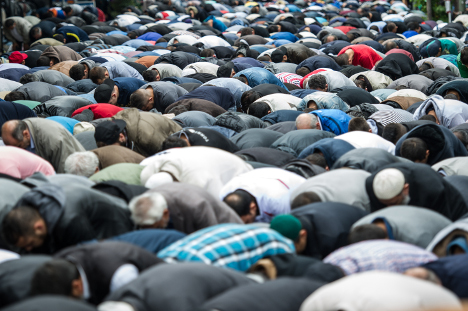
In Berlin around 1,000 Muslims took part in a public prayer on the street outside the Mevlana mosque in Kreuzberg which was damaged in an arson attack in August.
 
 
"We must stand united as a society when there are hate crimes, whether against churches, mosques, synagogues or other places of worship," said Ali Kizilkaya, spokesman of the Coordination Council of Muslims.
   
Aiman Mazyek, chairman of the Central Council of Muslims, said Germany's Muslims wanted to take a clear stand against Islamic State (IS) group fighting in Iraq and Syria, and other jihadist movements.
   
"These are terrorists and murderers who drag Islam into the dirt and bring hatred and suffering to the people, including to their own fellow Muslims, in Syria, in Iraq and elsewhere," he wrote in the top-selling Bild newspaper.
   
"We want to make clear that the majority of Muslims in this country and around the world think and act differently. Islam is a peaceful religion."
 
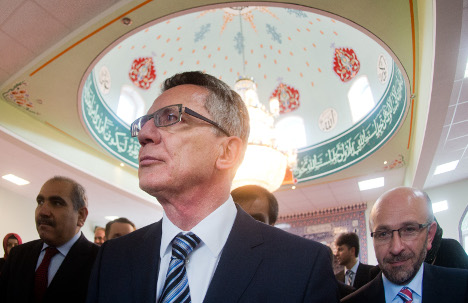
Germany's interior minister Thomas de Maizière supported the day of action by visiting a mosque in Hanover on Friday afternoon.
 
   
The day of protest follows a rally against anti-Semitism in Berlin last Sunday in which Jewish leaders and German politicians led by Chancellor Angela Merkel condemned a recent spate of slurs and attacks against Jews.
   
Tempers flared at a series of pro-Palestinian demonstrations in July, during Israel's assault on Gaza, as some protesters chanted that Jews should be "gassed" and "slaughtered".
   
Muslims say they have also been the target of hate speech and vandalism of their houses of worship amid rising public fear of Islamist militancy, and of the role of European jihadists fighting in Syria and Iraq.
   
German security services say some 400 German citizens have joined jihadists in Syria and Iraq, of whom about 130 have since come home, while German nationals have also fought with Somalia's al-Qaeda-linked al-Shabaab.
   
This month the appearance of self-styled "Sharia police" vigilantes in the western city of Wuppertal sparked outrage in Germany.
   
Mazyek said at a press conference on Tuesday that a rise in anti-Muslim sentiment means that "we have exhausting and difficult times behind and presumably also ahead of us".
   
He said there had been five arson and other attacks on mosques in the past three weeks.
 
Three charged over Isis propaganda
 
On Friday prosecutors brought charges against three Germans accused of sending money and camera equipment to help the jihadist group Islamic State make propaganda videos.
The accused were identified only as Karolina M., 25, who has been in pre-trial detention since March, as well as Jennifer Vincenza M. and Ahmed-Sadiq M., both 22, who have not been detained.
Karolina M., a German-Polish dual citizen, is married under Islamic law to an Isis militant in Syria, prosecutors said.
"For the production of Isis propaganda videos she sent him, through middle men, cameras and accessories worth €1,100 in October 2013," they said.
"Shortly after, she travelled to Syria and handed the IS member three more cameras and more than €5,000 in cash."
The prosecutors said she returned to Germany and later sent him another €6,000 in six tranches, including more than €2,000 that the other two defendants had collected.
The three are charged with supporting a foreign terrorist organisation.

Tuesday, 16 September 2014

Texas nationalists see hope in possible Scottish secession

SAN ANTONIO — Texas nationalists are awaiting Scotland's pending vote on seceding from the United Kingdom in the hopes it could happen in Texas.
Scottish voters will hit the polls Thursday to decide whether to break long-standing ties with the United Kingdom, which currently contains Scotland, England, Wales and Northern Ireland.
Secessionists in Texas have seized on Scotland's possible independence: in a post about the vote, the Texas Nationalist Movement wrote on their website, "Scotland's internal and external opponents of independence sound like the typical battered wife syndrome."
"Centralists in America fear that, if Scotland votes yes, it may set a chain of events in motion that could affect many more western regions," the movement organizers wrote. "Suddenly, the impossible seems possible."
With some new attention on Texas nationalism comes repeated arguments for independence: Yahoo columnist Rick Newman notes that — with its GDP of $1.6 trillion and population of 27 million — Texas would be the 13th largest country in the world if it obtained independence from the United States. He also wrote Texas could lure companies away from the United States and survive on the strength of its economy.
On the flip side, Newman pointed out that Texas would have to create its own defense apparatus and adapt to losing federal funds.
In addition, support for Texas nationalism is relegated to a relatively small contingent of Texas residents and is not a mainstream view, said Mark Jones, a political scientist at Rice University.
"That [popular] support is severely lacking," Jones said.

Muslim politician to run for mayor in Oslo

Sultan wants to challenge Fabian Stang of the Conservative Party to become Oslo mayor.
The nomination committee of the Green Party chose Sultan as its candidate for Oslo's top position, reported Aftenposten.
 
Sultan said: “I think it is an exciting challenge. Oslo is an exciting city with great challenges and also great opportunities.”
 
The politician believes Oslo needs a Muslim mayor and does not see his religion as a barrier to the position.
 
Sultan said: "I think that sometimes we give people in comment fields and anonymous bloggers too much attention. My experience is that most people are in a completely different place. They are interested in someone who can do something about the problems they struggle with and do not care about their ethnic or religious background.”
 
The Green Party is aiming for ten-percent support in Oslo at the municipal election next autumn. 
 
If the Greens achieve a new red-green majority together with Ap (Labour Party), SV (Socialist Left Party) and Rødt (Red Party), and assuming the Greens get m,ore votes than SV, then Sultan could be in a strong position to get the nod as mayor of Oslo.

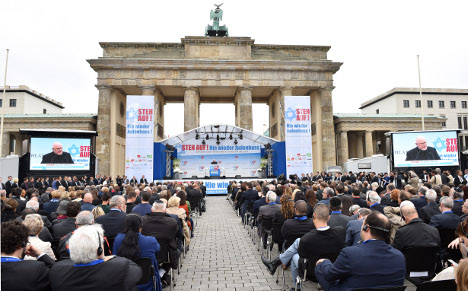
Merkel: 'Jewish life is part of German identity'

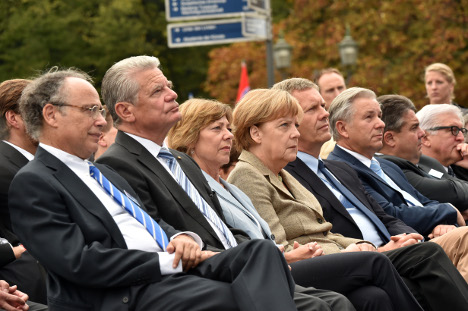
About 5,000 attended the event, held under the banner "Stand Up: Jew Hatred - Never Again!", which coincided with the first ever annual meeting of the World Jewish Congress (WJC) in the German capital.
"The fight against anti-Semitism is our state and civic duty," said Merkel in an address at Berlin's iconic Brandenburg Gate, close to the city's Holocaust Memorial.
   
"I will not accept it, and none of us here will accept it."


In July, at the height of the Israeli bombardment of Gaza, Germany's Jewish community condemned an "explosion of evil and violent hatred of Jews" at pro-Palestinian rallies where some demonstrators chanted that Jews should be "gassed", "burnt" and "slaughtered".
   
More seriously, four people were shot dead in May at the Jewish museum in Brussels, Belgium. The museum only reopened on Sunday.
   
The spate of ugly incidents that deeply unsettled Germany's resurgent 200,000-strong Jewish community also saw a petrol bomb hurled at the facade of a synagogue in the western city of Wuppertal.
   
The attacks came 75 years after the outbreak of World War II, during which Nazi Germany murdered six million Jews, a crime that remains a source of enduring shame in the country.
   
Merkel said the fact that today Jews are living again in Germany "is almost a miracle".
   
"Jewish life belongs here and is part of our identity.... There must be no room for discrimination and marginalization," she said.


Merkel - who has won Israel's highest civilian honour for her efforts against anti-Semitism and Holocaust denial - said that "Germany is aware of its eternal responsibility for the break of civilization called the Shoah".
   
"Those who hurl abuse at people who wear a kippah or a Star of David on a chain, attack them or assault them, also hit out at and injure all of us," she said.
   
"Those who deface gravestones in a Jewish cemetery also deface our culture. Those who make synagogues targets of hatred and violence also shake the foundations of our free society."
   
Germany, which was home to some half a million Jews before WWII, saw that number plummet to only around 15,000 after the war. The Jewish community has grown again, in part as Germany took in Jews from the former Soviet Union, and now numbers around 200,000.

'Medieval stain of anti-Semitism'
 
WJC president Ronald S. Lauder praised post-war Germany for being "one of the most responsible countries on earth" and "Israel's ally and friend," but added that "something has changed".
   
"This summer, all of the progress of the last 70 years has been darkened by a rising tide of anti-Semitism," he said. "There are some places I might expect to see this - but not here in Germany."
   
He cited several reasons for the recent resurgence of the "medieval stain of anti-Semitism".
   
"When the economy declines, people become fearful and often they look for a scapegoat. Throughout history, that scapegoat has been the Jews," he said.


He also pointed at "some of the vilest anti-Jewish propaganda coming out of the Middle East" and spreading across the Internet.
   
He warned that history has shown that "a group that instills fear and hatred may start small but can grow into a large and dangerous tidal wave".
   
The head of the Central Council of Jews in Germany, Dieter Graumann, said recent months saw "horrible shock waves of hatred against Jews, across Europe".
   
"Synagogues were attacked, Jewish people have been threatened," he told the rally, attended by many German political and religious leaders.
   
"In social networks tons of buckets of hatred, of malice and agitation were poured over us."
   
Graumann demanded that "Muslim organisations here must do a lot more than in the past to consistently combat the catastrophic hatred of Jews in their ranks".
   
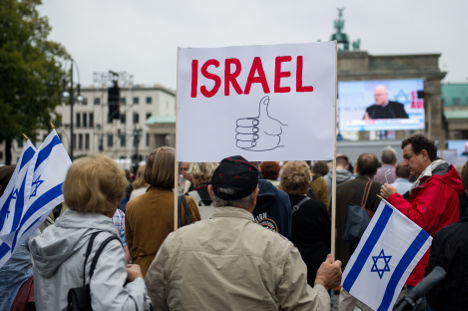
Many Israeli flags and placards were raised at the rally, one of which read "Against Violence and Hatred - Security for Jews".
   
Eduart Schechter, 69 and originally from the former Soviet Union, said: "We moved to Germany with great hopes and dreams. But the reality is different to what we imagined. Now we are scared."
   
Alexander Schramm, a 29-year-old PR professional, said: "I think it's regrettable that it took so long to organize this rally. I am here to show that we'll stay alert."
 
thelocal.de

Sunday, 14 September 2014

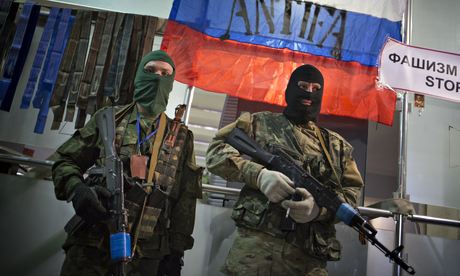
The forgotten connection between Pro-Russian separatists and ANTIFA

Luhansk
Masked pro-Russia gunmen at the seized building in Luhansk. Photograph: Alexander Zemlianichenko/AP

Sitting on a sofa in the seized security office in Luhansk, Sergei Gerachov admits his men have a large number of weapons. "We raided the armoury when we took this building over," he explains cheerfully. "Ordinary guys get Kalashnikovs. If you're a commander like me you get a pistol. We've plenty of grenades too."
In fact Gerachov, 48, a Soviet war veteran who spent three years fighting the mujahideen in Afghanistan, has two pistols strapped to his waist. Dressed in khaki fatigues, he wears a gold brooch decorated with the two-headed eagle of the Russian Federation.
Gerachov is one of a group of pro-Russian separatists who took over the building in the eastern city of Luhansk. It used to belong to Ukraine's SBU security service. The officers guarding it fled. That was more than two weeks ago. Since then Gerachov and his comrades have turned the building in the centre of Luhansk into a fortress. There are sandbags and razor-wire, and two young guards block the entrance with riot shields. One shield has the slogan "No to the US and EU".
The separatists have raised the Russian flag and managed to gouge out half of the blue and yellow Ukrainian trident adorning the upper storey. The gunmen have given themselves a name: the People's Army of the East.
In the green park opposite, meanwhile, a sprawling tent city has sprung up, inhabited by civilian volunteers. There is a shop selling icons and a red booth where you can watch Rossiya 24, the pro-Kremlin Russian TV channel. One sign says in English: "No to fashism" [sic]. A sound system pumps out patriotic songs. It looks and feels like an anti-western mini-Woodstock.
On Monday pro-Russian supporters from across the region met inside the separatists' HQ. The delegates picked a new "people's governor" of Luhansk – Valeriy Bolotsky, a former policeman from a nearby mining town. He was too busy on Tuesday to give interviews. According to Gerachov he spent the weekend in Moscow talking to officials before returning to Ukraine on Sunday night to take up his new role as the city's secessionist boss.
Russia has vehemently denied involvement in the seemingly co-ordinated takeover of government buildings across the east of Ukraine this month. So what exactly was Bolotsky doing in Moscow? "He was probably taking instructions," Gerachov says. "Not from the spy agencies but at a political level," he suggested.
How long was the people's governor in Russia? "About 24 hours," he says. One of Gerachov's aides came in with a commando knife, and asks: "Someone walked in with this. Can we allow it?"
The decision to choose Bolotsky was taken behind closed doors. (One at the meeting reportedly said those there enjoyed support from two important people: Putin and Jesus.) The delegates agreed to stage two referendums to decide the region's future status. The first, on 11 May, will ask voters to decide whether Luhansk should keep its current status or become an autonomous entity. The second, on 18 May, will ask whether Luhansk should be independent or join the Russian Federation, like Crimea.
It's hard to say how these referendums will be meaningful democratic exercises. Roughly 1,500 people turned up to Monday's rally – in a city of 450,000. Luhansk's regional and city administrations continue to function as normal.
The separatists control only a single building in the oblast (region). In neighbouring Donetsk, by contrast, pro-Russian militias have grabbed at least a dozen offices. On Tuesday rebels in the town of Slavyansk took another journalist hostage, this time an American, Simon Ostrovsky.
The administration has held talks with the militia aimed at ending the occupation peacefully. So far it has had no success. In the meantime Luhansk's energetic police chief, Timur Yuldashev, has formed his own "Timur" battalion to fight against separatism. Yuldashev told the local paper that those with pro- and anti-Kiev views in fact wanted the same thing: to live in a successful state free of corruption, and Russia had artificially inflated the separatist problem.
Certainly, Luhansk's would-be rulers are a disorderly bunch. On Monday a rival pro-Russia group, the Young Guard, tried to seize the occupied security agency building from the People's Army of the East. "About 300 guys turned up. They tore down our flag. We pushed them away from the barricades," says Gerachov, adding that his men were better armed. "They may have had a couple of hunting rifles. We have automatic weapons."
They have made their hardline views known via a bizarre hip-hop tune posted on YouTube. The song's rhyming lyrics call for a union of Ukraine, Russia and Belarus. It makes fun of European gay pride parades. The singer is dressed in full paratrooper kit, including helmet. Also visible are a rocket-propelled grenade launcher, two grenades and a Russian flag.
The referendums scheduled for next month may shed light on the Kremlin's plans. The rhetoric from Moscow over the past few days has been ominous. It has accused Kiev's pro-western government of violating the agreement signed in Geneva last week under which illegal groups were supposed to disarm. Russia's foreign minister, Sergei Lavrov, said Moscow may be forced to act – and that was before the call by the Ukrainian president on Tuesday to relaunch military operations against pro-Russia militants.
Western officials suggest the following scenario: Russia's acknowledges the 18 May referendum as legitimate. It then recognises the "people's assemblies" in Donetsk and Luhansk as the sovereign ruling government in eastern Ukraine. It refuses to recognise presidential elections due to be held across Ukraine on 25 May. Moscow's goal, the officials say, is for the region to become a feeble political entity under de facto Russian control.
Undoubtedly, some in Luhansk genuinely welcome the prospect of Russia becoming the region's new landlord. "The government in Kiev is illegitimate. They are fascists paid by America," says Larissa Brik, 63, standing in the park opposite the SBU building. Her friend Tamara adds: "Putin is a great leader. He's clever. He's tenacious. We want to live with Russia."
A group of students pose for photographs next to the razor wire. Katya Alexeyavna, 22, says she has been training to be a history teacher. "My grandfather fought in the Red Army. I hate to see the way history is being rewritten. I can't accept the view from western Ukraine that Soviet troops were occupiers." What does she want? 'I'd like to live in a federalised country. I'm not against living in Russia."
Her friend Marina Konstantina, a junior doctor, says Ukraine's 23 years as an independent country have been ignominious, characterised by misgovernment and thieving. But would a Luhansk "people's government" be any different? "The stealing would carry on but on a smaller scale," she replies. The area's core problem, she says, is long-term economic decline – low wages, especially for state employees, and a Soviet legacy of unprofitable heavy industry and mines.
"Things can't get any worse," she says. "That's why we want change."

theguardian.com

German LGBT activist severely beaten in Belgrade

A German man who participated at a conference on LGBT rights was in intensive care Saturday after he was severely beaten by unknown attackers in Belgrade, a doctor said.
Dusan Jovanovic from Belgrade's Emergency centre said the man, identified only by the initials D.H. by police, was admitted with "life-threatening" injuries.
"He was received with severe head injuries and bleeding, so he has undergone surgery and put in intensive care as his condition is very serious," Jovanovic told AFP.
The 26-year-old woke up later Saturday and communicated, but his condition "remains critical for next 24 hours," Health Minister Zlatibor Loncar told reporters after visiting the man.
Police said they had arrested all three perpetrators of the attack, which happened in downtown Belgrade, but gave no further details.
Earlier, Serbia's Interior Minister Nebojsa Stefanovic said he had ordered an urgent probe into the incident and vowed to find those responsible.
"We will not allow this kind of thing to remain unpunished... and we will arrest the German citizen's attackers," Stefanovic said in a statement.
The NGO Labris, which organised the conference on LGBT (lesbian, gay, bisexual and transsexual) rights, held a protest march along central Belgrade streets.
The incident occurred two weeks ahead of a scheduled gay pride parade, the first since more than 150 people were wounded in clashes between security forces and ultra-nationalists in 2010.
Authorities in deeply patriarchal Serbia have banned gay pride marches ever since, citing security reasons.

Saturday, 13 September 2014

German newspaper targeted by neo-Nazis

The Organisation for Security and Cooperation in Europe said on Friday that neo-Nazi vandalism and threats against a local newspaper in eastern Germany were "unacceptable and must be stopped".

This week vandals sprayed the words "Jews" and the Nazi slogan "Sieg Heil" on the office windows of the Lausitzer Rundschau, a newspaper known for its coverage of far-right groups.
The week before four swastikas were daubed on other offices of the paper as well as "Jews, kill them" and "We'll get you all". There were similar incidents against the daily in 2012.
"These threats and acts of vandalism must be stopped and I am confident that the authorities will take the necessary precautions to ensure journalists' safety," the OSCE's media representative Dunja Mijatovic said.
"I welcome the condemnation of these attacks from the highest level of the German authorities in Brandenburg state and trust that these incidents will be swiftly and thoroughly investigated," she said in a statement.
The chief editor of the newspaper, Johannes Fischer, told the Berliner Zeitung that it would fight back with words which were "the most powerful weapons against spray cans and baseball bats".
Chancellor Angela Merkel will speak at a rally at the iconic Brandenburg Gate in Berlin against anti-Semitism on Sunday coinciding with a World Jewish Congress (WJC) meeting in the German capital.

Thursday, 11 September 2014

Southern Hate Groups Are Forming Racist, Armed Militias

The League of the South (LOS), a neo-Confederate group, has assembled a uniformed, armed militia whose mission is to attempt a “second southern secession,” reported The Southern Poverty Law Center.
Named “The Indomitables,” the militia contains members of many fringe, pro-Southern and racists groups: white supremacists, former Klansmen, and neo-Nazis. The idea for “The Indomitables” came about early this year at the LOS national meeting.
Many people called and left messages with the LOS, asking how the militia was to be used and why. LOS leader Michael Hill responded:
Even if we are – and you really have no idea on earth if we are or not – setting up a Southern militia or some other form of paramilitary organization, we are doing nothing that free men have not done for centuries. Deal with it and stop your whining.
According to the Southern Poverty Law Center, years of increasingly violent speech made by the LOS have culminated into the formation of this armed militia.
“The primary targets will not be enemy soldiers; instead, they will be political leaders, members of the hostile media, cultural icons, bureaucrats, and other of the managerial elite without whom the engines of tyranny don’t run,” wrote Hill in an essay posted on the LOS website last month.
Some members of the militia include former special ops military who possess knowledge in demolitions and military combat tactics. Michael Tubbs is a former green beret who, with the aid of another soldier, stole two M-16 rifles from fellow servicemen. They shouted “This is for the KKK” while escaping the scene, and were later caught and charged with stealing government property, said the SPLC. Hill gave Tubbs a leadership role in the new militia.
Although these kinds of groups tend to stay on the fringe and are mocked more than they are feared, the intensity and extreme nature of this newfound armed militia is alarming. However, it’s more likely to be a bunch of extreme right-wing nutjobs looking for attention.

Mark Potok on James Woods: Crimes against White people can't be hate crimes

MEMPHIS - To some who watched a grainy cellphone video of Saturday’s brutal mob attack outside an East Memphis grocery store, the math is simple: Black assailants plus white victim equals hate crime.
As further proof, these critics point to the inelegant remark made by a black woman who watched and videotaped the crowd of black teens pouring across a Kroger parking lot.
As several teens kicked a white Kroger worker who curled into a fetal position to protect himself, the woman can be heard on the video laughing and saying, “They got a white dude.”
But the insistence that the federal government investigate the attack as a hate crime — as actor James Woods demanded on Twitter this week — illustrates a fundamental misunderstanding of what a hate crime is, say legal observers.
Woods used the woman’s words as the social media equivalent of a gavel in his demand for an investigation by the U.S. Attorney General.
“Mr Holder,” @realjameswoods tweeted Wednesday to his 158,000-plus followers, “stand above politics and address the cancer of ALL racism in America. Go to Memphis. #holderchallenge #TheyGotaWhiteDude.”
The 11 alleged assailants arrested to date are black. Two other Kroger employees intervened — one white and one black — and were both slightly injured for their efforts.
But no amount of retweets or clamor — some of which came in the form of profanity-laced, slur-laden emailed threats to Memphis police director Toney Armstrong — can make the facts match the elements required to prosecute this as a racially motivated attack.\
“The current civil rights intimidation statute of the state of Tennessee does not cover the facts as we know them right now that happened on the Kroger parking lot,” Shelby County Dist. Atty. Gen. Amy Weirich said this week.
Mark Potok, senior fellow at the Southern Poverty Law Center, which tracks hate crimes, said Woods’ logic was often employed by white nationalists who “call for crimes like this to be charged as hate crimes when there is no evidence to support this.”
“Many people feel that any kind of interracial violent crime is a hate crime and that’s not true,” Potok said.
“These are people who feel that whites are somehow under attack by black people and that the government is not on white people’s side.”To prove that the assailants wanted to beat up a white person requires evidence of intent, said Steve Mulroy, a law professor at the University of Memphis who teaches both criminal and civil rights law.
That proof could come in many forms, he said, starting with an admission by the defendant that the victim was targeted because of his or her race.
A prosecutor might also look for a pattern of similar crimes or comments made to others that indicated a bias toward a particular protected class.
And while the words of the woman who took the video, with at least 500,000 views on YouTube, may be jarring to the ears, Potok said, “she’s an observer who’s simply commenting on what she sees.”
Said Mulroy: “There’s no evidence to suggest that the woman who was taking the video was in any way allied with the attacker.”
“If the woman said, ‘Aha, they got themselves a redhead!’ would we say this is an anti-ginger hate crime?”
According to the Tennessee Bureau of Investigation, black people made up 47 percent and white people 37 percent of the 348 victims of reported hate crimes in Tennessee last year. White perpetrators accounted for a slightly larger share of hate crime offenders than black ones, at 46 percent to 45 percent.
In 2013, anti-black bias was linked to nine cases of aggravated assault reported by Memphis Police; four cases of simple assault and one case of intimidation reported by Millington Police; and six cases of simple assault and one case of aggravated assault reported by the Shelby County Sheriff’s Office.
That same year anti-white bias was tied to one case of simple assault and another of intimidation reported by Memphis Police.
What the federal government labels hate crimes, state law calls civil rights intimidation.
Weirich and Armstrong acknowledged the feedback they’ve gotten from people who, like Woods, are insistent that the case has the elements of a hate crime.
“I have read the administration’s release saying there is no justification to view this racist beating as a hate crime,” wrote a critic in an email to Armstrong. “My planned visit is now canceled. I will not support a racist city or its bigoted, racist administration. Shame on you.”
This is a direct challenge to Eric Holder: Are you, Sir, going to Memphis, TN to address the Kroger racial hate crime?

video and source here

95-Year-Old Woman Has Been Keeping Her Link to Hitler a Secret for More Than 50 Years


Margot Woelk
They were feasts of sublime asparagus – laced with fear. And for more than half a century, Margot Woelk kept her secret hidden from the world, even from her husband. Then, a few months after her 95th birthday, she revealed the truth about her wartime role: Adolf Hitler’s food taster.
Woelk, then in her mid-twenties, spent two and a half years as one of 15 young women who sampled Hitler’s food to make sure it wasn’t poisoned before it was served to the Nazi leader in his “Wolf’s Lair,” the heavily guarded command center in what is now Poland, where he spent much of his time in the final years of World War II.
“He was a vegetarian. He never ate any meat during the entire time I was there,” Woelk said of the Nazi leader. “And Hitler was so paranoid that the British would poison him – that’s why he had 15 girls taste the food before he ate it himself.”
With many Germans contending with food shortages and a bland diet as the war dragged on, sampling Hitler’s food had its advantages.
“The food was delicious, only the best vegetables, asparagus, bell peppers, everything you can imagine. And always with a side of rice or pasta,” she recalled. “But this constant fear – we knew of all those poisoning rumors and could never enjoy the food. Every day we feared it was going to be our last meal.”
The petite widow’s story is a tale of the horror, pain and dislocation endured by people of all sides who survived World War II.
Only now in the sunset of her life has she been willing to relate her experiences, which she had buried because of shame and the fear of prosecution for having worked with the Nazis, although she insists she was never a party member. She told her story as she flipped through a photo album with pictures of her as a young woman, in the same Berlin apartment where she was born in 1917.
Margot Woelk
One of the food testers of Adolf Hitler, Margot Woelk poses in her apartment after an interview with The Associated Press in Berlin, Thursday, April 25, 2013. Margot Woelk was one of 15 young women who sampled Hitler’s food to make sure it wasn t poisoned before it was served to the Nazi leader in his “Wolf’s Lair,” the heavily guarded command center in what is now Poland, where he spent much of his time in the final years of World War II. Margot Woelk kept her secret hidden from the world, even from her husband then, a few months after her 95th birthday, she revealed the truth about her wartime role. Credit: AP
Germany Hitler's Food Tester
Margot Woelk, one of the food testers of Adolf Hitler, shows an old photo album and points to a picture taken prior to the WWII and showing the way to the later built Fuehrer Headquarters “Wolf’s Lair”, during an interview with The Associated Press in Berlin, Thursday, April 25, 2013. Credit: AP
Woelk first revealed her secret to a local Berlin reporter a few months ago. Since then interest in her life story has been overwhelming. School teachers wrote and asked her for photos and autographs to bring history alive for their students. Several researchers from a museum visited to ask for details about her life as Hitler’s taster.
Woelk says her association with Hitler began after she fled Berlin to escape Allied air attacks. With her husband gone and serving in the German army, she moved in with relatives about 435 miles (700 kilometers) to the east in Rastenburg, then part of Germany; now it is Ketrzyn, in what became Poland after the war.
There she was drafted into civilian service and assigned for the next two and a half years as a food taster and kitchen bookkeeper at the Wolf’s Lair complex, located a few miles (kilometers) outside the town. Hitler was secretive, even in the relative safety of his headquarters, that she never saw him in person – only his German shepherd Blondie and his SS guards, who chatted with the women.
Hitler’s security fears were not unfounded. On July 20, 1944, a trusted colonel detonated a bomb in the Wolf’s Lair in an attempt to kill Hitler. He survived, but nearly 5,000 people were executed following the assassination attempt, including the bomber.
“We were sitting on wooden benches when we heard and felt an incredible big bang,” she said of the 1944 bombing. “We fell off the benches, and I heard someone shouting ‘Hitler is dead!’ But he wasn’t. ”
Following the blast, tension rose around the headquarters. Woelk said the Nazis ordered her to leave her relatives’ home and move into an abandoned school closer to the compound.
With the Soviet army on the offensive and the war going badly for Germany, one of her SS friends advised her to leave the Wolf’s Lair.
She said she returned by train to Berlin and went into hiding.
Woelk said the other women on the food tasting team decided to remain in Rastenburg since their families were all there and it was their home.
“Later, I found out that the Russians shot all of the 14 other girls,” she said. It was after Soviet troops overran the headquarters in January 1945.
Germany Hitler's Food Tester
FILE – This undated file picture shows the German Fuehrer Adolf Hitler and his mistress Eva Braun while dining. Credit: AP
When she returned to Berlin, she found a city facing complete destruction. Round-the-clock bombing by U.S. and British planes was grinding the city center to rubble.
On April 20, 1945, Soviet artillery began shelling the outskirts of Berlin and ground forces pushed through toward the heart of the capital against strong resistance by die-hard SS and Hitler Youth fighters.
After about two weeks of heavy fighting, the city surrendered on May 2 – after Hitler, who had abandoned the Wolf’s Lair about five months before, had committed suicide. His successor surrendered a week later, ending the war in Europe.
For many Berlin civilians – their homes destroyed, family members missing or dead and food almost gone – the horror did not end with capitulation.
“The Russians then came to Berlin and got me, too,” Woelk said. “They took me to a doctor’s apartment and raped me for 14 consecutive days. That’s why I could never have children. They destroyed everything.”
Like millions of Germans and other Europeans, Woelk began rebuilding her life and trying to forget as best she could her bitter memories and the shame of her association with a criminal regime that had destroyed much of Europe.
Germany Hitler's Food Tester
Margot Woelk, one of the food testers of Adolf Hitler, shows an old photo album with a picture of herself taken around 1939 or 1940, during an interview with The Associated Press in Berlin, Thursday, April 25, 2013. Credit: AP
She worked in a variety of jobs, mostly as a secretary or administrative assistant. Her husband returned from the war but died 23 years ago, she said.
With the frailty of advanced age and the lack of an elevator in her building, she has not left her apartment for the past eight years. Nurses visit several times a day, and a niece stops by frequently, she said.
Now at the end of her life, she feels the need to purge the memories by talking about her story.
“For decades, I tried to shake off those memories,” she said. “But they always came back to haunt me at night.”
Source:

Monday, 8 September 2014

jewUSA: Video: Negro gang brutally beats white couple

Atlanta Hawks Owner I Pulled a Donald Sterling Outs Himself for Super Racist Email

Atlanta Hawks owner Bruce Levenson abruptly announced he's selling the team because he's guilty of sending an email so racist ... it would make Donald Sterling cringe.

Levenson admits he sent the email to team execs back in 2012, urging them to get more suburban white fans at games. He then laid out all the problems with the current fan base, listing the following:

- it's 70 pct black
- the cheerleaders are black
- the music is hip hop
- at the bars it's 90 pct black
- there are few fathers and sons at the games
- the concerts [after games] are either hip hop or gospel

Levenson continued in the email ... "My theory is that the black crowd scared away the whites and there are simply not enough affluent black fans to build a significant  season ticket base." He also complained that he's told team execs, "I want some white cheerleaders ... I have even bitched that the kiss cam is too black."

NBA Commissioner Adam Silver says Levenson copped to the email in July -- about 2 months after Donald Sterling was banned -- and immediately informed the league he would sell the team.

Levenson apologized to fans in a statement, saying ... "If you're angry about what I wrote, you should be. I'm angry at myself too."

Whites should leave Zimbabwe says President Mugabe


Speaking in the area of Zvimba, President of Zimbabwe, Robert Mugabe said that White people should “all go back to England“, vowing to Zimbabweans that Whites will never return to the farm land they were evicted off of.


“The West prefers a weak leader who, they hope, would allow the whites to come back,” he said according to AllAfrica.com.


“Don’t they [Westerners/White people] know where their ancestors came from? The British who are here should all go back to England.”


“What is the problem? We now have aeroplanes which can take them back quicker than the ships used by their ancestors.”


Hang on a minute, what happened to this “we all come from Africa” theory? Where are the anti-Whites now?


Back in July this year Mugabe caused a uproar after he declared that White people would no longer be allowed to own land in Zimbabwe, and the few White people left must now be removed.


“We will have no mercy for white people regarding the land, they cannot own our soil.” Mugabe said back in July, according to thezimmail.co.zw.


“They can own properties and factories according to our laws but not a piece of land.”


“We want it indicated in our laws that Zimbabwe has truly come back to its owners and the whites will never come back”


Strangely, this was under-reported by the anti-White mainstream media. If a White leader said this about Black people in Europe, the mainstream media would scream “Hitler!”, and “Nazi!”.


This is because the anti-White mainstream media operates under this thinking: Africa for the Africans, Asia for the Asians, but White countries for everyone.


Basically, White countries are the only countries on the planet that have been singled out and chosen to be “diverse melting pots of humanity”.


Back in the real world, if you “single out” a group for mass immigration of foreigners and force the group to assimilate – there’s one word for that and one word alone: genocide. In this case it’s White genocide.


When it comes to anti-Whites, this “diversity” they’re pushing is just a code for White genocide.


- Whites should leave Zimbabwe says President Mugabe. | White GeNOcide Project

Oswald Spengler and the Faustian Soul of the West (part 1)

If I had to choose one word to identify the uniqueness of the West it would be “Faustian”. This is the word Oswald Spengler used to designate the "soul" of the West. He believed that Western civilization was driven by an unusually dynamic and expansive psyche. The “prime-symbol” of this Faustian soul was “pure and limitless space.” This soul had a "tendency towards the infinite," a tendency most acutely expressed in modern mathematics. The “infinite continuum,” the exponential logarithm and “its dissociation from all connexion with magnitude” and transference to a “transcendent relational world” were some of the words Spengler used to describe Western mathematics. But he also wrote of the “bodiless music” of the Western composer, “in which harmony and polyphony bring him to images of utter ‘beyondness’ that transcend all possibilities of visual definition”, and, before the modern era, of the Gothic “form-feeling” of “pure, imperceptible, unlimited space” (Decline of the West, Vol.1, Form and Actuality [Alfred Knopf, 1923] 1988: 53-90).

This soul type was first visible, according to Spengler, in medieval Europe, starting with Romanesque art, but particularly in the “spaciousness of Gothic cathedrals,” “the heroes of the Grail and Arthurian and Siegfried sagas, ever roaming in the infinite, and the Crusades,” including “the Hohenstaufen in Sicily, the Hansa in the Baltic, the Teutonic Knights in the Slavonic East, [and later] the Spaniards in America, [and] the Portuguese in the East Indies Spengler thus viewed the West as a strikingly vibrant culture driven by a type of personality overflowing with expansive impulses, “intellectual will to power.” “Fighting,” “progressing,” “overcoming of resistances,” battling “against what is near, tangible and easy” – these were some of the terms Spengler used to describe this soul (Decline of the West: 183-216).

A variety of words have been used to described or identify the peculiar history of the West: "individualist," "rationalist," "imperialist," "secularist", "restless," and "racist." Spengler's term "Faustian," it seems to me, best captures the persistent, and far greater, originality of the West since ancient times in all the intellectual, artistic, and heroic spheres of life. But many today don't read Spengler; there are no indications, in fact, that the foremost experts on the so-called "rise of the West" have even read any of his works.

The current ac
ademic consensus has reduced the uniqueness of the West to when this civilization "first" became industrial. This consensus believes that the West "diverged" from other agrarian civilizations only when it developed steam engines capable of using inorganic sources of energy. Prior to the industrial revolution, we are made to believe, there were "surprising similarities" between Europe and Asia. Both multiculturalist and Eurocentric historians tend to frame the "the rise of the West" or the "great divergence" in these economic/technological terms. David Landes, Kenneth Pomeranz, Bin Wong, Joel Mokyr, Jack Goldstone, E.L. Jones, and Peer Vries all single out the Industrial Revolution of 1750/1830 as the transformation which signaled a whole new pattern of evolution for the West (or England in the first instance). It matters little how far back in time these academics trace this Revolution, or how much weight they assign to preceding developments such as the Scientific Revolution or the slave trade, their emphasis is on the “divergence” generated by the arrival of mechanized industry and self-sustained increases in productivity sometime after 1750.

But I believe that the Industrial Revolution, including developments leading to this Revolution, barely capture what was unique about Western culture. I am obviously aware that other cultures were unique in having their own customs, languages, beliefs and historical experiences. My claim is that the West was uniquely exceptional in exhibiting in a continuous way the greatest degree of creativity, novelties, and expansionary dynamic. I trace the uniqueness of the West back to the aristocratic warlike culture of Indo-European speakers as early as the fourth millennium. The aristocratic libertarian culture of Indo-European speakers was already unique and quite innovative in initiating the most mobile way of life in prehistoric times starting with the domestication and riding of horses and the invention of chariot warfare. So were the ancient Greeks in their discovery of logos and its link with the order of the world, dialectical reason, the invention of prose, tragedy, citizen politics, and face-to-face infantry battle. 

The Roman creation of a secular system of republican governance anchored on autonomous principles of judicial reasoning was in and of itself unique. The incessant wars and conquests of the Roman legions, together with their many war-making novelties and engineering skills, were one of the most vital illustrations of spatial expansionism in history. The fusion of Christianity and the Greco-Roman intellectual and administrative heritage, coupled with the cultivation of the first rational theology in history, Catholicism, were a unique phenomenon. The medieval invention of universities -- in which a secular education could flourish and even articles of faith were open to criticism and rational analysis in an effort to arrive at the truth -- was exceptional. The list of epoch making transformation in Europe is endless, the Renaissance, the Age of Discovery, the Scientific Revolution(s), the Military Revolution(s), the Cartographic Revolution, the Spanish Golden Age, the Printing Revolution, the Enlightenment, the Romantic Era, the German Philosophical Revolutions from Kant to Hegel to Nietzsche to Heidegger.
Limitations in Charles Murray’s Measurement of the Accomplishments of Western civilization

Some may wonder how can one make a comparative judgement about the accomplishments of civilizations without some objective criteria or standard of measurement. There is a book by Charles Murray published in 2003, Human Accomplishment, Pursuit of Excellence in the Arts and Sciences, 800 BC to 1950, which systematically arranges “data that meet scientific standards of reliability and validity” for the purpose of evaluating the story of human accomplishments across cultures. It is the first effort to quantify “as facts” the accomplishments of individuals and countries across the world in the arts and sciences by calculating the amount of space allocated to these individuals in reference works, encyclopedias, and dictionaries. Charles Murray informs us that ninety-seven percent of accomplishment in the sciences occurred in Europe and North America from 800 BC to 1950. It also informs us that, in the Arts, Europe alone produced a far higher number of “significant figures” than the rest of the world combined. In music, “the lack of a tradition of named composers in non-Western civilization means that the Western total of 522 significant figures has no real competition at all” (p. 252-259).

Murray avoids a Eurocentric bias by creating separate compilations for each of “the giants” in the arts of the Arab world, China, India, and Japan, as well as of the “giants” of Europe. In this respect, Murray recognizes that one cannot apply one uniform standard of excellence for the diverse artistic traditions of the world. But he produces combined (worldwide) inventories of “the giants” for each of the natural sciences. Combined lists for the natural sciences are possible since world scientists themselves have come to accept the same methods and categories. The most striking feature of his list of “the giants” in the sciences (the top 20 in Astronomy, Physics, Biology, Medicine, Chemistry, Earth Sciences, and Mathematics) is that they are all (excepting one Japanese) Western (p. 84, 122-29).

What explanation does Murray offer for this remarkable “divergence” in human accomplishments? He argues that human accomplishment is determined by the degree to which cultures promote or discourage individual autonomy and purpose. Accomplishments have been “more common and more extensive in cultures where doing new things and acting autonomously [were] encouraged than in cultures [where they were] disapprove[d].” Human beings have also been “most magnificently productive and reached their highest cultural peaks in the times and places where humans have thought most deeply about their place in the universe and been most convinced they have one." (p. 394-99). The West was different in affording individuals greater autonomy and purpose.

One major limitation in Murray is that he attributes to Christianity this sense of purpose and place in the universe, unable to account for the incredible accomplishment of the pagan Greeks and Romans. It is also the case that Murray’s Human Accomplishment is a statistical assessment, an inventory of names, not an attempt to capture the historically dynamic character of Western individualism. His book leaves out all the dramatic transformations historians have identified with the West: Why did the voyages of global discovery “take” in early modern Europe and not in China? Why did Newtonian mechanics elude other civilizations? Actually, no current historical work addresses all these transformations together. Countless books have been published on one or two major European transformations, but no scholar has tried to explain, or pose as a general question, the persistent creativity of Europeans from ancient to modern times across all the fields of human endeavor. The norm has been for specialists in one period or transformation to write about (or insist upon) the “radical” or “revolutionary” significance of the period or theme they happen to be experts on.

Missing is an understanding of the unparalleled degree to which the entire history of the West was filled with individuals persistently seeking "to transcend every optical limitation" (Decline of the West: 198). In comparative contrast to the history of India, China, Japan, Egypt, and the Americas, where artistic styles, political institutions and philosophical outlooks lasted for centuries, stands the "dynamic fertility of the Faustian with its ceaseless creation of new types and domains of form" (Decline of the West: 205).  I can think of only three individuals, two philosophers of history and one historical sociologist, who have written in a wide-ranging way of: i) the “infinite drive,” “the irresistible trust” of the Occident, ii) the “energetic, imperativistic, and dynamic” soul of the West, and iii) the “rational restlessness” of the West – Hegel, Spengler, and Weber.

Spengler is the one who overcomes in a keener way another flaw in Murray: his account of European distinctiveness is limited to the intellectual and artistic spheres. He pays no attention to accomplishments in warfare, exploration, and heroic leadership. His definition of accomplishment includes only peaceful individuals carrying scientific experiments and creating artistic works. Achievements come only in the form of “great books” and “great ideas”. In this respect, Human Accomplishments is akin to certain older-style Western Civ textbooks where the production of "Great Works" by "Great Men" in conditions of "Liberty" were the central themes. David Gress dubbed this type of historiography the “Grand Narrative” (1998). By teaching Western history in terms of the realization of great ideas and works in the arts and sciences these texts “placed a burden of justification on the West" to explain how the reality of Western colonialism across the world, the higher degree of warfare among Europeans, the invention of far more destructive military weapons, the slave trade, and the unprecedented destruction of the civilizations of the Americas, should  be left out of the account of Western accomplishments. Gress called upon historians to move away from an idealized image of Western uniqueness. Norman Davies, too, has criticized the way early Western civilization courses tended to “filter out anything that might appear mundane or repulsive” (A History of Europe, 1997: 28).

The Faustian Personality

I believe that Oswald Spengler's identification of the West as "Faustian" provides us with the best word to overcome the current naïve separation between a cultured/peaceable West and an uncivilized/antagonistic West with his image of a strikingly vibrant culture driven by a type of Faustian personality overflowing with expansive, disruptive, and imaginative impulses manifested in all the spheres of life. For Spengler, the Faustian spirit was not restricted to the arts and sciences, but was present in the culture of the West at large. Spengler thus spoke of the “morphological relationship that inwardly binds together the expression-forms of all branches of Culture.” Rococo art, differential calculus, the Crusades, the Spanish conquest of the Americas were all expressions of the same restless soul. There is no incongruity between the “great ideas” of the West and the so-called “realities” of conquest and suffering. There is no need, from this standpoint, to concede to multicultural critics, as Norman Davies believes, “the sorry catalogue of wars, conflict, and persecutions that have dogged every stage of the [Western] tale” (p. 15-16). The expansionist dispositions of Europeans were not only indispensable but were themselves driven, as I argue in my book, The Uniqueness of Western Civilization, and will briefly outline below, by an intensely felt desire to achieve great deeds and heroic immortality.

The great men of Europe were artists driven by an intensively felt desire for unmatched deeds. The “great ideas” – Archimedes’ “Give me a place to stand and with a lever I will move the whole world,” or Hume’s “love of literary fame, my ruling passion” – were associated with aristocratic traits, defiant dispositions – no less than Cortez’s immense ambition for honour and glory, “to die worthily than to live dishonoured.”

In contrast to Weber, for whom the West “exhibited an unrivaled aptitude for rationalization,” Spengler saw in this Faustian soul a primeval-irrational will to power. It was not a calmed, disinterested, rationalistic ethos that was at the heart of Western particularity; it was a highly energetic, goal-oriented desire to break through the unknown, supersede the norm, and achieve mastery. The West was governed by an intense urge to transcend the limits of existence, by a highly energetic, restless, fateful being, an "adamantine will to overcome and break all resistances of the visible" (Decline: p. 185-86).

There was something Faustian about all the great men of Europe, both in reality and in fiction: in Hamlet, Richard III, Gauss, Newton, Nicolas Cusanus, Don Quixote, Goethe’s Werther, Gregory VII, Michelangelo, Paracelsus, Dante, Descartes, Don Juan, Bach, Wagner’s Parsifal, Haydn, Leibniz’s Monads, Giordano Bruno, Frederick the Great, Rembrandt, Ibsen’s Hedda Gabler. 
  • The Faustian soul – whose being consists in the overcoming of presence, whose feeling is loneliness and whose yearning is infinity – puts its need of solitude, distance, and abstraction into all its actualities, into its public life, its spiritual and its artistic form-worlds alike. (Decline: 386).
For Spengler, Christianity, too, became a thoroughly Faustian moral ethic. “It was not Christianity that transformed Faustian man, but Faustian man who transformed Christianity -- and he not only made it a new religion but also gave it a new moral direction”: will-to-power in ethics (344). This “Faustian-Christian morale” produced
  • Christians of the great style --- Innocent III, Loyola and Savonarola, Pascal and St. Theresa […] the great Saxon, Franconia and Hohenstaufen emperors…giant-men like Henry the Lion and Gregory VII…the men of the Renaissance, of the struggle of the two Roses, of the Huguenot Wars, the Spanish Conquistadores, the Prussian electors and kings, Napoleon, Bismarck, Rhodes (348-49).
But what exactly is a Faustian soul? How do we connect it in a concrete way to Europe’s creativity? To what original source or starting place did Spengler attribute this yearning for infinity? To start answering this question we should first remind ourselves of Spengler's other central idea, his cyclical view of history, according to which i) each culture contains a unique spirit of its own, and ii) all cultures undergo an organic process of birth, growth, and decay. In other words, for Spengler, all cultures exhibit a period of dynamic, youthful creativity; each culture experiences “its childhood, youth, manhood, and old age.” “Each culture has its own new possibilities of self-expression, which arise, ripen, decay and never return” (18-24, 106-07). Spengler thus drew a distinction between the earlier vital stages of a culture (Kultur) and the later stages when the life forces were on their last legs until all that remained was a superficial Zivilisation populated by individuals preoccupied with preserving the memories of past glories while drudging through the unexciting affairs of their everyday lives.

However, notwithstanding this emphasis on the youthful energies of all cultures, Spengler viewed the West as the most strikingly dynamic culture driven by a soul overflowing with expansive energies and “intellectual will to power.” By "youthful" he meant the actualization of the specific soul of each culture,"the full sum of its possibilities in the shape of peoples, languages, dogmas, arts, states, sciences." Only in Europe he saw  "directional energy," march music, painters relishing in the use of blue and green, "transcendent, spiritual, non-sensuous colors," "colours of the heavens, the seas, the fruitful plain, the shadow of the Southern noon, the evening, the remote mountains" (245-46). I think John Farrenkopf has it right when he argues that Spengler’s appreciation for non-Western cultures as worthy subjects of comparative inquiry came together with an “exaltation” of the greater creative energy of the West (2001: 35).

But what about Spengler's repetitive insistence that ancient Greece and Rome were not Faustian? Although I agree with Spengler that in certain respects the Greek-Roman “soul” was oriented toward the present rather than the future, and that its architecture, geometry and finite mathematics were bounded spatially, restrained, and perceptible, he overstates his argument about the lack of an expansionist spirit, downplaying the incredible creative energies of Greeks and Romans, their individual heroism and urge for the unknown. Farrenkopf thinks that the later Spengler came to view the Greeks and Romans as more individualistic and dynamic. I agree with Burckhardt that the Classical Greeks were singularly agonal and individualistic, and with Nietzsche's insight that all that was civilized and rational among the Greeks would have been impossible without this agonal culture. The ancient Greeks who established colonies throughout the Mediterranean, the Macedonians who marched to “the ends of the world,” and the Romans who created the greatest empire in history, were similarly driven, to use Spengler’s term, by an “irrepressible urge to distance” as the Germanic peoples who brought Rome down, the Vikings who crossed the Atlantic, the Crusaders who wrecked havoc on the Near East, and the Portuguese who pushed themselves with their gunned ships upon the previously tranquil world of the Indian Ocean. Spengler does not persuade in his efforts to downplay this Faustian side of the Greeks and Romans.

What was the ultimate original ground of the West’s Faustian soul? There are statements in Spengler which make references to “a Nordic world stretching from England to Japan” and a “h
arder-struggling” people, and a more individualistic and heroic spirit “in the old, genuine parts of the Mahabharata… in Homer, Pindar, and Aeschylus, in the Germanic epic poetry and in Shakespeare, in many songs of the Chinese Shuking, and in circles of the Japanese samurai” (as cited in Farrenkopf: 227). Spengler makes reference to the common location of these peoples in the “Nordic” steppes. He does not make any specific reference to the Caucasian steppes but he clearly has in mind the “Aryan Indian” peoples who came out of the steppes and conquered India and wrote the Mahabharata. He calls “half Nordic” the Graeco-Roman, Aryan Indian, and Chinese high cultures. In Man and Technics, he writes of how the Nordic climate forged a man filled with vitality
  • through the hardness of the conditions of life, the cold, the constant adversity, into a tough race, with an intellect sharpened to the most extreme degree, with the cold fervor of an irrepressible passion for struggling, daring, driving forward.
Principally, he mentions the barbarian peoples of northern Europe, whose world he contrasts to “the languid world-feeling of the South” (Farrenkopf: 222). Spengler does not deny the environment, but rather than focusing on economic resources and their “critical” role in the industrialization process, he draws attention to the profound impact environments had in the formation of distinctive psychological orientations amongst the cultures of the world. He thinks that the Faustian form of spirituality came out of the “harder struggling” climes of the North. The Nordic character was less passive, less languorous, more energetic, individualistic, and more preoccupied with status and heroic deeds than the characters of other climes. He was a human biological being to be sure, but one animated with the spirit of a “proud beast of prey,” like that of an “eagle, lion, [or] tiger.” Much like Hegel’s master who engages in a fight to the death for pure prestige, for this “Nordic” individual “the concerns of life, the deed, became more important than mere physical existence” (Man and Technics: A Contribution to a Philosophy of Life, Greenwood Press, 1976: 19-41).

This deed-oriented man is not satisfied with a Darwinian struggle for existence or a Marxist struggle for economic equality. He wants to climb high, soar upward and reach ever higher levels of existential intensity. He is not preoccupied with mere adaptation, reproduction, and conservation. He wants to storm into the heavens and shape the world. But who exactly is this character? Is he the Hegelian master who fights to the death for the sake of prestige? Spengler paraphrases Nietzsche when he writes that the primordial forces of Western culture reflect the “primary emotions of an energetic human existence, the cruelty, the joy in excitement, danger, the violent act, victory, crime, the thrill of a conqueror and destroyer.” Nietzsche too wrote of the “aristocratic” warrior who longed for the “proud, exalted states of the soul,” as experienced intimately through “combat, adventure, the chase, the dance, war games” (The Genealogy of Morals, 1956: 167). Who are these characters? Are their “primary emotions” any different from humans in other cultures?

Share

Twitter Delicious Facebook Digg Stumbleupon Favorites More