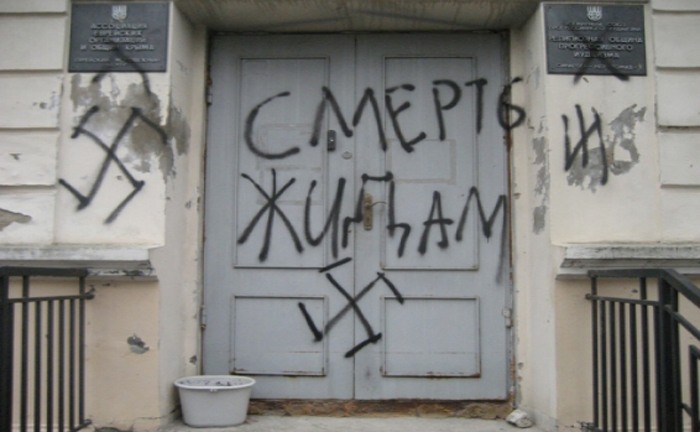
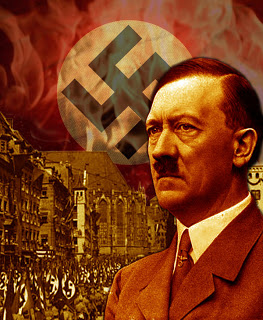
German people!
National Socialists!
After long months when I was forced to keep silent, despite heavy concerns, the time has come when I can finally speak openly.
When the German Reich received England’s declaration of war on 3
September 1939, the British attempted once again to frustrate any
attempt to begin a consolidation, and thus a strengthening, of Europe by
fighting the then strongest power on the Continent.
England formerly destroyed Spain through many wars.
For the same reason it waged its wars against Holland.
With the help of all of Europe it later fought France.
And around the turn of the century, it began to encircle the German Reich and it began the World War in 1914.
Germany was defeated in 1918 only because of its inner disunity. The
results were terrible. After first hypocritically declaring to be
fighting only against the Kaiser and his regime, they began the
systematic destruction of the German Reich after the German army had
laid down its arms. As the prophecy of a French statesman, who had said
that there were twenty million Germans too many, began to be fulfilled
through starvation, disease, or emigration, the National Socialist
movement began building the unity of the German people, thereby
preparing the rebirth of the Reich.
This new revival of our people from poverty, misery, and shameful
contempt was a sign of a pure internal rebirth. England was not
affected, much less threatened, by this. Nonetheless, it immediately
renewed its hateful policy of encirclement against Germany. Both at home
and abroad, we faced the plot we all know about between Jews and
democrats, Bolshevists and reactionaries, all with the same goal: to
prevent the establishment of a new people’s state, to plunge the Reich
again into impotence and misery.
The hatred of this international world conspiracy was directed not only
against us, but also against those peoples who also had been neglected
by Fortune, who could earn their daily bread only through the hardest
struggle. Italy and Japan above all, alongside Germany, were almost
forbidden to enjoy their share of the wealth of the world. The alliance
between these nations was, therefore, only an act of self-defense
against a threatening, egotistical world coalition of wealth and power.
As early as 1936, according to the testimony of the American General
Wood to a committee of the American House of Representatives, Churchill
had said that Germany was becoming too strong again, and that it
therefore had to be destroyed.
In summer 1939, England thought that the time had come to renew its
attempts to destroy Germany by a policy of encirclement. Their method
was to begin a campaign of lies. They declared that Germany threatened
other peoples. They then provided an English guarantee of support and
assistance, next, as in the World War, let them march against Germany.
Thus between May and August 1939, England succeeded in spreading the
claim throughout the world that Germany directly threatened Lithuania,
Estonia, Latvia, Finland, Bessarabia, and even the Ukraine. Some of
these nations allowed themselves to be misled, accepting the promises of
support that were offered, and thereby joined the new attempt to
encircle Germany.
Under these circumstances, I believed that I was called by my
conscience, and by the history of the German people, to assure not only
these nations and their governments that these British accusations were
untrue, but also to reassure the strongest power in the East through
formal declarations that our interests did not conflict.
National Socialists!
You probably all felt that this was a bitter and difficult step for me.
The German people have never had hostile feelings toward the peoples of
Russia. During the last two decades, however, the Jewish-Bolshevist
rulers in Moscow have attempted to set not only Germany, but all of
Europe, aflame. Germany has never attempted to spread its National
Socialist worldview to Russia. Rather, the Jewish-Bolshevist rulers in
Moscow have constantly attempted to subject us and the other European
peoples to their rule. They have attempted this not only intellectually,
but above all through military means.
The results of their efforts, in every nation, were only chaos, misery, and starvation.
I, on the other hand, have tried for two decades to build a new
socialist order in Germany, with a minimum of interference and without
harming our productive capacity. This has not only eliminated
unemployment, but also the profits of labor have flowed increasingly to
working people.
The results of our policies are unique in all the world. Our economic
and social reorganization has led to the systematic elimination of
social and class barriers, with the goal of a true people’s community.
It was, therefore, difficult for me in August 1939 to send my minister
to Moscow to attempt to work against Britain’s plans to encircle
Germany. I did it only because of my sense of responsibility to the
German people, above all in the hope of reaching a lasting understanding
and perhaps avoiding the sacrifice that would otherwise be demanded of
us.
With the exception of Lithuania, Germany declared that those areas and
nations were outside Germany’s political interests. There was a special
provision in the case that England succeeded in inciting Poland into war
against Germany. But here, too, German claims were moderate, and in no
relation to the accomplishments of German arms.
National Socialists!
The results of the treaty, which I sought in the interests of the German
people, were particularly severe for Germans living in the affected
nations.
Over half a million German people’s comrades — all of them small
farmers, craftsmen, and workers — were forced, almost overnight, to
leave their former homes to escape a new government that threatened them
with vast misery, and sooner or later, with complete extermination
(Ausrottung).
Even so, thousands of Germans disappeared! It was impossible to learn
what had happened to them, or even where they were. More than 160 of
them were men holding German citizenship.
I kept silent about all this, because I had to keep silent! My wish was
for final agreement with this state, and if possible a lasting
settlement.
But even during our march into Poland, in violation of the treaty, the Soviet rulers suddenly claimed Lithuania.
The German Reich never intended to occupy Lithuania, and never made any
such demand on Lithuania. To the contrary, it turned down the request by
the Lithuanian government to send German troops there, since that did
not correspond to the goals of German policy.
Nonetheless, I accepted this new Russian demand. But that was only the beginning of ever new demands.
The victory on Poland, gained exclusively by German troops, gave me the
occasion to extend a new offer of peace to the Western powers. It was
rejected by the international and Jewish warmongers.
The reason was that England still hoped to mobilize a European coalition
against Germany that would include the Balkans and Soviet Russia.
Those in London decided to send Ambassador Cripps to Moscow. He has
clear orders to improve relations between England and Soviet Russia, and
to develop them along lines England wanted. The English press reported
on the progress of his mission, as long as they were not silent for
tactical reasons.
The first results were evident in fall 1939 and spring 1940. Russia
justified its attempts to subject not only Finland, but also the Baltic
states, by the sudden false and absurd claim that it was protecting them
from a foreign threat, or that it was acting to prevent that threat.
Only Germany could have been meant. No other power could enter the
Baltic Sea, or wage war there. I still had to remain silent. The rulers
of the Kremlin continued.
Consistent with the so-called friendship treaty, Germany removed its
troops far from its eastern border in spring 1940. Russian forces were
already moving in, and in numbers that could only be seen as a clear
threat to Germany.
According to a statement by Molotov, there were already 22 Russian divisions in the Baltic states in spring 1940.
Although the Russian government always claimed that the troops were
there at the request of the people who lived there, their purpose could
only be seen as a demonstration aimed at Germany.
As our soldiers attacked French-British forces in the west, the extent
of the Russian advance on our eastern front grew ever more threatening.
In August 1940, I concluded that, given the increasing number of
powerful Bolshevist divisions, it was no longer in the interests of the
Reich to leave the eastern provinces, so often devastated by war,
unprotected.
This, however, is exactly what the British and Soviets had hoped. The
fact that so much of the German forces, in particular the air force, was
tied down in the east made it impossible for the German leadership to
bring a radical end to the war in the West.
This was the goal of both British and Soviet Russian policy. Both
England and Soviet Russia wanted to prolong this war as long as possible
in order to weaken all of Europe and plunge it into ever greater
impotence.
Russia’s threatened attack on Rumania was intended not only to take over
an important element in the economic life not only of Germany, but of
Europe as whole, or at least to destroy it.
With boundless patience, the German Reich attempted after 1933 to win
over the southeastern European states as trading partners. We,
therefore, had the greatest possible interest in their domestic
stability and order. Russia’s entrance into Rumania and Greece’s ties to
England threatened to rapidly transform this area into a general
battleground.
Despite our principles and customs, and despite the fact that the
Rumanian government had brought on these troubles itself, I urgently
advised them, for the sake of peace, to bow to Soviet extortion and cede
Bessarabia.
The Rumanian government, however, believed that it could justify this
step to its own people only if Germany and Italy in return guaranteed
the security of its remaining territory. I did this with a heavy heart.
When the German government gives a guarantee, it will stand by it. We
are neither English nor Jewish.
I thus believed that I had saved peace at the last moment, even if at
the cost of a heavy obligation. To reach a final resolution of these
problems and to clarify Russian intentions toward the Reich, as well as
under the pressure of steadily increasing mobilization along our eastern
border, I invited Mr. Molotov to come to Berlin.
The Soviet foreign minister demanded further clarification from Germany on the following four questions:
Molotov’s first question:
Does Germany’s guarantee for Rumania in the event of an attack mean war with Russia in the event of an attack Soviet Russia?
My answer:
The German guarantee is broad and obligates us absolutely. Russia has
never told us that it has any interest in Rumania outside Bessarabia.
The occupation of northern Bukowina was already a violation of this
assurance. I therefore do not believe that Russia could have any further
claims on Rumania.
Molotov’s second question:
Russia feels itself threatened by Finland again. Russia is unwilling to
tolerate this. Is Germany ready to provide no support for Finland, and
above all to withdraw the German troops in Kirkenes?
My answer:
As in the past, Germany has no political interests in Finland. However,
the German government cannot accept a new Russian war against the tiny
Finnish people, particularly since we could never believe that Finland
threatens Russia. However, we do not want war in the Baltic Sea.
Molotov’s third question:
Is Germany willing for Soviet Russia to provide a guarantee to Bulgaria,
and to send Soviet-Russian troops to Bulgaria for this purpose —
although he (Molotov) wished to say that they did not have the intention
of removing the king.
My answer:
Bulgaria is a sovereign state, and I did not know that, just as Rumania
had asked for a German guarantee, Bulgaria has asked for one from Soviet
Russia. I would also have to discuss the matter with my allies.
Molotov’s fourth question:
Soviet Russia absolutely requires free passage through the Dardanelle,
and also demands, for its protection, several important positions on the
Dardanelle or along the Bosporus. Is Germany willing to agree to this
or not?
My answer:
Germany is ready at any time to agree to changes in the Statute of
Montreux that benefit the Black Sea states. Germany is not willing to
approve Russian bases on the straights.
National Socialists!
I behaved as the responsible leader of the German Reich, but also as a
responsible representative of European culture and civilization.
The result was an increase in Soviet Russian activity against the Reich,
above all the immediate beginning of efforts to subvert the new
Rumanian state and an attempt to use propaganda to eliminate the
Bulgarian government.
With the help of confused and immature people, the Rumanian Legion
succeeded in organizing a coup that removed General Antonescu and
plunged the nation into chaos. By removing legal authority, they also
removed the grounds for Germany to act on its guarantee.
Still, I believed it best to remain silent.
Immediately after this enterprise collapsed, there was a new increase in
Russian troops along the German eastern border. Increasing numbers of
tank and parachute divisions threatened the German border. The German
army, and the German homeland, know that until a few weeks ago, there
was not a single German tank or motorized division on our eastern
border.
If anyone needed final proof of the carefully hidden coalition between
England and Soviet Russia, the conflict in Yugoslavia provided it. While
I was making a last attempt to keep peace in the Balkans, and in
agreement with the Duce invited Yugoslavia to join the Three Power Pact,
England and Soviet Russia organized a coup that toppled the government
that was ready for such an agreement.
The German people can now be told that the Serbian coup against Germany
was under both the English and Soviet Russian flags. Since we were
silent, the Soviet Russian government went a step further. Not only did
they organize a Putsch, but signed a treaty of friendship with their new
lackeys a few days later that was intended to strengthen Serbia’s
resistance to peace in the Balkans, and turn it against Germany. It was
no platonic effort, either.
Moscow demanded that the Serbian army mobilize.
Since I still believed that it was better not to speak, the rulers of the Kremlin took a further step.
The German government now possesses documents that prove that, to bring
Serbia into the battle, Russia promised to provide it with weapons,
airplanes, ammunition, and other war material through Salonika.
That happened at almost the same moment that I was giving the Japanese
Foreign Minister Dr. Matsuoka the advice to maintain good relations with
Russia, in the hope of maintaining peace.
Only the rapid breakthrough of our incomparable divisions into Skopje
and the capture of Salonika prevented the realization of this Soviet
Russian-Anglo-Saxon plot. Serbian air force officers, however, fled to
Russia and were immediately welcomed as allies.
Only the victory of the Axis powers in the Balkans frustrated the plan
of involving Germany in battle in the southeast for months, allowing the
Soviet Russian armies to complete their march and increase their
readiness for action. Together with England, and with the hoped for
American supplies, they would have been ready to strangle and defeat the
German Reich and Italy.
Thus Moscow not only broke our treaty of friendship, but betrayed it!
They did all this while the powers in the Kremlin, to the very last
minute, hypocritically attempted to favor peace and friendship, just as
they had with Finland or Rumania.
I was forced by circumstances to keep silent in the past. Now the moment
has come when further silence would be not only a sin, but a crime
against the German people, against all Europe.
Today, about 160 Russian divisions stand at our border. There have been
steady border violations for weeks, and not only on our border, but in
the far north, and also in Rumania. Russian pilots make a habit of
ignoring the border, perhaps to show us that they already feel as if
they are in control.
During the night of 17-18 June, Russian patrols again crossed the German border and could only be repelled after a long battle.
Now the hour has come when it is necessary to respond to his plot by
Jewish-Anglo-Saxon warmongers and the Jewish rulers of Moscow’s
Bolshevist headquarters.
German people!
At this moment, an attack unprecedented in the history of the world in
its extent and size has begun. With Finnish comrades, the victors of
Narvik stand by the Arctic Sea. German divisions, under the command of
the conqueror of Norway, together with the heroes of Finland’s freedom
and their marshal, defend Finnish soil. On the Eastern Front, German
formations extend from East Prussia to the Carpathians. From the banks
of the Pruth River, from the lower Danube to the Black Sea, German and
Romanian soldiers are united under state leader Antonescu.
The purpose of this front is no longer the protection of the individual
nations, but rather the safety of Europe, and therefore the salvation of
everyone.
I have therefore decided today once again to put the fate of Germany and
the future of the German Reich and our people in the hands of our
soldiers.
May God help us in this battle






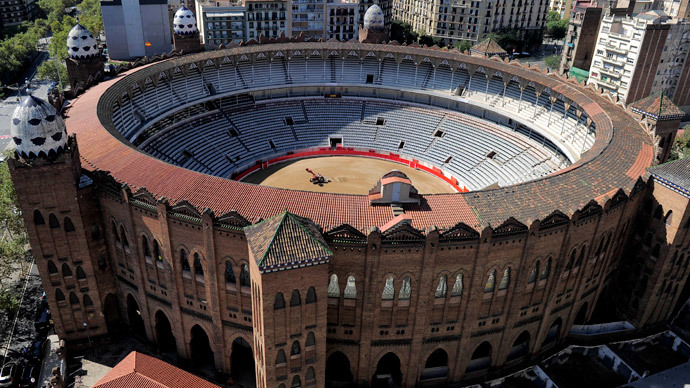 The building would
include a 300m high minaret which may become the third largest in
the world after those in Mecca and Medina, reports 20 Minutos, Spain's most-read general
newspaper, citing its sources close to the project. The mosque
for Barcelona’s Muslims will also have a conference hall, a Koran
study center, housing up to 300 people, and a museum of Islamic
art and history.


 Money or the box?: asylum seekers are being offered up to $10,000 to leave detention centres on Nauru and Manus Island. Photo: James Davies





 HEINRICH HOFFMANN / HO / EPA