Since the Holocaust, Purim and the Book of Esther cannot be taken only in the light-hearted spirit of the merriest of holidays.
Words presaging the scourges of (literally) a few thousand years of
antisemitism and the idea of murder of all members of a minority are
right there in the good book: “There is a certain people scattered
abroad and dispersed among the peoples in all the provinces of thy
kingdom; and their laws are diverse those of every people […] If it
please the king, let it be written that they be destroyed […]’ (Esther
3: 8-9). There is an added description covering the concept of genocide
of the targeted minority: “to annihilate all Jews, both young and old,
little children and women, in one day” (3: 13).
Here in Lithuania, as in the other countries on ground zero of the
Holocaust, where just tiny remnant Jewish communities remain in a few
cities, and hundreds upon hundreds of towns and villages are wholly
without a single Jewish inhabitant, it is remarkable that the Holocaust
itself has become the focus of a posh new brand of antisemitism.
You would think after all, wouldn’t you, that antisemites would avoid
the topic of the Holocaust at all costs. It’s the empirical evidence of
what their hatred wrought. But there is, alas, a new cunning genus of
antisemitism that is flourishing in Eastern Europe, and being exported
to the West in all sorts of ways, and not attracting much protest. The
reasons for the silence are many, including frankly the geostrategic
alliances by America, Israel, and other Western nations with those
countries in Eastern Europe that have joined up with NATO and the
European Union. In the case of Jewish leaders and dignitaries from
various Western countries, there has been an Achashverosh-like practice
of marching out honor-hungry organizational directors and professors for
endless medals, awards, grants, junkets, conferences and other favors.
In return for being paraded with horse-and-apparel through the streets
of a latter-day Shushan, some Jewish leaders will turn a blind eye to
the new state-sponsored effort to write the Holocaust out of history
(without denying a single death) while getting the world to ignore the
resurgence of neo-Nazism. The connection between the two: the
glorification of the Holocaust’s local perpetrators and collaborators in
these parts of Eastern Europe, particularly in the three Baltic states —
Lithuania, Latvia, and Estonia.
Instead of denying the Holocaust (quite impossible in countries with
hundreds of mass graves outside nearly every town, containing the
remains of the erstwhile Jewish population), the “wise men and women” of
governments, universities, media, the arts and other high culture
sectors have come up with a new theory of twentieth century history. It
is called “double genocide” and runs something like this: Stalin and his
Jewish cronies committed the first genocide against the peoples of
Eastern Europe, and then came the opposite and equal reaction, Hitler’s
genocide with the help of the East European peoples that had suffered at
the hands of “Stalin and the Jews.” Dressed up in more sophisticated
language, this double genocide nonsense is gaining ground despite the
simplest evidence on the ground: These countries had their entire Jewish
minorities murdered, but their majority populations, for all the abuses
of communism and Soviet misrule (which of course had cronies and
lackeys of every people in the region), had actually grown, and been
ready for EU and NATO within a few short years after the fall of the
Soviet Union. No genocide there.
Sometimes it is the corollary that becomes the main point, outshining
the theorem it derives from. In the case of the three Baltic countries
and some others (for example western Ukraine), there is a burning wish
among nationalists and “patriots” to turn the local Nazi collaborators
who did much or most of the actual killing for the Nazis (here in
Lithuania starting in dozens of locations before the Germans even
arrived) into “national heroes” (on the grounds that these killers of
Jewish civilian neighbors were also “anti-Soviet”).
Let us never forget the Righteous Gentiles, tsadíkey umoys ho-óylom
in countries like Lithuania, Latvia and Estonia, where saving a Jew
required inspirationally exceptional courage: the rescuers were
perceived as betraying not some occupying army but their own pro-Nazi
nationalist leaders of the time.
But you will look in vain for streets and squares named for the
rescuers of Jews in Lithuania. By contrast, there are many named for
Holocaust perpetrators and collaborators. In other words, the new
antisemitism entails perversion of history and honoring of the killers,
often covering it all up with lavish “Jewish” events for the benefit of
Jewish visitors from the West and Israel and the international
diplomatic community.
One of the results of all this is that today’s neo-Nazis here are not
all skinhead types. Far from it. They include professors,
parliamentarians, mainstream journalists and others who are finding that
they can glorify the murderers of their country’s Jewish population
while finding favor with honor and travel hungry foreigners.
Which brings us, finally, to Purim.
***
Each year in the season of Purim, twenty-first century Lithuania now
has not one but two neo-Nazi marches: the first on the 16th of February
in Kovno (now Kaunas), to mark the declaration of the state’s
independence of 1918 which launched the interwar republic; and the
second, on March 11th in Vilna (now Vilnius), to mark the declaration of
independence from the Soviet Union in 1990 (which became fully real the
following year with the fall of the USSR).
Like citizens of every background, those who are Jewish rejoice
together with their countrymen. February 16th marks the start of a
period of remarkable Jewish rights and autonomy in the early years of
the interwar republic. March 11th marks the end of the Soviet era of
religious and cultural repression, restricted migration, lack of basic
freedoms and its replacement by a democratic state that is now part of
NATO and the European Union and a close ally of the US and Israel.
All the more lamentable that the authorities have “given” the
neo-Nazis the city centers of their two major cities, one for each of
the two independence days. What a miserable, pathetic way to express
pride in the nation.
One of the major reasons the state allows neo-Nazis to dominate both
independence days has to do with the current battle of ideas over
history. On the issue of considering Hitler’s local collaborators to be
heroes, the ideas of the neo-Nazis are tragically congruous with the
powerful nationalist establishment among the region’s elites, including
those who go out of their way to show every kindness to visiting Jews
from around the world.
And so it was last week in Kovno (Kaunas), renowned for its Jewish life of many centuries’ standing.
The lead banner of the parade had the image not of one of the great
poets or artists of Lithuania, nor of one of the fabled medieval grand
dukes who gave the country a deserved reputation of tolerance for
centuries. That reputation included the famous charter of rights for the
Jews of Grodno in 1389, issued by Grand Duke Witold (Vytautas), one of
the most remarkable documents of its time. In fact, in Jewish folklore
of the Lithuanian lands, he was called the Cyrus of Lithuania (der
Kóyresh fun Líte), after the great king of Persia who allowed the Jews
to return to Jerusalem and follow their traditions and laws.
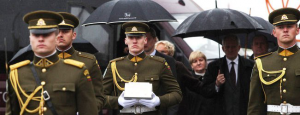
May
2012: A government honor guard at Vilnius airport receives the remains
for reburial of the 1941 Nazi puppet prime minister who ordered
thousands of Jews into a death camp.
No, the choice was a different one. The front banner of the February
16th Independence Day march featured the picture of Juozas
Ambrazevičius-Brazaitis, the Nazi puppet prime minister of 1941 who
personally signed orders confirming German demands for thousands Jews of
this very city, Kovno/Kaunas, to be taken to a “concentration camp” (it
was actually the nearby Seventh Fort mass murder site). Within weeks,
he signed another order for all the remaining Jews of the city to be
incarcerated in a ghetto within four weeks. For local Holocaust
survivors, the white armbands, worn by the local murderers in 1941 and
this parade’s marshals in 2013, are a particularly pain-provoking
gesture.
It was less than a year ago that an international scandal ensued when
the Lithuanian state, despite the difficult financial circumstances of
its good everyday people, spent tens of thousands of dollars to
repatriate from Putnam, Connecticut, the remains of this very
Ambrazevičius-Brazaitis and honor his
memory with a series of lavish events (we responded with an open letter right here on
Algemeiner.com).
One of the “liberal” professors at the university in Kaunas then told
the press that the reburial represents the “drama” of Lithuanian history
for the world, and complained that people are afraid to honor the
Nazis’ local prime minister “for fear of getting hit over the head with a
club by the Jews.” (And that’s what they call a liberal professor
here). That university, Vytautas Magnus University in Kaunas, contains
to boast a lecture hall and bas relief honoring the Nazi puppet prime
minister, and an
international petition is underway on that score.
There was little international reaction, as professors and Jewish
leaders with an interest in Lithuania who got wined and dined by various
Lithuanian consulates and embassies kept quiet.
As ever, there was one voice on the international scene that did not
remain quiet, that of the legendary Nazi-hunter Dr. Efraim Zuroff,
originally of Brooklyn, who has been on the case not only of individual
Nazi war criminals, but of the attempts over the last quarter century of
these countries to turn the local collaborators into heroes. He
immediately responded last spring to the reburial with a
powerful essay.
***
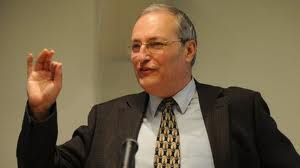
Efraim Zuroff, director of the Simon Wiesenthal Center's Israel office and acclaimed Nazi-hunter and Holocaust specialist.
Last week, as preparations for the pre-Purim neo-Nazi march in Kovno
began to go into high gear, a rumor started to spread like wildfire
among the tiny Jewish community left here in Lithuania. The joy was
palpable when word began to circulate in the small Jewish community:
Efraim Zuroff kumt tsu forn afn marsh! (“Efraim Zuroff is coming for the [neo-Nazis’ Kaunas] march!”). Somebody on the planet Earth cares.
Dr. Zuroff has written his
own memoir
in a sister publication in Israel. In it, he mentions a number of
Purimesque absurdities that result when you get close enough to the
neo-Nazis to be monitoring their march (which local human rights
advocates failed to do, running in the opposite direction on the day,
and which the American embassy has still failed to condemn publicly).
The juxtaposition of the dead serious and the carnivalesque of Purim were never far away.
Nearly a week before the February 16th march, Artūras Račas, the head
of Lithuania’s major news agency, BNS (Baltic News Service), published
on his private blog the following view of Efraim Zuroff: “That’s why I
want to say this: among the greatest propagators of antisemitism in
Lithuania, besides the little local Nazis, are, unfortunately, Jews,
whose people or even relatives experienced the Shoah. To give sound
foundation to this statement of mine, it’s sufficient to mention the
name of E. Zuroff. This is a person whose purpose and life goal is to
encourage antisemitism in Lithuania and throughout Eastern Europe. If
Israel were really interested in reconciliation and good relations, then
Zuroff long ago would be made to sit in a dark jail without windows
together with Hezbollah terrorists. For life and without possibility of
parole!”
Efraim, making his plans to be with the small group of protesters who
would stand up to the neo-Nazis’ march, had, the same day as it
happened, asked me where the best place in Vilnius would be for a press
conference the day before the march. I told him frankly, that the only
plausible place was the headquarters of the same BNS (Baltic News
Service) in central Vilnius, where the media would actually turn up.
Efraim, speaking from his office in Jerusalem in his (and my) native
Brooklyn English responded: “What?! You want me to pay this BNS for
their premises after the director said I should be put in jail for
life?”
And so it came to pass that we held our joint press conference the
day before the march. One journalist, a supposed specialist on Jewish
affairs, had us mixed up right and proper, asking in a question for the
opinions of “Efraim Katz and Dovid Zuroff.” Another wanted to know
what’s wrong with a “patriotic march.” Dr. Zuroff, the world’s last
great Nazi hunter, explained that “patriotism” based on antisemitism and
glorification of Holocaust killers is no patriotism, and that true
friends of Lithuania and the Baltics will be the first to stand up
against such perversions in a modern democratic and tolerant society. He
pointed out the connection of the acceptability of the neo-Nazi march
with the street names honoring killers and Nazi collaborators when there
were none honoring the local rescuers.
Then a question came my way. A young journalist wanted to know how I
could possibly be against the neo-Nazis’ march if I believe in
democracy, free speech, free expression, and all the rest of it. I told
him that there was once a saying among Vilna Jews of old about something
that belongs in some backwater shtetl and not in the center of the big
city: In Balbíreshok! In other words, sure, in some little shtetl on
some day or other, but not on independence day in the heart of the great
city. There is a time and place for everything, and allowing the Nazis
the center of the city on independence day in a member state of NATO and
the European Union is frankly a sick statement of state support.
Balbíreshok is the Yiddish name for the Lithuanian town now called
Balbieriškis in the Lithuanian language. Within minutes, one of the
neo-Nazi leaders was tweeting and posting: In all his years here, Katz
has only learned one word of Lithuanian, which he mispronounces
Balbíreshok (so much for the intercultural respect for Jewish and
minority place-names).
Trying to lighten the atmosphere at the press conference, Dr. Zuroff
“complained” that the neo-Nazis had the added chutzpah to stage their
march on Shabbos, limiting what observant Jews could do in protesting
the situation. (But nobody in the room, it seemed, got that one.)
At the march itself on the following day, Dr. Zuroff and I found
ourselves well protected by police, though the few local Lithuanian
anti-fascists who turned up, very brave young Lithuanians, were harassed
and asked to give their names and addresses.
The lead banner of the march had a picture of the above-noted Nazi
puppet prime minister, who was thereby made into the hero of the
independence day march. There were sieg heils, shouts of “Lietuva
Lietuviams” (“Lithuania for Lithuanians,” a bit strange in a city with
no noticeable ethnic minorities), and a wide variety of fascist symbols
used to adhere to a quiet agreement with authorities not to brandish
actual swastikas this year (they were on hand last year and were made
legal in Lithuania by a court decision in 2010).
The Lithuanian media has been full of attacks on Efraim Zuroff, the
one Mordechai on the planet this year who came specially to freezing,
icy, neo-Nazi honoring Kaunas/Kovno to show solidary with the victims
and survivors of the Holocaust, and to protest the present government’s
policies of honoring the perpetrators both directly and via neo-Nazi
marches. It is a reminder to the governments of Eastern Europe that not
all foreign Jewish leaders are interested in their medals and junkets,
and it is a reminder that the spirit of Simon Wiesenthal lives on, more
as a guardian against a fascist-orientated rewriting of history, even as
the last Nazi criminals go the way of the world.
One elderly man came up to me on the street a day later. He said:
“Hey, you, sir, I don’t know if you are Zuroff or Katz, but I want to
tell you that you were both right, I saw that press conference on
television. It is disgraceful that they are honoring the fascists. But I
do have one criticism of something you said. I was born in
Balbieriškis. It’s not an unworldly little hick town at all, please
choose another example next time.”
“Next time” is the second neo-Nazi parade, scheduled for the second
independence day, March 11th , in the center of the capital city,
Vilnius, just a few weeks from now (
there is an international petition underway on that one, too).
So sure, if we have to, we’ll find the name of another shtetl to
which it could be moved if the government finds the political will to
make the independence day celebration in the capital something to be
proud of for people of all backgrounds.
In the meantime, do us a favor, and do something for the morale and
cheer of the last Holocaust survivors in Eastern Europe. Please contact
your elected officials, asking them to ask the Lithuanian government to
ban the neo-Nazi march from the capital city on independence day.
The author is the editor of www.defendinghistory.com. ( a jewish named Kotz)







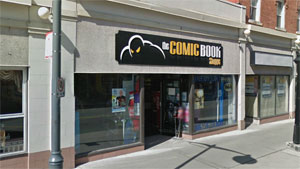 The
Comic Book Shoppe on Bank Street, as well as another location in
Nepean, are no longer stocking the work of a controversial American
author. (Google Streetview)






 Three Tottenham Hotspur supporters were