In recent years European religious and political leaders
along with leading academics have emphasised on returning to Europe’s
‘Christian’ Identity but history tells a different story that actually
Europe’s historical Identity and roots has more in common with Hinduism‘ :
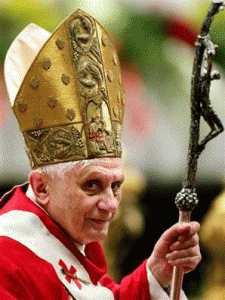
Pope Benedict XVI
On 11 April2011 Pope Benedict XVI accused anyone who
denied Europe ‘s Christian roots of suffering from “amnesia” and said
it was the equivalent of saying that humans
“can live without oxygen or food”.This was enhanced in November by the Italian Prime Minister Mario Monti, who said that the Church’s Magisterium and the
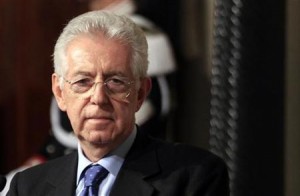
Italian PM Mario Monti
Christian roots of Europe are in dispensable in facing the
continent’s economic crisis. Already on 20 May 2010 at symposium in Rome
on the Orthodox and Catholic Churches of Europe , president of the
Pontifical Council for Promoting Christian Unity, Cardinal Walter
Kasper, stated
,”If Europe wants to have a future again, it must first and foremost renew its Christian roots.”
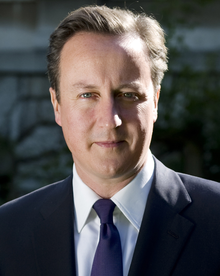
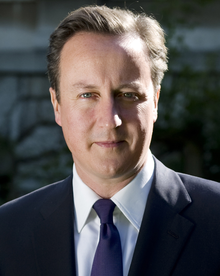
UK PM .David Cameron
The greater input of Christianity into public life has also
been witnessed by David Cameron and his predecessor as prime minister,
Tony Blair. On 17 May 2012,
Cardinal Cormac Murphy-O’Connor, Britain’s most senior Roman Catholic, warned that the spread of secularism and atheism were
“very,
very dangerous” fostering intolerance and the drive towards
totalitarianism in order to eliminate Christianity in the nation.
Is Europe a Christian Product?
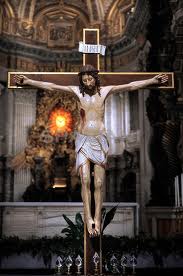
While
such idealisation of Christianity can be expected from clerics and true
believers in the faith, there have been other voices who see a European
identity defined through Christianity as useful even if its not
actually true. Even staunchly secular anti-clerical France has not been
immune from pushing the importance of faith. Just before he lost office,

Nicolas Sarkozy:Ex-President France
Nicolas Sarkozy
declared, “We should uphold both sides – accept the Christian roots of France ... while defending secularism”.
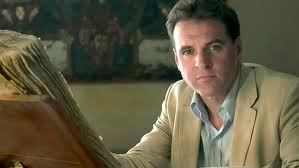
Niall Ferguson :British historian.
Scottish-born historian and political conservative
Niall Ferguson calls himself “an incurable atheist” Nevertheless he is
also a vocal champion for restoring Christendom because there isn’t
sufficient “religious resistance” in the West to radical Islam.

Oriana Fallaci
Italian journalist Oriana Fallaci
spent her last years before her death in 2006 inveighing against a
Muslim influx that was transforming her beloved continent into
“Eurabia.” Fallaci was a self-declared “Christian atheist” because she
thought Christianity provided Europe with the essential cultural and
intellectual bulwark against Islam. These become more than just
intellectual gymnastics when right-wing extremist

Anders Breivik
Anders Breivik killed 77 people in a horrific carnage in Norway . In his political manifesto Breivik wrote
“European
Christendom and the cross will be the symbol in which every cultural
conservative can unite under in our common defence. It should serve as the uniting symbol for all Europeans whether they are agnostic or atheists.”
While not an actual believer, the hardcore nationalist nevertheless had
faith “in Christianity as a cultural, social, identity and moral
platform.”
In his 2010 book
Reflections on the Revolution in Europe, Christopher Caldwell of the
Christopher Caldwell
Financial Times speaks of the revival of “Team Christian” as Islam
asserts itself in Europe such as attempts to rededicate Cordoba
Cathedral as a mosque. Already in Britain and France more people attend
mosque on Friday than church on Sunday which sends pulses racing because
while Christianity is seen as indigenous and part of what it means to
be

France :Muslim Devout Praying on street
European, Islam and other such exotic Oriental
creeds are seen as foreign intrusions. This has been as much an issue as
human rights and democracy when resistance is made to Turkey joining
the European Union.
In his classic work The Clash of Civilisations, Samuel Huntington reveals that the “West” has never actually generated a major religion:

Samuel Huntington
“The great religions of the world are all products of
non-Western civilizations and, in most castes, antedate Western
civilization.”
Later he does define “Western Christianity” comprising Catholicism and Protestantism as
“the single most important characteristic of Western civilization”
defining itself against Byzantine Orthodoxy as much as against Islam.
Yet he also mentions the “Classical legacy” which in his words included
“Greek philosophy and rationalism, Roman law, Latin and Christianity”.
So Huntingdon once again relates western identity back to Christianity.
But it is his Greek and Roman citations which I wish to elaborate on
further because they provide the core meaning when we look for the
actual origins of ‘ Europe ’
.
What do we mean by ‘ Europe ’?
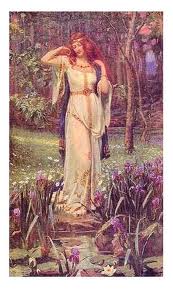
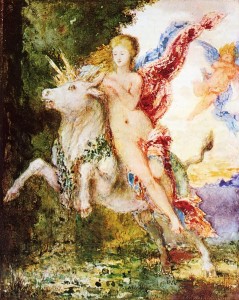
Goddess Europa
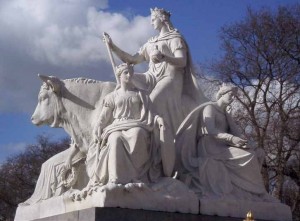
The continent actually takes its name from Europa, a Phoenician woman of distinguished lineage, the daughter of Agenor the King of Tyre.
She was also descended from the nymph Io, priestess of Hera in Argos ,
who was seduced by the Greek god Zeus. Her brother Cadmus contributed
the alphabet to Greece . Zeus was enamoured of Europa and decided to
seduce by transforming himself into a tame white bull and mixed in with
her father’s herds. Europa onto his back allowing Zeus to run into the
sea and swim, with her on his back, to the island of Crete . Here he
revealed his true identity, and made Europa the first queen of Crete .
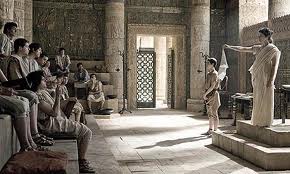
Plato and Aristotle
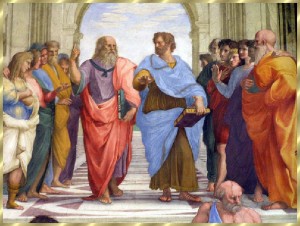
Therefore the very identity of Europe is not
grounded in Christianity but the long lost pagan past which produced the
first great civilisation on the continent. Does anyone regard the
teachings of Socrates, Plato, Aristotle, Pythagoras and other great
philosophers as backward? These are the great founding fathers of
European and western civilisation which is so often touted as superior.
Yet they were all products of a pagan environment as was the very
‘democracy’ first formulated in the city of Athens . For that reason if
Islam and other ‘exotic’ creeds are an intrusion then where exactly does
that leave Christianity? By that token it is as ‘foreign’ as Islam and
another Middle Eastern import.
The myth of Europe having Christian roots is exploded.
This use of ‘myth’ is interesting because while Christianity to this
day derides others as heathens, idolaters and pagans, relegating
folklore and moral stories into the realms of mythology, the real myth
is that Christianity somehow protected or led to the rights and freedoms
which we now take for granted. The historical reality is somewhat
different.
Hammer of Christ
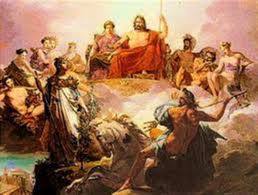
Roman Gods
The Romans were generally tolerant of different creeds and hence the
empire had spiritual dynamism and vitality. Mithras and Isis shared the
pantheon along with Jupiter, Mars and Serapis. It was this environment
which allowed Christianity to grow and flourish in the first place until
Constantine accepted it as the imperial creed because it helped him
gain political power over his rivals. Once in power the angry male
demiurge known as ‘God’ revealed his true power as Christianity brooked
no rivals. That
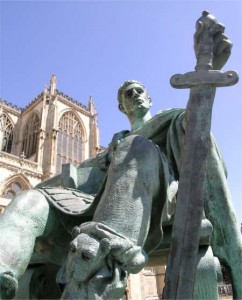
constantine
included within its own ranks as the Nicene Creed deemed many
self-confessed Christians as heretics. The Emperor Constantius II, who
reigned from 337 till 361, marked the beginning of the era of formal
persecution against Paganism by the Christian Roman Empire, with the
emanation of laws and edicts which punished Pagan practices. From the
350s, new laws prescribed the death penalty for those who performed or
attended Pagan sacrifices and for the worshipping of idols.
Pagan temples were closed and the traditional Altar of Victory
was removed from the Senate. Increasingly ordinary Christian formed mobs
destroying, pillaging, desecrating, vandalising many of the ancient
Pagan temples, tombs and monuments
.Julian the Apostate attempted to restore the traditional pagan tolerance as practiced by the emperors before him but it was too late
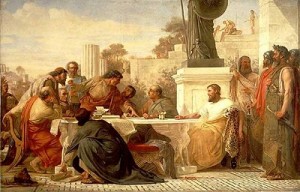
{Roman Emperor Julian
because the monotheistic mind set had spread too deep. The decrees of
Emperor Theodosius from 389 to 391 that the iron grip of religious
totalitarianism really took root. The remaining Pagan holidays were
abolished, the eternal fire in the Temple of Vesta in the Roman Forum
extinguished, the Vestal Virgins disbanded, while auspices and
witchcraft were punished.
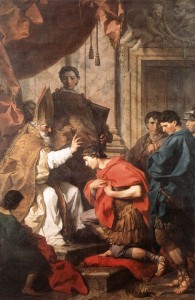
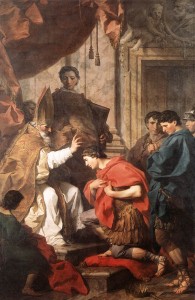
St Ambrose Converting Theodosius to Christianity
Until 395 Theodosius authorized or participated in
the destruction of many temples, holy sites, images and objects of piety
throughout the empire, participated in actions by Christians against
major Pagan sites, issued a comprehensive law that prohibited any Pagan
ritual even within the privacy of one’s home, Paganism was now
proscribed, a “religio illicita”. He also is likely to have suppressed
the Ancient Olympic Games whose last record of celebration is from
393.The repressive laws were continued by Honorius and Arcadius as they
attempted to snuff out any revival of paganism. The surviving pagans
blamed the sack of Rome in 410 on neglect and suppression of the ancient
traditions. But the monotheistic juggernaut of hate was by now
unstoppable. Rationalism and philosophy became the bête noir of a
religion that could not stand people thinking for themselves.
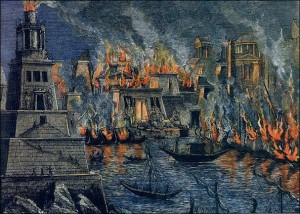
Burning of the library : Alexandria
In this burning atmosphere of intolerance and hatred
the great Library of Alexandria was pillaged and destroyed by Christian
mobs. The temples of Alexandria were closed by Patriarch Theophilus of
Alexandria in AD 391 and this allowed the destruction of the great
library. Anyone who could think outside the narrow confines of the
monotheistic gagging order was at risk as Neoplatonist philosopher
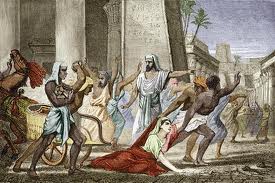
Hypatia found to her cost in 415.
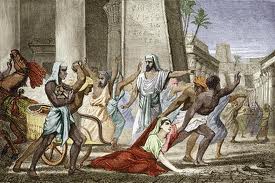
Hypatia being dragged by christians to her brutal death
Taken by a Christian mob to the church called
Caesareum, they completely stripped her and then murdered her with
tiles. After tearing her body in pieces, they took her mangled limbs to a
place called Cinaron, and there burnt them. During the fifth century
all Hellenic monuments, altars and temples of Athens , Olympia , and
other Greek cities were destroyed.
In 529 Emperor Justinian closed the Academy of
Athens leading some of the remaining Academy members to flee to
Ctesiphon , the capital of the Sassanid Iranian emperor Khosrau I. In
542 Justinian allowed the inquisitor Ioannis Asiacus to forcibly convert
the pagans of Phrygia, Caria and Lydia in Asia Minor . Within 35 years
of this crusade, 99 churches and 12 monasteries are built on the sites
of demolished pagan temples.In the sixth century, Christian authorities
suppressed in Egypt the Navigium
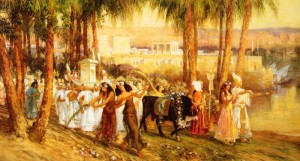
Navigium Isidis festival banned in Egpyt as Christians took over
Isidis, a religious festival in honour of the goddess Isis. Yet as
late as 840, the inhabitants of Laconia in Greece , resisted the attempt
of Tarasius, Patriarch of Constantinople, to convert them to
Christianity. The ancient culture and civilisation which had given rise
to essential elements in our modern civilisation, were extinguished by
the intolerant monotheistic deity of Christianity.
Women as Christ’s Sacrifice
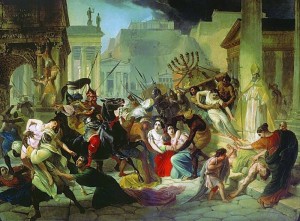
Collapse of Rome
Christianity is said to have civilised the Europe of the Dark Ages,
that period after the fall of the Roman Empire in western Europe plagued
by disease, fragmented political systems, de-urbanisation and a return
to a more rustic way of life as Germanic tribes, Huns, Magyars and
Norsemen pillaged, raped, enslaved and caused general mayhem as well as
massive demographic upheavals.
Christianity has always had this false vision of itself as
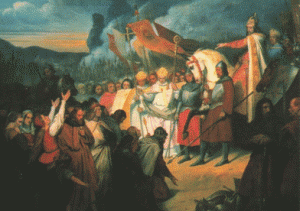
a superior creed against the rude backward ramblings of heathen tribes
who worshiped fierce unforgiving gods that sometimes demanded human
sacrifice. This is ironic considering that the new upstart creed
claimed to drink the blood and eat the flesh of its god. We need to look
behind a history written by the Christian victors. In doing so we find
remarkable revelations.
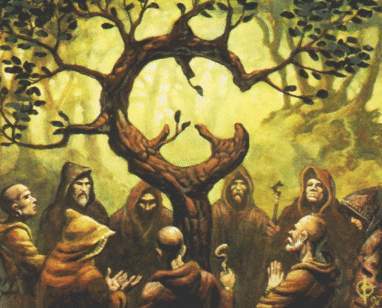
druids
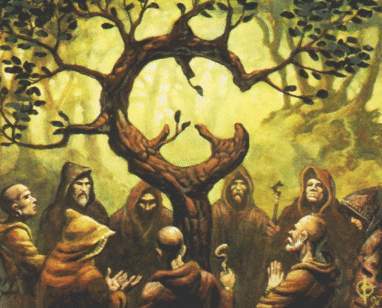
For example the Celtic druids had immense control over the
population not so much from fear (as with the Christian clerics) but due
to their knowledge of astronomy and religious rituals. In pre-Christian
Ireland , druids, poets or fili and a learned class of legalists known
as Brehon had special status in a society which respected scholarship
despite the dearth of written records.
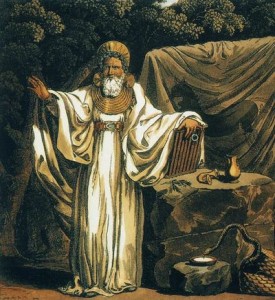
a Druid Elder
Druids often sat on the right hand of Celtic kings,
and in fact spoke before the king did. Myles Dillon, who was senior
professor at Dublin Institute for Advanced Studies, and Nora Chadwick,
who was Honorary Life Fellow at Newnham College , made incredible
parallels with the Indian situation, as far back as 1967:
“This class of professional men, priests and scholars, seems to,
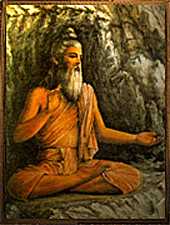
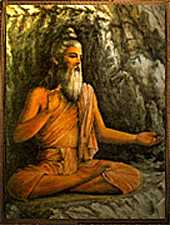
Vedic Brahmin
share a common Indo-European inheritance with the brahmins of
India, for the later and fuller evidence of Irish sources shows a
similar class, the filid, who, while shorn of their priestly office in a
Christian society, have retained the scholarly functions of the druids
as poets, genealogists, lawyers, and the practice of oral rather than
written tradition. Both the form and content of their learning show
astonishing similarity to brahminical tradition.”
River Thames 'Tamas'
The River Thames may in fact take its name from the Sanskrit Tamas meaning
“dark”
as its waters are often dark and cloudy; another school of thought is
that it is named after the Roman Tam meaning “wide” and Isis meaning
water. Chadwick was a major scholar on the Celts and commented on the
common parallels between the Druids and Brahmans. Druids also taught
that the self was immortal, the soul transmigrated into different bodies
after death, and conducted ritual sacrifices to appease the gods. The
Celtic religion survived most apparently in ancient Irish folklore.
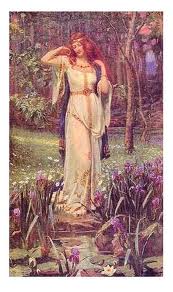
Celtic Goddess Airmid
Like the Vedas,the extant Old Irish
literatures-memorized and transmitted through a 12-year training by an
Irish bard class who were the inheritors of the druids – are an
essential window into Celtic thought. Again, like the early Vedas, the
Old Irish sagas and hymns are at times locked in metaphor for which we
have lost the keys, with vast gulfs of knowledge missing from the Old
Irish literature. The only existing material is that put into
writing-for the first time-by Irish Christian monks in the seventh
century. By then 700 years of warfare and had been imposed by the Papacy
virtually extinguishing the flames of the European pagan religions. All
that remained was a Europe brightly misted in folk wisdom and sagas and
inlaid with thousands of temple sites, holy groves and springs,
stoneworks, fortresses, towns, cremation and burial grounds, sacred
rivers, mountain aeries, seaside grottoes and treasure lakes all bearing
names, artifacts and wisdom of the Celtic Gods, druids and
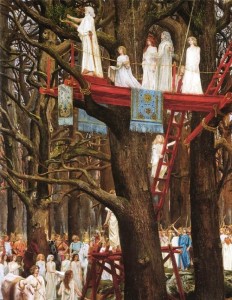
Druids cutting mistletoe :The Celts believed
that Mistletoe held the soul of the Holy Oak & therefore embodied
its Sacred fertility.
culture. Most of what is considered Christian Europe is actually
pagan Europe . Christmas day (December 25th) was usurped and
inaccurately fixed by Christians from the Roman festival of Mithra. It
came in turn from the Celt festival of the winter solstice, an
astronomical event the druids observed to set the exact beginning of the
new solar year-the same calculation brahmins made in India .
The Celts were not alone in this. Balts, Slavs,
Germans and Nordics nestled in-all the way north to the frozen wastes of
Iceland . They each radiated a language, spiritual mindset and culture
that tracks that of the early
Vedic civilisation. At
dawn, Germans daily slipped into cold, sacred rivers for ablution,
chanting and wearing loose-flowing robes and a topknot in their long
hair “so emblematic of the brahmins”. So recorded Tacitus. The Slavs
took seven steps around a holy fire in marriage. The Icelander saga-the
Edda-contains creation passages that are Upanishadic in tone.
The British Isles and other areas of northern Europe
that were formerly druidic are still densely punctuated by holy wells
and holy springs that are now attributed to some Christian saint, often a
highly local saint unknown elsewhere. Of course not all pre-Christian
holy places were respected enough for them to survive, however, as most
ancient European sacred groves, such as the pillar Irminsul were
destroyed by Christianizing forces. Many Christian churches were built
upon sites already consecrated as pagan temples or mithraea.
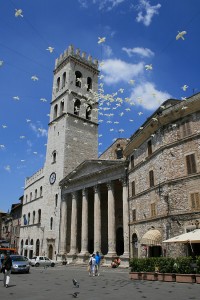
Santa Maria Sopra} Minerv :A pagan temple for Minerva then a church was built on top of it.
The church of Santa Maria sopra Minerva (literally Saint Mary above
Minerva) in Rome is just the most obvious example of this. Sulpicius
Severus, in his Vita of Martin of Tours, a dedicated destroyer of
temples and sacred trees, remarks
“wherever he destroyed heathen temples, there he used immediately to build either churches or monasteries”
When Benedict took possession of the site at Monte Cassino, he began
by smashing the sculpture of Apollo and the altar that crowned the
height. No surprise then that the historicity of several saints has
often been treated sceptically by most academics, either because there
is a paucity of historical evidence for them, or due to striking
resemblances that they have to pre-Christian deities.
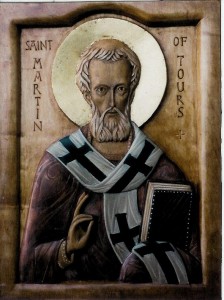
St Martin of Tours : Revered Christian Saint and Pagan temple destroyer
Once the tribal king or chief was converted the
bishops knew that the rest would follow. This is how Christianity
established itself promising power and wealth not any deep spiritual
succour. Clovis , King of the Franks, converted therefore as a matter of
military and political expediency, forcibly converting his subjects to
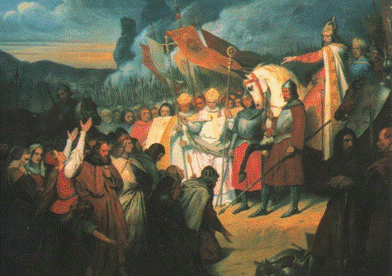
Christianity. But it was left to his descendant Charlemagne to slaughter
tens of thousands of Saxons, Avars and Slavs in order that they might
know God’s loving kindness.
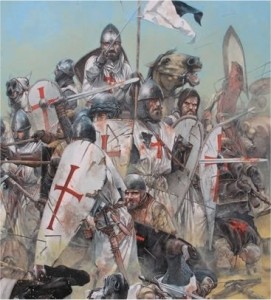
Christian Crusaders on the} rampage
From the twelfth century Latin Crusades against the
heathens of northern and eastern Europe as monastic military sects such
as the Teutonic Knights spread Christianity among the Slavs, Finns,
Estonians, Lithuanians and Latvians, from the eleventh to fifteenth
centuries. German landowners dominated over the indigenous converts
which they converted, conquered and colonised especially in Prussia ,
Estonia and Lithuania . In Prussia the Slavs were either converted or
expelled as the Knights established centres at Konigsberg and
Marienburg. The colonists established new towns which became centres of
Germanisation in sea of heathen Slavs.
Heathen Slav and Baltic women were subject to rape with the actual monks
taking an eager and even more active role than the secular military
auxiliaries. Yet Lithuania managed to hold out against Christianity as
late as 1413.
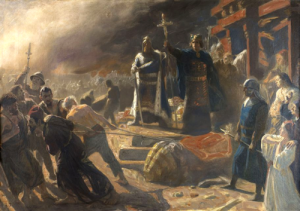
Danish Bishop Absalon destroys the 'idol' of Slavic god Svantevit
Europe was now fully Christianised
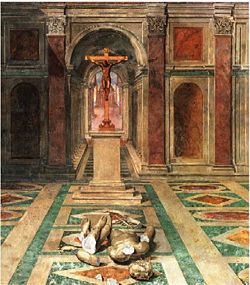
"Triumph of Christianity"} by Tommaso Laureti
(1530–1602), ceiling painting in Vatican Palace. Images like this one
celebrate the triumph of Christianity over the paganism of Antiquity}
But the bloodthirsty cosmic tyrant of
Christianity would not be satisfied now that his appetite for human
flesh was insatiable. In terms of oppression and sadomasochistic
violence, few things in the history of Christianity can surpass the
omnipotent fear and brutality shown by the Inquisition. During the first
fifty years after its founding in Spain in 1478, an estimated fifty
thousand victims were tried, most of whom were burnt at the stake. In
fact the numbers were huge for the time. In Toledo , about ten per cent
of the population was tried by the Inquisition between 1486 and 1499.
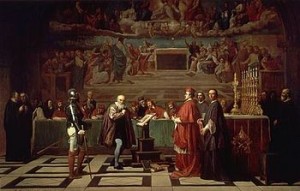
Galileo before the The Inquisition
For more than three centuries the Inquisition was
the most powerful institution in Spain and its colonies in the Americas
and Philippines , and in Portugal and its colonies of Brazil , Africa
and Asia . That is an incredible amount of the globe over an incredibly
long time. The Inquisition allowed the Catholic Church to stamp out any
remaining vestiges of paganism, such as belief in fairies, trolls,
gnomes and other such beings. It was this that led to its campaign
against witchcraft. Belief in witches had ironically been heresy. But in
1458, an inquisitor named Nicholas Jaquerius began to reverse this
attitude so that by 1484, the Church performed a complete volte-face.
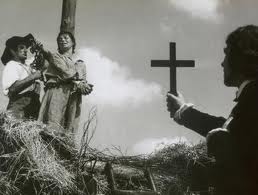
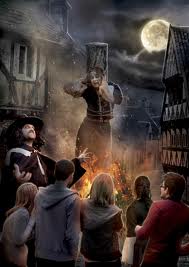
Witch burnings
Indeed it was heresy not to believe in witches. This became codified
in 1486 with the writing of a book called Malleus Maleficarum, or Hammer
of the Witches. Written by Dominicans Heinrich Kramer and Johann
Sprenger, this obscene and pornographic book, this became a manual for
anyone involved in the prosecution of witchcraft. In its unashamed
misogyny, the authors of Malleus were literally psychopathic in their
hatred of women, who were regarded as weak, fallen, deceiving, prone to
heresy, bearer of falsehood, contaminating, and tempting the faithful
with their insatiable carnal lust.
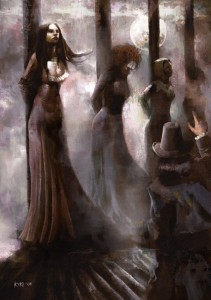
Women burnt at the stake
Midwives were also suspect due to their intimate
knowledge of female gynaecology, and hence were suspected of killing
newborn infants, causing others to be sick or deformed, and even bad
behaviour among children. Girls that had been jilted were blamed for
then seeking solace with devils. Anything could be ascribed to
witchcraft: female masturbation, ergot poisoning, erotic dreams. In the
terror it unleashed across Europe , when a suspect was found she was
tortured or threatened into confession, a fair trial being completely
out of the question.
It was not just the Catholics. Anti-witch madness
spread to the Protestant churches as well. By the middle of the
sixteenth century, witches were being burned at the stake in their
hundreds. In 1585, two German villages were so decimated of female
demographics that only one woman remained alive in each. The Inquisition
itself boasted that it hard burned at least 30,000 witches over 150
years.
Between 1560 and 1680, a minimum of forty thousand victims were
killed by the witch hunts of Protestant northern Europe . Protestants
may have felt even more fear of witches than Catholics because they
rejected rituals such as exorcism. However they kept the belief in
demonology and the Malleus was amazingly just as popular in Protestant
Europe. With the Reformation, Christianity became a political ideology
used by the ruling elite to prove their piety in suppressing heresy and
witchcraft.
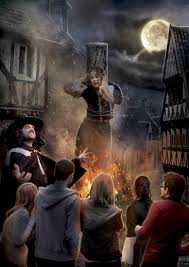
Midwives,female healers all burnt at the stake
The latter was said to be an international
conspiracy against the state, church and god, even though most suspects
were women that were poor and elderly. Economic changes may have also
increased this general paranoia, with the sixteenth century witnessing
famines and destruction with religious wars. Commercialisation of
agriculture meant uprooting of peasant communities and severe
demographic dislocation. Traditional female healers also posed a threat
to the dominance of male doctors. So the cumulative effect was to prove
deadly to thousands of women in Christian Europe. The last official
execution for witchcraft in England was in 1642, and as late as 1775 for
Germany . But lynching for witchcraft continued in parts of Christian
Europe until the twentieth century. Scotland saw witch-hunts from the
1590s. The misogynist carnage against innocent females peaked during
1643-9 and 1661-2, with most victims being from society’s lower orders.
Most were also subject to killing by the mob even after being acquitted
in court as happened as late as 1705 in Edinburgh .
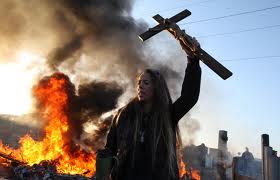
women often accused other women of witchcraft to take the focus of themselves
Hatred of women played a significant part of course. But the
Reformation was also a concerted attempt to purge Christianity of any
vestiges of paganism. Protestants saw veneration of Catholic saints as
the offspring of heathen deity worship, which in many cases it actually
was considering how those original shrines had been usurped by
Christianity when not actually destroyed by the intolerant monotheistic
faith.
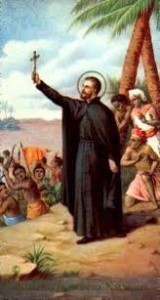
St Francis Xavier who first requested the Inquisition to be brought to India
The same intolerance and destruction demonstrated by
Christianity’s violent spread in Europe was to be exported. Highly
sophisticated societies of the Mayans, Aztecs and Incas were pulverised
as the same psychopathic monsters led their minions in the name of the
intolerant male jealous god.
Whole civilisations were wiped out in order that Christ might
demonstrate his misguided ‘love’ for humanity. The same was tried in
India with the Portuguese Inquisition. But ancient Hindu civilisation
proved a hard nut to crack which was to prove ominous for Christian
belief in Europe itself.
A Return to the Roots of European Civilisation
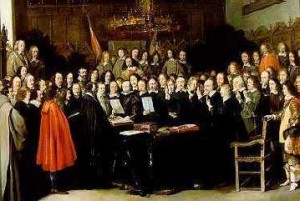
Signing the Treaty of Westphalia
The Reformation did at least have the advantage of dismembering the
power of an omnipotent church. As the centuries progressed and an uneasy
toleration dictated by the Treaty of Westphalia prevailed after the
destructive Thirty years War new ideas could develop.
As the eighteenth century Enlightenment progressed various scholars
looked into Europe ’s pre-Christian past. While this included Celtomania
and interest in the Norse sagas, it was ancient Greece which appealed
to the German Romantics because it was composed of small virtuous states
just like Germany .
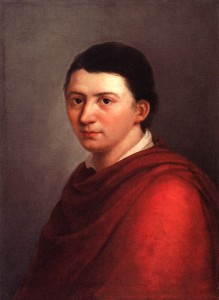
Friedrich Schlegel
Herder and other Romantics saw language not to
transmit reason but to express feeling. Greek was therefore valued for
its poetic qualities. From 1802 Friedrich Schlegel in Cologne who began
studying Sanskrit and thus learnt the antiquity of Indian culture,
having been attracted by the work of Sir William Jones, Orientalist, and
founder of the Asiatic Society in Calcutta who realised the affinity
between Sanskrit with Latin and Greek. Believing that European peoples
descended from the Indian Himalayas.
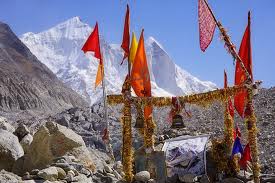
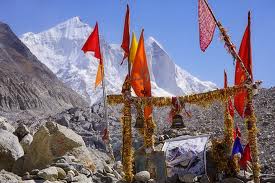
hindu prayer flags : himalayas
He published Essay on the Language and Wisdom of the
Indians in 1808. Schlegel proposed that in the distant past, a nation
of priests and warriors from the Himalayas had been transformed into
murderous hordes and not only conquered India, but also struck far north
into the cold forests of Germany and Scandinavia, claiming evidence for
this migration existed in Sanskrit references to a sacred mountain
revered by Hindus.
In 1803 Schegel said
“Everything, absolutely everything, is of Indian origin.” Hegel (1770-1830) said that the Germans were direct disciples of Indian philosophy and culture.
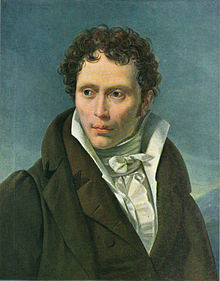
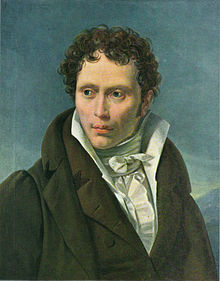
Schopenhauer
Schopenhauer (1788-1866) preferred Buddhism and
Hinduism over Christianity. Nietzsche went further in stating that
Christianity had caused a “slave morality” and that it was inferior to
Buddhism. It was apparent that given half a chance thinking people in
Europe were actually getting quite sick of the chimerical Middle Eastern
ideology which had been forced upon them by Constantine, Theodosius,
Charlemagne, the Vatican, Calvin and Martin Luther having destroyed all
vestiges of the deep spirituality which once thrived across Europe. This
allowed for the spread of monotheism to a people spiritually
distraught and disheveled. As Nietzsche famously opined:
“Not every one may be a Christian: one is not ‘converted’ to Christianity—one must first be sick enough for it.”
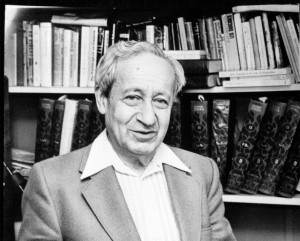
Léon Poliakov
Research by renowned French scholar Léon Poliakov’s
reveals that looking to India was also part of the attempt of Europeans
to give themselves cultural and civilisational origins cleansed of their
ultimately Jewish heritage through the filter of Christianity and the
Bible. Humanist ideas which followed the Renaissance and the opening up
of the East to European exploration had led to a greater awareness of
the antiquity of Indian civilisation. Kant and Herder saw analogies
between the myths and philosophies of Europe and India which helped them
to cleanse the former of its Judaic heritage, and in doing so tried to
find the origin of Western culture in India and not the Near and Middle
East.
Indeed this theory claimed an
Aryan invasion of Europe
before we have the theory even applied to India . The Germans believed
that they had been the victims of great power rivalries, notably between
France and Austria . German intellectuals therefore sought solace in an
exotic land where like themselves the people were subjugated, India .
Thinkers such as Frederick von Schegel (1772-1829), his brother August
Wilhelm (1765-1845), Wilhelm von Humboldt (1767-1835) and Arthur
Schopenhauer (1778-1860) were beyond being mere students of Indian
literature and philosophy.
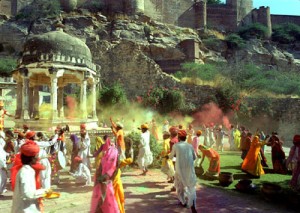
Colorful India
They were infatuated with the ancient land. But
reaction against the imperialism of Napoleon led to the triumph of those
forces which believed in a romanticist and mystical idea of a German
nation with its special cultural mission as epitomised by Fichte’s
Address to the German Nation but also found in a host of nationalist and
anti-Semitic myths which drew upon and warped the original Romanticism
and Enlightenment concepts. By the middle of the nineteenth century
Wolfgang Merzel looked for inspiration to Medieval German Christianity
and the pagan past with gods such as Odin. The construction of a
non-existent pagan Germanic past was helped by figures such as Richard
Wagner whose operas evoked primeval myths in a German identity cleansed
of Roman, Christian and Jewish influence. Romanticist and racist German
nationalism was popularised by scholars and writers and dominated
intellectual and public life. Wagner’s idealisation of a German pagan
past showed Siegfried as messianic and Christ-like with little
resemblance to actual German mythology.
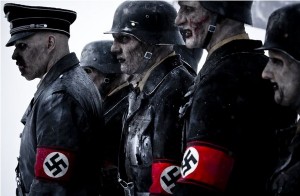
nazis and the church close companions
Now none of this had anything to do with traditional paganism. It had more to do with an obsessive
anti-Semitism
integral to the Church from its very inception which was taken to its
genocidal conclusions. The Romantics and other thinkers from the
Enlightenment merely replaced the outer sheen of Christianity with a
veneer of ancient paganism. The infrastructure provided by Christianity
was left intact. It therefore lent itself easily to racial and religious
fervour which were the direct result of secularising purely Christian
concepts, however neatly they were embellished by stolen pagan imagery.
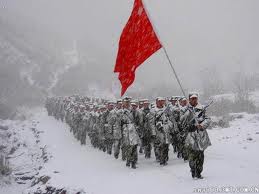
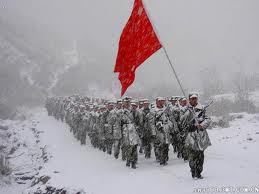
Red Army
The angry, jealous, male demiurge commonly referred to as
GOD, could easily be secularised into the sole acceptable RACE, THEORY,
dialectic, or a host of other ideologies which claim to hold the ‘Truth’
by qualifications which are self-evident only to the given ideology’s
most zealous disciples and missionaries. No other way of life is
acceptable and is best extinguished or kept in a museum. It is this
which has led to the mass murder of millions in the name of progress,
rationalism and science.
 The unstoppable
outward aggression is obvious if we understand that the millenarian and
apocalyptic fervour emphasises this and only this. Introspection,
self-discovery and indeed that knowledge of self is of no use for
chiliastic ideas which have no concept of the inner journey and
experience of the self, no matter how much they tout an amorphous
‘individualism’; which all so easily translates into conformity,
coalescing into a mindless collective.
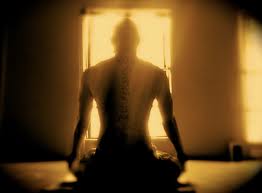 This is the diametric opposite
of what Hindus have retained in the concept of yoga which is the inner
journey of self-discovery, because it was not acceptable to the
aggressive demiurge worshiped in monotheism as Christianity violently
smashed its way through Europe . That explains not just continued
Christian hostility to neo-paganism but to Hinduism itself. When the
Pope and evangelical Christians urge their cowed followers not to
partake of yoga because it brings evil spirits they know exactly what
they are talking about because the inner journey is the greatest threat
to an ideological infrastructure which emphasises nothing beyond the
outer expression and the very crass materialism which it periodically
denounces.

Pat Robertson
Pat Robertson, emperor of all evangelical hatemongers, says
“we can’t let that stuff come to America”
because it threatens his entire worldview as well as his lucrative
business interests – just as he sends missionaries in the manner of a
swarm of locusts to places such as India to destroy the ancient
indigenous culture in the name of the angry, jealous, and ultimately
lonely dysfunctional male demiurge they call GOD. It does not matter
that this god may indeed be absent.
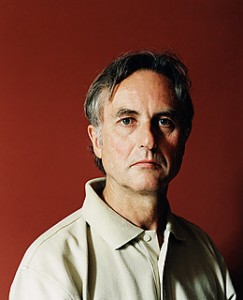
Richard Dawkins : Prophet of Monotheist Atheism ?
Even atheism is a result of the same monotheistic framework.
After all god has to be present in some form if he is being actively
denied the right to exist. Then again how many of the demiurge disciples
actually believed in this deity’s existence? It was after all Pope Leo X
who candidly admitted:
“It has served us well this myth of Christ”.
The fact that something so seemingly innocent as
yoga can lead religious demagogues to burn with hatred should tell its
something about the intractable conflict between the monotheistic world
view and the inherent natural spirituality which emanates from and
guides humanity. The misnomered merciful god is nothing more than a
cosmic dictator whose mannerisms are emulates by his followers on earth
in their iconoclastic fervour. Millions will forfeit their lives should
they refuse to bow before the omnipotent will of this repugnant entity.
That is exactly what happened as Christianity spread through Europe .
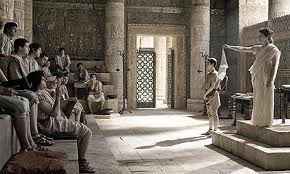
Alexandria
Not content with desecrating pagan shrines, some of
which such as Alexandria were seats of ancient learning without which
the modern western civilisation would scarcely have been possible, the
disciples of the demiurge literally incinerated anyone suspected of
holding onto ‘heathen’ beliefs.
In this New World Order dominated by a celestial male autocrat the
voice of women was all but silenced. From Hypatia’s cruel dismemberment
at the hands of a fourth century Christian mob in Alexandria it was not
such a small step to a mindset which led to the burning of thousands of
females at the stake for the crime of witchcraft, right up in fact until
the late eighteenth century. Not exactly encouraging for those who wish
to return Europe to its Christian roots.
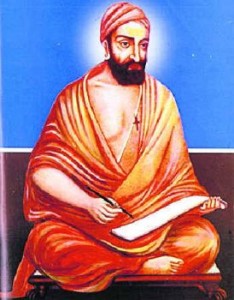
Fraudster Robert di Nobili
Yet also modern Hindus ignore these inconvenient
facts. Subjected to centuries of monotheistic imperialism they have
internalised a deep inferiority complex. To have many gods is seen as a
mark of shame. Arya Samaj was nothing more than Christianity with Hindu
garb, just as was attempted by
Catholic missionary Robert di Nobiliin
the seventeenth century. This process of ‘indigenisation’ has been used
more recently by hardcore groups such as Gospel for Asia , South Asian
Concern and Fr. Bede Griffiths in his Christian ashram. ISKCON did the
same while claiming to be a new faith, the only true faith, subverting
Shri Krishna into the same demiurge which people in the west had come to
Hare Krishna hoping to reject – only to get it forcibly rammed down
their throats. Yet the loosening grip of religious dogma on much of the
western world and the willingness to experiment with new spiritualism
provides an opportunity. Hindus have preserved the ancient spiritual
knowledge which was once common to cultures now denounced as pagan.
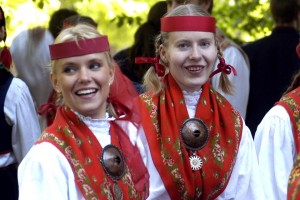
Estonian culture hasn't forgotten its pagan roots
In August 2011 the BBC reported Estonia as being the least religious
country. Barely thirteen percent of the population belongs to the once
powerful Lutheran Church .
The fall of communism has led many in this former Soviet republic to
look to their traditional paganism as they commune with nature in order
to find deep spiritual purpose to their lives such as with Maausk where
trees and the earth are cherished. About half the population adheres to
these beliefs. The signs are therefore encouraging.
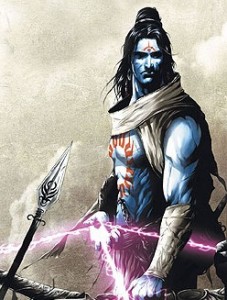
Lord Rama
Despite centuries of effort by the demiurge Hinduism
has survived and its relevance to the modern age will only be enhanced
by spiritual rediscovery in Europe such as that witnessed in Estonia .
Europe needs to return to its pagan past, a glorious past where Druids
and others communed with a cosmos and created the classical Roman and
Hellenic heritage which western civilisation claims as its own.
Such defenders of this civilisation would therefore do well to
understand and comprehend Hinduism as the only surviving pagan culture
in order to reach full realisation of the statement written above the
Oracle at Delphi in ancient Greece :
“KNOW THYSELF”
This was the culture which not only gave the world the very word ‘democracy’ but also
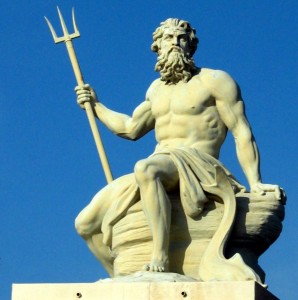
God Poseidon
the basis of western philosophy, science, mathematics and logic.
Plato and Socrates it must be remembered were the result of the very
pagan environment so mocked and hated by the Church. That hatred has
continued to this day.
Europe as Victim of Christian Colonialism
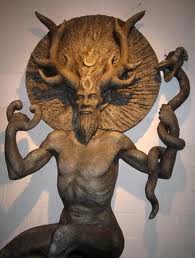
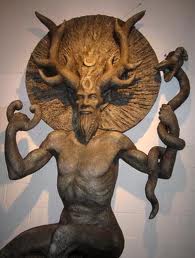
Cernunnos the thorned god
Modern Europe is not always the enlightened place
one would think as under the veneer of democratic slogans, lies the
sinister underbelly. Pagans and followers of indigenous European
religions are thus still being targeted without mercy. As recently as
October 2006, British pagans were attacked by Christian extremists while
celebrating a sacred festival at Glastonbury .
In Greece the celebration and worship of the ancient
religion of Zeus and Apollo at ancient temples is actually illegal.In
2000 Archbishop Khristodoulos of Athens mobilised thousands of
supporters in condemning EU insistence on minority rights as leading to
the de-Christianisation of Europe .
Indeed modern Greece is so far removed from its ancient roots that Samuel Huntington was prompted to write this:
“ Greece is not part of Western civilization, but it was the home of Classical
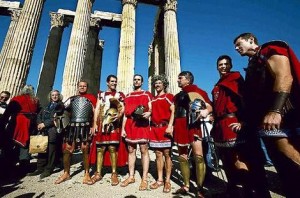
Worshippers dressed as ancient Greek warriors defy a Government ban to pray at the Temple of Zeus in Athens.
civilization which was an important source of Western
civilization…..Yet Greece is also an anomaly, the Orthodox outsider in
Western organizations.”
Archbishop Khristodoulos of Athens was therefore emphatic that Greece was firmly part of the East and not the West.
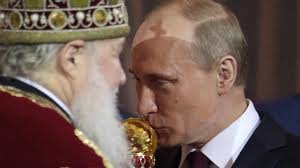
Under Vladimir Putin the position of the Russian
Orthodox Church has been greatly enhanced as it provides moral and
spiritual legitimacy to the new authoritarianism and nationalism which
now underpins Russia . Putin has regularly attended church services and
conspicuously wears a crucifix to demonstrate his Christian faith.
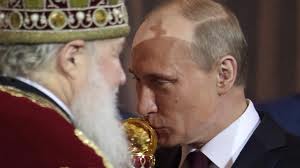
Putin a regular at church
Religious dogma, such as opposition to evolution, is
taught as fact in Russian schools. So entrenched is the church into the
organs of modern Russia, that in Lubyanka the church next to the FSB
headquarters bears a plaque thanking them for their help in restoration
work. The 2006 declaration by the World Council of Russian People, an
assembly of secular organisations which recognises the spiritual
leadership of the Orthodox hierarchy, adopted theDeclaration of Human
Dignity and Rights to counter the UN’s Declaration of Human Rights.
Patriarch Aleksei, head of the Orthodox Church, said that western ideas
of human rights inhibited the faithful from living in accordance with
their beliefs and indeed would lead to a neo-pagan revival. Faith,
ethics and loyalty to fatherland were said to supersede the rights of
the individual. Orthodox support for Russian nationalism, especially
Putin’s anti-western ideology, lead it to support the idea of Russia’s
civilisational uniqueness and superiority, enhancing xenophobia, racism
and the idea that all other beliefs, including non-Orthodox forms of
belief are foreign to Russian soil and a threat to its very soul.
Religious freedom has thus been severely curtailed.
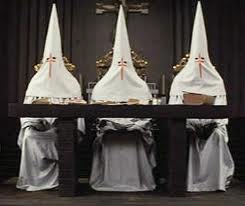
Church Uniting against Paganism
Presently the churches are united in their unceasing
war against the vestiges of paganism. Islam can be accommodated through
it being a common Abrahamic cousin and the self-flagellation which a
declining church subjects itself when faced with a stronger party – as
is obvious from the number of churches being turned into mosques right
on European soil. Atheists, agnostics, humanists and secularists can be
scoffed at as the preserve of intellectuals who can be defeated with the
combination of sickly sinister smiles through outreach programmes
catering to society’s most vulnerable in order to ensnare more gullible
and desperate victims. As mentioned earlier, the continent takes its name
from the pagan goddess Europa. for two thousand years she was all but
banished from memory by the monotheist imperialism which tolerated no
other deity than the jealous and aggressive male demiurge sanctioned by
the Church. How fitting then that it is through hinduism, the surviving
pagan culture which has continued to honour the sacred feminine in the
form of durga and kali as the female force of shakti, that she should
return from her spiritual exile. if Europe wishes to return to its roots
it can only do so by once again becoming the continent of its feminine
deity,
Europa.
source