Poland once had a Jewish population of three
million, 90% of whom were killed in Hitler's Holocaust. But after
decades of conversion to Catholicism and emigration, a Jewish revival is
beginning.
Wearing his yarmulke (Jewish head covering), long beard and
ringlets it's hard to believe that Pawel Bramson was once a skinhead.
Now he is a shochet - a slaughterer who kills animals for kosher food in
accordance with Jewish religious law.
For a short time in the 1990s, he and his skinhead friends in Warsaw saw Jews and other minorities as the enemy.
"Did we go out on the street and cause trouble? Yes we did.
If we saw a black guy walking down the street we used to chase him. If
we caught him, we did what we did. It's so difficult to say where this
hatred came from. I can't explain it myself," he tells the BBC.
Mr Bramson, 36, cannot even remember ever seeing any Jews on Warsaw's streets at the time.
"It was madness, because we didn't know anything about Jews
or Jewish culture. There were just slogans, like 'Jews rule the world',
'Jews are bad, they own all the property', those kind of things. A young
person always needs to find an enemy," he says.
Shocking discovery
Born into and raised as a practising Roman Catholic, he made a
discovery at the age of 24 which turned his life upside down. A friend
had told his wife, Ola, that she was Jewish, and when she began working
through the archives she discovered by chance that Pawel also came from a
Jewish family.
"It was the biggest shock of my life, apart from when my son
was born. It was really like a huge blow. For most of my life I had
hated them and at a time when I'd only just begun to learn to tolerate
them I discovered that I was also Jewish. It was too much to take in at
once," he says.
Mr Bramson's parents were assimilated Jews who had become practising Catholics.
"I went to my parents and said, 'Hey, I've got
these documents, why did you never tell me?' Later they confirmed it
was true and that's when I started to go to the synagogue to learn more.
"I found out that my grandfather was twice in German labour
camps. Other Jews died in concentration camps, so now I need to
cultivate my knowledge and keep in mind the memory of my ancestors," he
says.
His decision to become an Orthodox Jew caused difficulties
with his parents who chose to remain practising Catholics. His case is
just one of thousands that have come to light following the end of
communism in 1989, Poland's chief rabbi, Michael Schudrich, says.
"It's far more common than people are aware of, it's probably
in the thousands at least. We have had support groups and certainly
people have been shocked. The overwhelming majority of people come to
peace with it. It's not simple, it takes patience," Rabbi Schudrich
tells the BBC.
'Horrible murders'
Jews have been living in Poland side by side with their
Catholic neighbours for almost 1,000 years. By the 1930s the community
numbered more than three million, the largest in Europe.
Poland was then a multi-ethnic society with large numbers of
Ukrainians, Belarusians, Jews and Germans. That society was destroyed
during World War II.
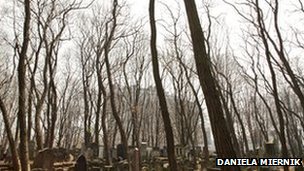 Poland has struggled with its image of being a Jewish graveyard
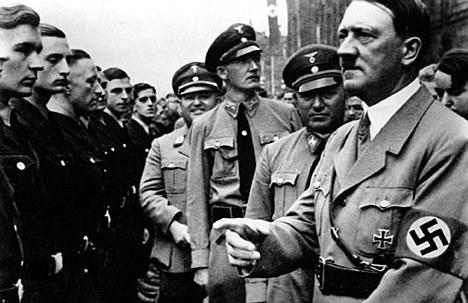
The Germans murdered 90% of Polish Jews during the Holocaust.
At the end of the war Poland's allies, the Soviet Union, US and Britain
decided to shift the country's boundaries westwards, forming a
homogenous Catholic country governed by a communist system imposed from
the outside by the Soviet Union.
"Due to the lack of central authority in Poland just after the war there were
gangs of Poles who were killing Jews
in the couple of years just after the war. Horrible, horrible murders,
1,500, 2,000 people. It made a huge spiritual and psychological impact
saying, you know, we're still not safe and so people said, either I
leave and if I don't leave Poland I leave Judaism," Rabbi Schudrich
says.
Thousands of Holocaust survivors chose to leave, emigrating
to Israel or the US. Jews who stayed were often communists who believed
in the power of the system to transform the country.
But anti-Semitism was also used as a tool by the communist
authorities. More than 20,000 Jews left Poland after an anti-Zionist
purge led by the Politburo in 1968. Now, it's estimated there are just
20,000 people at most with Jewish roots left in Poland.
Since 1989 there has been a
gradual reawakening of interest in Poland's Jewish history and culture.
Now there is a large annual Jewish festival in Krakow that attracts
thousands of international visitors, and Jewish film and literature
festivals.
Yiddish and Hebrew classes are popular and Poles have taken
it upon themselves to look after some of the thousands of Jewish
cemeteries across the country. Polish prisoners even take part in such
community schemes on a voluntary basis and Rabbi Schudrich visits
prisons to give talks on Jewish history and culture.
Warsaw's Tslil choir sings in Hebrew and Yiddish. Most of the
members, like Marta Wesolowska, are not Jewish but they feel a special
connection to the music.
"I think this is really quite exotic for us but very deeply
rooted in the Polish tradition. Jewish music was a part of Polish
culture for hundreds of years and after the Second World War it was
destroyed and we try to revive this tradition," she told the BBC.
Poland is still viewed from outside as a giant Jewish
graveyard, the place where the Germans built the death camps Treblinka,
Sobibor, Belzec and Auschwitz. It's an image Rabbi Schudrich has spent
decades trying to change.
"Until 1989 no one was aware that so many Jews were left in
Poland. People could have realised it but they didn't, so there was an
image that it was all over here and that's the image I heard when I came
here in the '70s and it took me a while to realise it just simply is
not true.
"Stereotypes change very slowly, so it's a process, for me it's a painfully too-slow process," he says.
BBC